
December 8, 2025
The Era of “Not Coaching but Watching”: How Modern Basketball Lost Its Sideline Leadership
Basketball has never been more skilled, more tactical, or more demanding. Players today shoot better, move faster, and train year round. Development systems have grown; analytics have matured; player performance is tracked in the smallest detail. Yet as the game has evolved, a surprising and concerning trend has emerged across youth, college, and even university basketball:
Coaches are becoming quieter. Less active. Less present. More like spectators than leaders.
It’s not meant as a disrespectful observation, it is a reflection of a growing shift in the culture around coaching. More and more, the sideline looks passive. Coaches fold their arms, sit back, and simply watch as possessions unfold. Substitutions still happen, sure. Timeouts eventually get called. But the voice, direction, and in-game leadership that once defined coaching seems to be fading.
And as the sideline has gone quiet, so has the foundation of the sport.
Basketball is a player’s game, no one disputes that, but the absence of engaged coaching has begun to shape the game in ways we cannot ignore. The irony is striking: we have never invested so heavily in developing players, yet we are simultaneously under developing the people responsible for guiding them.
When Players Evolve but Coaches Do Not
Modern players train with shooting coaches, skill specialists, strength trainers, nutritionists, video analysts, and sports psychologists. But even as player development has accelerated, coaching development has largely stood still. Many coaches are hesitant to lead vocally, unwilling to adjust aggressively, or simply not confident enough to impose structure in real time.
This gap shows up in the simplest way possible:
The sideline has turned into just another seat.
Games unfold like a film reel that coaches are watching, not directing. What was once an active command center where adjustments, teaching, reminders, and corrections were constant — now looks like a quiet observation deck.
But basketball does not need another spectator.
It needs a leader.
Why Are Coaches Becoming Passive?
Several cultural forces have reshaped modern coaching:
- Fear of conflict: Many coaches worry about upsetting players or parents and choose silence over leadership.
- Over-reliance on practice: Some believe teaching ends before tipoff, forgetting games require real-time coaching.
- Trainer culture: Players often trust private trainers more than team coaches, weakening the coach’s authority.
- Burnout: Heavy schedules, low compensation, and little support push coaches into disengagement.
- Lack of development: Coaches rarely receive mentorship or continued education, leaving them guessing rather than growing.
As coaching becomes reactive and observational, the very purpose of the role becomes diluted.
A Quiet Sideline Creates a Quiet Team
When coaches stop coaching, the consequences reveal themselves quickly:
- spacing collapses
- defensive rotations become inconsistent
- players lose accountability
- momentum swings go unaddressed
- late clock possessions become chaotic
- effort fluctuates
- huddles lose energy
- teams fall apart under pressure
Leadership is not a philosophical idea, it is a visible, audible, functional presence.
Basketball simply looks different when the sideline’s voice disappears.
What Coaches Can Do: The Tools They Are Forgetting They Have
This is the part often missed in the “silent sideline” era:
Basketball gives coaches constant moments to influence the game.
Not theoretical moments.
Real, structured, rule supported opportunities that can reshape momentum, fix breakdowns, and give players clarity.
Here are the tools coaches always control and too often underuse.
1. Timeouts: The Most Underrated Coaching Weapon
Coaches have a specific number of timeouts, all designed with purpose:
- to stop momentum
- to settle emotional swings
- to reset defensive coverages
- to draw up a scoring action
- to regain pace control
- to break an opponent’s run
- to give a tired team a mental reset
In a passive era, timeouts become delayed reactions or panic buttons.
In a coaching era, they are strategic touchpoints that define the flow of the game.
2. Starting Possessions Each Quarter
Every quarter begins with possession for one team.
This is a small but powerful moment.
A coach can predetermine:
- the first action
- the spacing
- the matchup they want to attack
- the tempo they want to set
Most turnovers on quarter opening possessions reveal a lack of structure.
Coaches who plan the first 5–7 seconds of a new quarter create immediate advantage.
3. Dead Ball Situations: Built-In Opportunities
The game stops constantly:
- baseline out of bounds
- sideline out of bounds
- jump balls
- full court inbound situations
- half court inbound situations
- free throws
Each is a moment to:
- run a designed play
- change matchups
- switch defensive coverage
- set pressure
- calm a rattled player
- remind a team of the next two actions
Most teams lose dozens of free chances to control the game because the coach never steps into the moment.
4. After-Foul Situations
A foul is not just a whistle, it is a reset button.
A coach can:
- call a coverage change
- sub for situational advantage
- stall momentum
- slow the next possession
- create a two for one situation
- communicate matchups
The best coaches treat fouls as mini-timeouts where they quickly shape the next possession.
5. Calling Plays From the Sideline
The sideline view gives a coach something players do not have:
perspective.
Players see their own matchup.
Coaches see the whole floor.
That allows a coach to:
- isolate a mismatch
- call for a switch-hunt
- create an empty-side action
- initiate a horns entry
- call for a flare, ghost, slip, or reject
- orchestrate a misdirection set
A silent sideline is a wasted view.
6. Defensive Control: Yes, Coaches Can Influence It
Defense isn’t random, coaches can dictate:
- switch or no-switch
- hedge, drop, ice, or blitz
- zone or man
- gap pressure
- press triggers
- matchups
- late-clock switching rules
- how to play the star player
When a coach is engaged, players defend with clarity.
When the sideline is silent, players defend on instinct and instinct alone gives up baskets
7. Using the Clock as a Strategy
Coaches can:
- slow the game
- speed it up
- use fouls to manage the clock
- control two for one opportunities
- break rhythm
- extend final possessions
Clock management is one of the strongest coaching tools but in the passive era, it’s nearly extinct.
Coaching Is Not Watching. Coaching Is Influence.
Basketball will always be a player driven sport.
But players thrive when coaches guide them with conviction.
The job is not to simply observe.
The job is to shape the game possession by possession, timeout by timeout, whistle by whistle.
When coaches stop using the tools the game gives them, they stop coaching.
And when coaches stop coaching, teams lose more than games, they lose identity, clarity, and direction.
The future of basketball must move back toward leadership, not further into silence.
Coaching is not about yelling.
It is not about ego.
It is not about control.
Coaching is about presence.
A voice.
A vision.
A structure.
A standard.
A leader who sees more than the players can see.
A teacher who corrects and communicates.
A strategist who knows when to intervene and when to empower.
If basketball is going to keep evolving, coaches cannot simply watch it happen.
They must be active architects of the experience shaping each moment, not observing it.
The game still needs coaches.
Real ones.
Engaged ones.
Leaders, not spectators.
December 7, 2025
ACAC MID-SEASON PERFORMANCE REVIEW
The midpoint of the ACAC men’s basketball season always reveals more than the standings alone can show. At this stage, efficiency metrics, shooting profiles, rebounding discipline, and turnover patterns begin to tell the real story behind each program’s direction. From an athletic director’s perspective, wins and losses matter but understanding why a team is trending upward or downward is far more valuable for long-term planning.
This season, the ACAC has shifted into a clearer hierarchy. Programs with continuity and structure are separating themselves early, while teams still establishing identity are showing more pronounced volatility. League wide offensive efficiency has stabilized at the top and collapsed at the bottom, widening competitive margins. For example, the strongest offensive units SAIT (1.091 Off Eff), LAKE (1.074), and BC (1.091) are producing at levels comparable to last season’s elite. Meanwhile, several struggling programs remain below the 0.85 efficiency threshold, where maintaining competitiveness becomes increasingly difficult.
On the defensive side, we’ve seen a noticeable departure from last year’s containment standards. KC still anchors the league defensively, allowing just 66.7 points per game with a strong 0.818 defensive efficiency, while a handful of programs have slipped sharply in opponent field goal percentage and rotation integrity. Teams allowing opponents to score near or above 1.050 points per possession are finding it nearly impossible to sustain leads, regardless of their offensive strengths.
The South has become defined by SAIT’s emergence and BC’s reliability. SAIT’s jump from last season’s mid tier profile to an undefeated start is backed by numbers, not luck. Their forced turnovers, steal rate, and ability to score before defenses set have elevated them into a genuine contender, not just a hot start team. BC may have lost some record dominance, but their 44% FG, controlled pace, and strong defensive rebounding show a program that still performs with veteran efficiency. LPK remains disciplined and strategically sound, though their 79.8 PPG and mid-range shooting profile limit their ceiling against elite defensive teams.
In contrast, STMU and MHC show predictable patterns: competitive in stretches, inconsistent in execution. STMU distributes the ball well (15.1 assists per game) but gives up too many efficient shots on the other end. MHC rebounds with authority (40.5 RPG) yet struggles with spacing and shooting droughts that cap their scalability. RDP and OC remain in regression phases, allowing 84–87 points per game and consistently losing the efficiency battle early in games.
The North Division tells a more layered story. KC is once again the most structurally complete program in the ACAC. Their 49.6% FG, 74.4% FT, and league leading 19.7 assists per game demonstrate offensive maturity, and their defensive profile lowest opponent FG% and fewest points allowed signals a team built for postseason control.
Lakehead, meanwhile, is one of the league’s most improved programs. Their rebounding presence, shot quality, and calm possession management have propelled them into a top-tier offense. Their improvement from last season’s 84.4 PPG to this year’s 87.7 PPG, paired with a defensive efficiency of 0.848, has transformed them from a competitive team into a legitimate contender.
NAIT remains exactly what they have been: disciplined, competitive, and structurally reliable. Their 45.4% FG, modest turnover rate, and balanced approach produce stable efficiency, even if the offensive ceiling is somewhat capped compared to KC or LAKE.
CUE’s regression is clear. Their FG% has dropped, turnover volatility has increased, and defensive containment has weakened significantly. Their defensive efficiency has drifted into the 1.085 range, which rarely aligns with sustained success.
Behind the top three, several programs UAA, TKU, NWP show commitment and competitiveness but still lack the efficiency foundation to consistently challenge higher-tier teams.
And within this landscape sits one of the most meaningful stories of the season.
AMBROSE UNIVERSITY
Ambrose’s year over year improvement is one of the clearest indicators of positive program direction in the ACAC North. The development is not reflected solely in wins, but in the underlying performance metrics that athletic directors rely on when evaluating program health.
Last season, Ambrose operated as one of the lowest efficiency teams in the conference. This year, their offensive efficiency has risen to 0.903, reflecting stronger spacing, better shot selection, and improved ball movement. The team has increased its assist totals, reduced turnover spikes, and elevated its overall field goal percentage subtle but meaningful indicators of a maturing offensive identity.
Defensively, Ambrose still allows a high opponent FG% and remains challenged in certain containment areas, especially at the rim. However, their defensive efficiency (1.071) and rebounding responsibility have improved enough to keep them competitive in games that last year would have slipped away early. They are no longer a team overwhelmed by physicality or pace. Instead, they demonstrate structure, composure, and tactical coherence.
Perhaps the most important sign of growth is consistency. Ambrose’s PPG has risen from low-70s range into the mid-70s (76.1 PPG), while their turnover rate has decreased, allowing games to flow with fewer self-inflicted setbacks. Their 30.4 rebounds per game reflect better positional discipline, and even though the number is not elite, the trend matters more than the raw total.
From an athletic director’s perspective, this season marks a key shift: Ambrose is no longer a program trying to find its footing it is a program building upward. The numbers match the eye test, and both point toward a team transitioning out of the bottom tier and into a competitive mid-tier identity with clear potential for continued growth.
Across the league, efficiency metrics strongly correlate with sustainability. KC, SAIT, LAKE, BC, and NAIT stand at the top because they value possessions, defend with clarity, and maintain disciplined shot profiles. LPK, STMU, MHC, and Ambrose form a rising middle group that can compete with anyone on the right night, though inconsistency in shooting or containment limits their ceiling for now. CUE, RDP, OC, NWP, and TKU have shown effort but lack the structural efficiency to consistently challenge top-tier teams.
As the second half of the season unfolds, the programs that maintain clean possession habits, rebounding accountability, and defensive stability will shape the playoff picture. Efficiency rarely lies; it reveals which programs are built for long-term competitiveness and which are still at the early stages of their development cycle.
This year, the numbers tell a clear story about the ACAC who is rising, who is stabilizing, and which programs have the strongest trajectory for future success. Ambrose, in particular, is positioned as one of the most improved programs in the conference, a trend that signals meaningful progress and future competitive potential without overstating their current position. The league is evolving, and the second half will only sharpen the distinction between teams with established identity and teams still searching for one.
November 21, 2025
Leading With Love: What Coaches Can Learn From John 13
Inspired by John 13:34 — “Love one another. As I have loved you, so you must love one another.”
In the world of sport, we talk endlessly about toughness mental toughness, physical toughness, competitive toughness. But the longer I coach, the more I realize that the most overlooked leadership trait isn’t strength at all. It’s love.
Not the soft, sentimental kind, but the disciplined, courageous, steady kind. The kind that stands firm in hard moments. The kind Jesus described in John 13:34 when He said, “Love one another.” He wasn’t talking about a feeling; He was talking about a way of leading. And leadership built on that kind of love must include something we rarely discuss: how to carry yourself when trust is tested.
Because every coach at every level eventually faces moments when trust breaks.
Not the dramatic movie style betrayals, but the quiet ones:
- A player believing a rumor before coming to you
- A colleague choosing convenience over loyalty
- A parent misreading your intentions
- A team turning cold after one tough season
These moments can shake even the most experienced leaders. But how we respond to disappointment becomes a defining moment in our leadership story.
The Lesson of Pat Riley: Love Is Accountability
Consider Pat Riley, one of the most successful coaches in NBA history. His players loved him not because he was easy, but because he was consistent.
During the 1980s Lakers era, Riley had a simple belief: love and accountability are not opposites; they depend on each other. He demanded excellence, but he also invested deeply in his athletes as human beings. He once said, “A coach’s job is to take players where they cannot take themselves.”
Not every player loved that level of challenge. Some resisted it. Some even pushed back hard. But Riley didn’t allow disappointment to turn into bitterness. He didn’t lower the standard; he didn’t abandon his values. He stayed committed to the long-term growth of his team and eventually, that foundation produced championships.
Leadership rooted in love doesn’t crumble when someone doubts you. It gets stronger.
Gregg Popovich and the Power of Steadiness
Even the great Gregg Popovich perhaps the most respected coach of this generation has faced moments of tension and disagreement. There were seasons when players questioned his decisions, his intensity, even his honesty.
But Popovich’s response was always the same:
- Tell the truth.
- Stay consistent.
- Lead with love, even when it’s tough.
He became known for caring about his players as people long before he cared about their performance. He learned their families, their stories, their values. He coached them hard, but he also connected deeply. That combination created a culture so strong it lasted two decades and produced five championships.
Popovich understood what many leaders forget: you can’t control who stays loyal, but you can control the integrity you bring to every interaction.
A Canadian Coach and the Gift of Presence
Across Canada, you’ll find coaches who embody this kind of leadership quietly and consistently. One high school basketball coach shared a story that stayed with me. He worked with many newcomer youth players for whom basketball wasn’t just a sport, but a lifeline during a difficult transition to a new country.
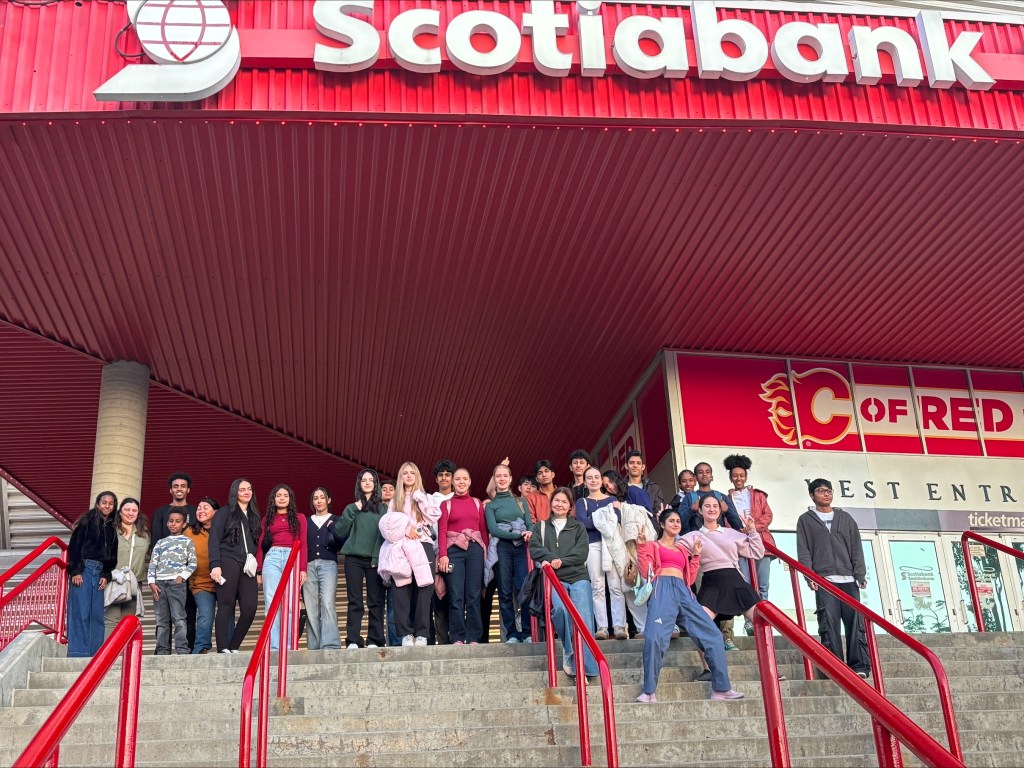
He organized team outings even taking them to their first ever hockey game. For those students, sitting in an arena surrounded by thousands of cheering fans wasn’t just entertainment; it was a moment of belonging, a glimpse of community, a reminder that they weren’t alone.
Yet even he faced seasons when people he trusted questioned him or misread him. What impressed me was not the pain he felt though it was real but the calm, humble way he continued to serve. He didn’t speak badly of anyone. He didn’t retaliate. He didn’t let disappointment change who he was.
He told me something I’ll never forget:
“A coach’s job is to bring light, even when the room feels dark.”
That is leadership shaped not by ego, but by principle.
The Call of John 13 — Leading With a Steady Heart
When Jesus said, “Love one another,” He wasn’t speaking to perfect people. He was speaking to disciples who would misunderstand Him, doubt Him, abandon Him and in one case, betray Him outright.
Yet He washed their feet.
He stayed at the table.
He kept loving with intention, even when it cost Him.
For coaches, teachers, and leaders, this is the blueprint.
Leadership is not about avoiding disappointment it is about responding to it without losing your character. It is about loving people enough to guide them, challenge them, forgive them, and continue walking with integrity even when others choose a different road.
Love Is the Legacy That Lasts
In sport, banners fade, trophies collect dust, and records eventually fall. But the leadership you show the steady, patient, faith rooted love you bring to your team becomes part of your legacy.
Players remember how you made them feel.
Colleagues remember how you carried yourself in hard seasons.
Communities remember leaders who stayed steady when things became difficult.
Disappointment may visit every coach, but it does not have to define any coach. When love leads, peace follows.
And as Jesus promised,
“My peace I give you… Do not let your hearts be troubled.” — John 14:27
In the end, leadership isn’t proven in perfect moments it’s proven when you keep showing up with purpose, character, and a heart that stays open even after being wounded. That is the kind of leadership that shapes teams. That is the kind that transforms communities. And that is the kind that endures long after the final buzzer sounds.
November 13, 2025
Evaluating Basketball Skills That Actually Win Games
How coaches can teach, measure, and connect skill development to real world performance using research and lessons from EuroLeague, FIBA, and the Olympics.
The Problem with the Numbers Game
Coaches love numbers.
Points, assists, rebounds, turnovers they’re the first thing we see after every game, the fuel of post game discussions, and often, the only thing that survives in memory. But here’s the problem, numbers tell what happened, not why it happened.
As coaches, our mission isn’t just to track outcomes it’s to develop the skills and decision making processes that create those outcomes. A player’s shooting percentage or assist total might fluctuate from night to night, but their technical foundation, anticipation, and reaction under pressure are what make those numbers sustainable.
If you’ve ever watched a player dominate drills during practice but disappear in live games, you’ve witnessed the gap between technical skill acquisition and game performance transfer. Closing that gap begins with better evaluation the kind that looks beyond the box score.
Why Stats Don’t Tell the Whole Story
Game stats can reveal trends, but they rarely explain performance.
For example:
- A low shooting percentage doesn’t distinguish between poor shot mechanics and bad shot selection.
- A high turnover count could come from great risk-taking creativity or simply lack of awareness.
- Even rebounding numbers can be misleading, one player might grab boards through positioning and anticipation, while another relies on athleticism that won’t scale against stronger opponents.
Peer reviewed research consistently shows that quantitative data alone is insufficient to evaluate skill performance meaningfully.
A 2020 review of assessment instruments in youth basketball concluded that a mixed-method approach combining observation-based rubrics with traditional statistics gives a far more accurate and actionable picture of player development (García-Santos et al., Frontiers in Psychology, 2020).
In short, coaches who only look at numbers are missing the story beneath the stats.
What the Data Actually Says
Let’s step away from theory and look at what elite competitions tell us.
Across the FIBA World Cup, Olympic Games, and EuroLeague, researchers have examined which performance indicators truly correlate with winning and they consistently highlight skills that can be taught, observed, and measured qualitatively.
- FIBA World Cup (2019): Teams that won had significantly better scores in paint efficiency, mid-range execution, and three-point accuracy, but also committed fewer turnovers and secured more defensive rebounds (Sampaio et al., Journal of Human Kinetics, 2020).
→ This suggests that decision-making and positional awareness matter as much as raw shooting. - Olympic Games (2008–2020): Analysis of elite teams found that winning teams limited opponents’ scoring to about 38.8% of possessions, compared to 45.8% for losing teams. They also used help defense effectively in nearly 60% of defensive sequences (Ibáñez et al., Revista de Psicología del Deporte, 2009).
→ Translation for coaches: defensive rotations, communication, and recovery footwork — not just “effort” win games. - EuroLeague (2010–2023): Over the past decade, two-point attempts have declined while three-point attempts and “true shooting percentage” have steadily risen (Yıldız & Bostan, European Sports Studies, 2023).
→ The modern game rewards efficient shot selection and spacing based decision making, meaning coaches must assess not just how players shoot, but when and why.
These trends tell us something profound: the skills that separate elite players from the rest spacing, anticipation, defensive balance, and timing are coachable and observable, but not always statistically visible.
Building Better Skill Assessments: What to Look For
A strong skill evaluation system captures three intertwined dimensions:
- Technical Execution: The mechanics and body control behind each movement.
- Decision Quality: The cognitive element: did the player choose the right action for the situation?
- Performance Under Pressure: Consistency of execution in game like stress conditions.
Each of these can be tracked with structured observation tools many of which are validated by sports science research.
1. Technical Execution: The Foundations That Don’t Flinch
This is the visible side of coaching the stance, balance, and sequencing that you can spot even without a scoreboard.
A 2022 reliability study on motor skill rubrics (De Martino et al., International Journal of Sports Science & Coaching) found that analytical rubrics, which break skills into observable components, are more reliable than “holistic” ratings like “good” or “bad.”
For example, for on-ball defense, a simple 4-level rubric could look like this:
| Level | Observable Behaviour |
|---|---|
| 4 | Maintains low stance; shuffles laterally without crossing feet; recovers to help within 2 steps. |
| 3 | Good stance, occasional crossing; consistent recovery within 3 steps. |
| 2 | Upright stance; delayed recovery; vulnerable to drive. |
| 1 | Poor stance; loses balance; repeatedly out of position. |
When multiple coaches use such rubrics and calibrate their judgments (e.g., by watching the same clips), consistency skyrockets and suddenly, skill evaluation becomes data, not opinion.
2. Decision Quality: Seeing the Game Before It Happens
Basketball IQ is hard to measure, but it’s not impossible. The key is to focus on decisions per opportunity rather than outcomes per possession.
In a 2v1 or 3v2 drill, track:
- Decision efficiency (% of correct reads): Whether the player made the right pass, drive, or pull-up.
- Time to decision: How long they take to act after receiving the ball.
- Spacing maintenance: Whether they preserved team shape during movement.
According to FIBA’s 2019 analytics report, top-tier teams averaged less than 2.5 seconds from first touch to shot or pass in half-court offense. Teaching players to make quick, high-quality reads is therefore measurable and essential.
3. Performance Under Pressure: Where Skill Meets Reality
Pressure separates trained skill from owned skill. It’s one thing to sink free throws in an empty gym; it’s another in a noisy arena with 15,000 fans and an Olympic berth on the line.
Research on motor learning (Lee & Farrow, Sports Medicine, 2020) shows that practice must simulate competitive unpredictability for skill transfer to hold up. For coaches, that means testing players in contested, time-constrained, or fatigue-based conditions.
For example:
- Shooting drills: alternate between open shots and quick closeouts.
- Defensive reads: use random cues or rotating attackers.
- Decision drills: impose countdowns or score-deficit scenarios.
Then, when you evaluate, note execution under pressure. Did the player maintain mechanics? Keep awareness? That’s the kind of data that mirrors what Olympic and EuroLeague analysts measure composure under defensive load.
Making Evaluation Meaningful (and Manageable)
A lot of coaches hesitate to use observation tools because they sound “too academic.”
But in practice, they can be quick and simple and once integrated, they dramatically improve both communication and consistency.
Here’s how to make it work:
- Calibrate your observers: Spend one film session with assistant coaches or senior players watching the same clips and discussing ratings. Studies show inter-rater reliability jumps 25–40% after one calibration session (Harvey et al., Journal of Teaching in Physical Education, 2021).
- Keep it lean: Don’t try to measure 20 skills at once. Focus on three: one technical, one tactical, and one behavioral. You can rotate them each week.
- Bridge practice and competition: Track whether the skills improved in drills actually appear in scrimmages or games. If not, tweak the drill structure.
- Use visuals and player feedback: Share brief reports or video highlights. When players see their growth visually, engagement increases — they start owning the process.
What Elite Trends Teach Us
This is where everything comes together when a coach’s micro-level observation meets macro-level game data.
Example 1: Three-Point Shot Selection
EuroLeague data over the past decade shows a steady climb in three-point attempt rate, with teams now taking over 40% of shots from beyond the arc. But the top shooting teams aren’t just firing more they’re firing smarter.
By tracking players’ shot quality (open vs contested) and decision timing, coaches can teach and assess what elite teams already know: spacing and decision-making drive efficiency.
Example 2: Turnover Management
At the 2019 FIBA World Cup, turnover differential was one of the top three predictors of victory margin. The difference wasn’t raw skill it was contextual awareness: when to attack, when to pull back, when to reset.
Your evaluation rubric for guards can include “risk recognition” the ability to recognize when not to force a pass. That’s exactly what separates Luka Dončić’s creative playmaking from reckless turnovers.
Example 3: Defensive Containment
In Olympic studies, winning teams forced lower quality shots through positioning rather than physical dominance.
If you’re grading a player’s defensive rotation timing or closeout control, you’re effectively teaching the skill behind the world’s top defenses those that reduce shot efficiency by forcing late-clock, off-balance attempts.
Case Study: Applying It with a Team
Imagine you coach a U17 squad preparing for nationals.
You decide to implement a 3-point evaluation focus for one month:
| Week | Focus Skill | Evaluation Tool | Practice Integration |
|---|---|---|---|
| 1 | Defensive stance & recovery | Analytic rubric (4 levels) | 1v1 closeout drills |
| 2 | Decision-making in transition | Observation sheet (2v1, 3v2) | Small-sided games |
| 3 | Shooting under pressure | Shot chart + video review | Fatigue-based drills |
| 4 | Combined application | Scrimmage assessment | Game simulation |
After a month, you find your players’ turnover rate dropped by 15%, defensive contest rate rose 20%, and shot selection quality (open vs contested) improved by 12%.
Those numbers mirror the same performance trends found in FIBA and EuroLeague studies meaning your process isn’t just anecdotal; it’s aligned with elite evidence.
Coaching as Evaluation, Evaluation as Coaching
At every level from grassroots gyms to the Olympic finals the game rewards execution, intelligence, and composure under pressure. The more we evaluate those qualities intentionally, the more our athletes grow in ways that stats can’t yet measure.
So the next time you look at the box score, ask yourself:
- What skill led to this number?
- Did I teach it, observe it, and reinforce it?
- Can my evaluation explain why it happened?
That’s how we transform coaching from reactive score-watching into proactive skill-building — rooted in science, guided by data, and proven by the world’s best players.
References:
Harvey, S. et al. (2021). Reliability of Analytic Rubrics in Coaching Evaluation. Journal of Teaching in Physical Education.
García-Santos, D. et al. (2020). Assessment Instruments for Basketball Skill Evaluation in Youth Players. Frontiers in Psychology.
Sampaio, J. et al. (2020). Game-Related Statistics as Predictors of Team Success in FIBA Basketball World Cup 2019. Journal of Human Kinetics.
Ibáñez, S. J. et al. (2009). Defensive Performance Indicators in Men’s Basketball: Analysis of Olympic Games 2008. Revista de Psicología del Deporte.
Lee, M., & Farrow, D. (2020). Practice Design and Skill Transfer in Team Sports. Sports Medicine.
Yıldız, Ö., & Bostan, N. (2023). EuroLeague Shot Selection Trends: A 10-Year Analysis. European Sports Studies.
October 26, 2025
The Rise of High Tempo Basketball
High-tempo basketball, characterized by fast breaks, quick transitions, and relentless pressure, has become a hallmark of modern play. Teams like the Stamford High School girls’ basketball team have embraced this style, leveraging the speed and versatility of their athletes to maintain a fast-paced offense and a pressing defense, maintained by frequent substitutions. This approach has led to a 7-0 start and a No. 4 ranking in the state, demonstrating the effectiveness of high tempo play.
The Coach’s Role in a Fast Paced Game
While the fast pace can make it challenging for coaches to exert influence during live play, their role remains crucial in several areas:
Coaches are responsible for developing a game plan that aligns with their team’s strengths and the opponent’s weaknesses. This includes deciding on the tempo of play, defensive schemes, and offensive strategies. For instance, teams may choose to play at a high tempo to exploit their athleticism and create scoring opportunities before the opposing defense can set up.
Even in a fast paced game, coaches can make impactful decisions during timeouts and stoppages. They can adjust defensive alignments, tweak offensive plays, and provide motivational support to keep players focused. Effective communication during these moments can help steer the team back on track.
In high-tempo games, managing player fatigue is essential. Coaches use substitutions strategically to maintain energy levels and ensure that players are fresh. This also allows for defensive matchups and offensive rotations to be optimized.
After the game, coaches analyze performance through video reviews and statistical breakdowns. This helps identify areas for improvement and reinforces learning. Engaging players in this process ensures continuous development and adaptation.
The Effectiveness of High Tempo Play
High-tempo basketball offers several advantages:
- Increased Scoring Opportunities: By pushing the pace, teams can create more fast-break situations, leading to higher scoring chances.
- Defensive Pressure: A fast pace can disrupt the opponent’s offensive rhythm, forcing turnovers and rushed decisions.
- Depth Utilization: Frequent substitutions allow teams to utilize their entire roster, keeping players fresh and engaged.
However, it’s important to note that high tempo play also comes with challenges:
- Risk of Turnovers: The increased speed can lead to mistakes and turnovers if not executed properly.
- Fatigue Management: Maintaining a high pace requires excellent conditioning and careful management of player minutes.
Balancing Tempo and Control
While high-tempo play is exciting and effective, it’s essential for coaches to balance speed with control. This involves:
- Controlled Aggression: Encouraging players to push the pace while making smart decisions.
- Situational Awareness: Recognizing when to slow down the game to execute set plays or manage the clock.
- Player Development: Ensuring that players are well trained in skills like ball handling, decision-making, and conditioning to thrive in a fast paced environment.
High tempo basketball has transformed the game, offering both challenges and opportunities. Coaches play a vital role in harnessing the benefits of this style while mitigating its risks. Through strategic planning, in game adjustments, and continuous player development, coaches can effectively guide their teams in the fast paced modern basketball landscape.
October 13, 2025
Guiding Newcomers Through Sport, Community, and Life
This past week, I had the privilege of taking a group of secondary and high school students, new immigrants and newcomers to a Calgary Hitmen versus Medicine Hat Panthers hockey game. For many of them, it was their first live sporting event, their first taste of community engagement, and perhaps one of the first moments where life outside school and home felt expansive and welcoming. As I watched them experience the thrill of the game, the roar of the crowd, and the camaraderie of cheering together, I realized how profoundly small gestures can shape young lives, particularly for those who are just beginning their journey in a new country.
Guiding these students has reminded me that teaching and mentorship extend far beyond the classroom or the gym. To envision the life of someone who is new to a place, a culture, or even a language is to practice foresight in the truest sense. When I organized this outing, I thought carefully not only about logistics but also about the social, emotional, and cultural impact it could have. I asked myself: How can I help them feel seen? How can I offer experiences that cultivate belonging? How can I empower them to engage with a broader community that may feel foreign or intimidating? Foresight is not just about personal goals; it is also about anticipating how our actions can open doors for others, creating opportunities for growth, joy, and connection.
Philosophically, this experience resonates with the idea that life unfolds through shared experiences, and that mentorship is a moral act of bridging gaps. The students’ wide eyed excitement and curiosity reminded me of the Stoic teaching that life is about perspective: we shape our understanding of the world by how we engage with it. By bringing them into a communal space, I wasn’t just facilitating entertainment; I was helping them envision a life full of possibilities, where they belong and can thrive. For newcomers, every moment of connection, every introduction to a local cultural experience, is a stepping stone toward identity, confidence, and purpose.
Faith, too, informs how I approach moments like this. Proverbs 22:6 encourages, “Train up a child in the way he should go; even when he is old he will not depart from it.” While this verse often applies to moral and spiritual guidance, it also speaks to nurturing opportunities for growth and exposure. By guiding students through community experiences, by showing them how to engage with the world around them, we plant seeds of courage, curiosity, and resilience. In these moments, mentoring becomes an act of stewardship not just of knowledge or skill, but of hope and belonging.
Organizing and witnessing this outing reminded me how interconnected vision, preparation, and faith are in shaping meaningful experiences. Just as foresight helps us set personal goals and anticipate challenges in life or sport, it also equips us to create transformative opportunities for others. Each step, each carefully considered plan, can become a turning point in a young person’s journey. Seeing the students laugh, cheer, and connect with their peers in the stands, I felt both humility and joy. Life starts anew for them in this country, and I am grateful to play even a small role in that beginning.
Ultimately, taking students to their first community experience of this kind reinforced a truth I hold deeply, our lives are most meaningful when we help others see beyond their immediate horizon, when we provide guidance, encouragement, and faith in the possibility of tomorrow. The thrill of a goal scored or a cheer shared is temporary, but the memory of being welcomed into a community, of being guided to feel like you belong, can shape a lifetime. In mentoring these students, I am reminded that teaching is not merely about instruction; it is about creating experiences that inspire, nurture, and illuminate the path ahead.
October 12, 2025
The Art and Faith of Envisioning Your Life
To envision your life is to enter a dialogue with time itself. It is more than mere planning or wishful thinking; it is a conscious effort to anticipate not only challenges but opportunities, to foresee outcomes, and to shape the character you wish to cultivate along the way. Philosophers from Aristotle to Seneca have long argued that a life without reflection is like a ship sailing without a rudder movement may occur, but direction is absent. Similarly, in faith, foresight is a spiritual discipline. Proverbs 21:5 reminds us, “The plans of the diligent lead surely to abundance, but everyone who is hasty comes only to poverty.” Planning and preparation are thus both practical strategies and acts of alignment with God’s purpose.
Philosophically, envisioning one’s life begins with reflecting on the self. Aristotle’s concept of eudaimonia, often translated as flourishing, suggests that human beings thrive when they intentionally cultivate virtues, habits, and goals aligned with their deepest nature. To see ahead is to ask, “Who do I wish to become?” and “What life would I consider meaningful?” This reflective foresight is not idle daydreaming but a form of mental rehearsal a blueprint for intentional living. The Stoics, too, emphasized imagining obstacles before they occur, teaching that negative visualization strengthens resilience. By anticipating both setbacks and successes, we do not merely plan for outcomes; we shape ourselves to endure and grow through them.
Faith adds another essential layer to this perspective. In religious thought, foresight is not solely human strategy; it is a partnership with God. Proverbs 16:3 advises, “Commit to the Lord whatever you do, and he will establish your plans.” Here, envisioning the future becomes a spiritual act. While we may see a path ahead, life’s uncertainties remind us that ultimate outcomes rest in God’s hands. Yet preparing diligently, breaking large goals into actionable steps, and working with discipline honor the gifts we have been given. Vision without action is vanity, yet action without vision is aimless. Faith bridges that gap, giving meaning to both the planning and the effort required.
Translating this philosophy into practice requires clarity and structure. The first step is to define your values and purpose, understanding what truly matters in life. These values act as a compass in moments of uncertainty. Once the end goal is imagined, the path to reach it must be charted. Breaking the vision into short term, medium term, and long term objectives provides tangible checkpoints to measure progress. Anticipating challenges is equally important; the Stoics’ premeditatio malorum reminds us that mentally rehearsing obstacles equips us to respond with composure. Finally, acting consistently, with patience and faith, transforms plans into reality, while reflection and adjustment ensure alignment with evolving circumstances and divine guidance.
Ultimately, foresight combines philosophical reasoning with spiritual trust. It asks us to use our intellect to map a path while surrendering the outcome to God’s wisdom. Jeremiah 29:11 reassures us: “For I know the plans I have for you, declares the Lord, plans to prosper you and not to harm you, plans to give you hope and a future.” In this partnership between human effort and divine providence, goal setting becomes more than ambition it becomes a form of stewardship over the life, talents, and opportunities entrusted to us.
Envisioning the future transforms life from passive drift into an intentional journey. Each small, thoughtful step becomes part of a larger narrative shaped by values, discipline, and faith. By anticipating challenges, preparing strategically, and acting consistently with humility and trust, we cultivate both personal growth and spiritual depth. To see beyond the horizon is not to control life, but to navigate it consciously, embracing responsibility, practicing virtue, and remaining open to the guidance of God. In doing so, we turn each vision into a lived reality, not only achieving goals but also becoming the people we were meant to be.
October 8, 2025
My Journey in Teaching, Coaching, and Guiding Youth
I was born in late 70s, and when I first started school in the 80s, everything felt very strict. I was just a little kid, only five or six years old. All I wanted was to play, run around, and have fun. But teachers had other plans. They expected obedience, silence, memorization, and repetition every single day. You couldn’t ask questions, share ideas, or reflect on what you were learning. You just had to remember and repeat it when asked. I struggled a lot. I had to repeat a couple of grades, but my dad didn’t agree with the teachers, so I continued my journey, struggling in the classroom. Honestly, I hated school.
At the same time, I found freedom on the soccer field and basketball court. That’s where I felt alive, valued, and joyful. On the field, coaches let us make decisions, try new things, and take responsibility for our own performance. I could lead, experiment, and see what worked for me. In the classroom, I was just following instructions. That contrast showed me early that learning isn’t just about memorizing, it’s about curiosity, exploration, and ownership. Sports gave me a sense of agency I couldn’t find in school. These experiences reflect what I now understand as a behaviorist approach in the classroom: repetition and compliance shape learning in very narrow ways, often limiting cognitive growth and creativity (Skinner, 1953).
When I went to university in Cyprus in the mid-1990s, there was more freedom to speak and think for yourself. People were encouraged to share ideas, discuss, and explore. It felt exciting, and I started to discover who I was outside of strict expectations. But classrooms were still mostly traditional. Teachers had been trained in older methods, and they expected compliance rather than curiosity. The world outside was changing, but inside the classroom, it hadn’t caught up. Here, I began to notice the developmental differences in learners, everyone matures and grows differently, and strict, one size fits all education can overlook those differences (Wood, 2015).
Moving to Canada was another awakening. Individual rights, freedom of speech, and the ability to make choices were amazing, but I struggled to take control of my own learning. For so long, I had just been following instructions. Around that time, my playing years were over, and I began coaching basketball. Early courses I took to qualify as a coach were heavy on theory and rules, and I felt some of that same rigidity I had experienced in school. But I also saw an opportunity to do things differently, embracing more humanist and holistic approaches, where learners’ curiosity, reflection, and agency are central (Rogers, 1969).
Over the years, I started working with the Canada Basketball coaching education board. I was teaching youth players and young coaches, and I realized the importance of giving them space to explore, ask questions, and take ownership of their learning. Back then, basketball was taught very rigidly. I would demonstrate strategies, and players would copy exactly what we called “5-on-0.” Over time, we shifted to drills and small games, teach 1v1 to breaking into 4 different teaching (1v0 to 1vc to 1v1 advantage drills and finally 1v1) as well as more breakdown games such as 2-on-1 or 4-on-3 etc.., which forced players to think, problem solve, and understand the game themselves instead of just memorizing plays. Seeing this change over twenty years, and the success that followed players moving to NCAA programs or professional leagues showed me the long term societal impact of empowering learners. When learners are given responsibility, they grow as individuals and contribute more to their communities (Dweck, 2006).
Indigenous ways of knowing also shaped how I think about learning. In 2008, while working at Brock University, I participated in a powwow. At the time, I didn’t know much about Indigenous culture or history, beyond a general awareness of the struggles communities had gone through. Listening to their stories and watching the ceremony opened my eyes. Over time, I began to see some similarities between their experiences and those of the immigrant youth I work with not the hatred or historical trauma, but the resilience, adaptation, and deep connection to community and environment. Their teachings about relationships, land, and storytelling reminded me that learning is about more than just following instructions; it’s about being part of a community and understanding your place in it.
Now, when I work with immigrant youth from grades one to twelve, I often use storytelling sometimes my own, sometimes examples from the community to help them make sense of their new environment and navigate challenges. Storytelling has become a key part of how I teach both basketball and life lessons, helping young people connect ideas, reflect on experiences, and feel ownership of their learning. I also focus on motivation and emotion, understanding that engagement, passion, and mindset shape development and learning, especially for students adjusting to a new culture and system (Alberta Education, 2018).
Looking back, I can see how my experiences shaped my understanding of learning. Strict classrooms reflected behaviorist approaches memorization, repetition, and compliance. Sports and coaching experiences showed me humanist, holistic approaches, where curiosity, reflection, and agency mattered. Developmental differences taught me the importance of meeting learners where they are. Indigenous knowledge taught me that culture, relationships, and community are central to learning. Motivation and emotion reminded me that engagement and passion drive growth.
Across all of this, I’ve learned that learning is personal, social, and tied to identity. Whether coaching basketball or working with immigrant youth, I try to create environments where learners can explore, reflect, and grow. I want them to understand not just what to learn, but how to learn, who they are, and who they can become. By sharing stories, guiding experiences, and giving them ownership of their journey, I hope to help them find their own voice just as my coaches helped me find mine. This approach aligns with Alberta’s Program of Studies, emphasizing flexible, student-centered learning that meets individual needs (Alberta Education, 2018).
References
- Alberta Education. (2018). Program of studies: K–12. Government of Alberta.
- Dweck, C. S. (2006). Mindset: The new psychology of success. Random House.
- Wood, C. (2015). Yardsticks: Children in the classroom ages 4–14 (4th ed.). Center for Responsive Schools.
- Kirkness, V. J., & Barnhardt, R. (2001). First Nations and higher education: The four R’s—Respect, relevance, reciprocity, responsibility. Journal of American Indian Education, 40(1), 1–15.
October 7, 2025
Teaching the “Other”: Lessons from the Classroom, the Field, and the Journey of Belonging
This past week we explored one of the most important and challenging questions in education: What does it mean to teach “others”? Not “others” as in outsiders, but “others” as in people whose stories, beliefs, and experiences differ from our own. It’s a question that reaches beyond pedagogy, it asks us to reflect on humanity itself.
As I sat in that discussion, I realized that my perspective as both an immigrant and a coach has shaped how I understand what it means to teach, lead, and connect. Teaching “others” isn’t about bridging a gap between “us” and “them.” It’s about recognizing that the gap itself is an illusion one that dissolves through curiosity, respect, and shared purpose.
When I first came to Canada, everything felt new, not just the cold winters, but the quiet codes of communication, the expectations of belonging, and the unspoken layers of cultural understanding that Canadians often take for granted. Like many immigrants, I carried my world with me: my language, my food, my sense of humor, my traditions, and my way of seeing time and relationships.
At first, I tried to fit into the mold, to speak and act like everyone else. But with time, I realized that the richness I brought from my culture wasn’t something to hide, it was something to share. That realization changed how I understood community. It also reshaped how I saw education.
When I eventually stepped into classrooms and gyms as both a teacher and a coach, I noticed something profound: every student and athlete is an immigrant in some way. They may not have crossed borders, but they are constantly navigating new languages of learning, identity, teamwork, and self-worth. Helping them find belonging is not just a duty; it’s an act of compassion.
Teaching “others” means creating spaces where difference isn’t erased, it’s valued. In my classroom, just like on the field, I try to build a sense of shared ownership. When I coach, I tell my players that the game belongs to all of us. The rules may be the same for everyone, but the experience of those rules differs from person to person. Some play for pride, others for escape, others for joy. My job isn’t to assume their reasons, it’s to understand them.
Similarly, in the classroom, inclusion doesn’t mean simply seating students of different backgrounds together. It means listening deeply. It means acknowledging that the child who struggles to speak up might carry stories and perspectives we’ve never heard before and that those stories are as essential to the community as the loudest voice in the room.
True cooperation doesn’t emerge from uniformity. It emerges from diversity in dialogue. The role of a teacher and a coach is to make that dialogue possible.
My coaching philosophy has always been built on three pillars: discipline, empathy, and purpose.
Discipline provides structure it’s what keeps us consistent when emotion fades. Empathy humanizes that structure it ensures that rules serve people, not the other way around. And purpose binds it all together it reminds every athlete that their effort means something beyond the scoreboard.
This philosophy isn’t limited to sport. In teaching, faith and empathy play the same role that strategy and teamwork do on the field. You can’t teach effectively if you don’t believe in the potential of those you teach. And you can’t lead authentically if you don’t care about who they are beyond grades, performance, or outcomes.
My faith teaches me that every person carries the image of something divine a spark of potential, a call to purpose. As a coach, I see that divine spark in the athlete who keeps showing up after every defeat. As a teacher, I see it in the student who asks the hard questions that others avoid. The “others” we teach are not obstacles to understanding; they are mirrors reflecting the parts of ourselves we haven’t yet learned to see.
Coming to Canada taught me humility not the kind that makes you smaller, but the kind that opens your eyes. It taught me that diversity isn’t just a strength; it’s a discipline. It requires effort to understand, patience to listen, and courage to let go of assumptions.
When I teach, I remind myself that my students are learning to belong just as I once did. When I coach, I remind my players that victory means little if it isn’t shared. And when I meet “others,” I remind myself that there are no others only people whose stories are waiting to be heard.
In the end, teaching “others” is not a special skill reserved for certain teachers. It’s the essence of what education truly means. Every act of teaching is an act of crossing across cultures, across generations, across experiences. It requires courage to step outside of comfort and humility to enter someone else’s world without trying to rewrite it.
As an immigrant, a teacher, and a coach, I have learned that understanding others begins with gratitude gratitude for the opportunity to learn from difference. Because when we teach with open hearts, we are not just teaching “others.” We are teaching ourselves how to become more fully human.
October 5, 2025
For some, you may be the only Bible they will ever read and the only Jesus they will ever see
It sounds simple, almost gentle, but it carries a kind of weight that follows you around once you let it sink in. It means that who you are how you treat people, how you lead, how you forgive can matter more than anything you’ll ever say. It means your life itself might be someone’s first (and maybe only) glimpse of grace.
That idea sits with me every time I walk into a gym or classroom. Over the years, I’ve learned that coaching isn’t really about plays or points, it’s about people. It’s about meeting them where they are, with all their strengths, insecurities, and masks, and trying to show them something real through your example.
I’ve coached hundreds of players some become family, others test your patience, and a few, if I’m honest, misread who you are completely. It’s strange how identity works in this space. Sometimes people see your energy, your background, your faith, your firmness and they twist it into something it’s not. They think they know your story just because they’ve seen a fragment of it. And sometimes, the hardest part of coaching isn’t the game it’s being misunderstood while trying to do good.
But then there are the ones who get it. The ones who see past the surface and feel the intention behind your actions. They understand that when you push them, it’s not for control it’s for growth. That when you hold them accountable, it’s not about power it’s about belief. Those players make it all worth it.
I’ve had players who didn’t like me at first. Maybe I was too direct, too demanding, too different from what they were used to. But months later, or sometimes years later, they’ll send a message something simple like, “Coach, I get it now.” And that’s everything. Because it means the lesson stuck. It means something beyond basketball reached them.
That’s the real reward.
I’ve never believed that coaching ends when the whistle blows. The court is just the setting the real work is in the space between drills, in the quiet conversations, in how you respond after a tough loss or a tough day. It’s in how you model consistency when things around you aren’t fair or easy.
Players don’t always remember what you said, but they’ll remember how you made them feel whether they felt safe, challenged, respected, or written off. They’ll remember if you stood by them when they failed, or if you treated them like people, not projects.
That’s what keeps me grounded.
Some days I carry the weight of misunderstanding of being judged by people who only see the surface of my identity. But I’ve learned not to let that harden me. You can’t control how others interpret you, but you can control how you respond. You can keep showing up with honesty, integrity, and calm strength. You can keep leading with purpose even when others project their fears onto you.
I’ve come to realize that the best form of leadership is quiet consistency. When you keep showing up the same way day after day the truth eventually speaks for itself. Time reveals what words can’t defend.
Basketball, for me, has always been a spiritual language. The rhythm of practice, the noise of the gym, the silence before a free throw it’s where I’ve learned some of life’s most important lessons: patience, humility, resilience, forgiveness. You can’t fake those things in competition. The game reveals what’s real in you.
That’s why I tell my players: it’s not about becoming perfect. It’s about becoming aware. Aware of how you affect others, aware of what you carry into every moment, aware that how you play and live says something about what you value.
Faith, to me, isn’t just about belief it’s about presence. It’s about showing up when it’s hard, serving when it’s inconvenient, loving when it’s not returned. Coaching gives me the daily chance to live that kind of faith not loudly, but quietly, through action.
And if even one person one player, one student walks away seeing something in me that points them toward patience, kindness, or hope, then maybe I’ve done my small part. Maybe I’ve lived that quote a little.
At the end of the day, the relationships matter most. The laughter before practice, the trust built over time, the shared belief that effort means something. Not every player will understand you right away. Some never will. But that’s okay. Because leadership isn’t about being liked it’s about being real.
I’ve stopped worrying about proving who I am to those who refuse to see. My energy belongs to the ones who do the ones who listen, grow, and eventually lead others the same way.
In a world obsessed with image, numbers, and quick results, I still believe in the slow work of transformation. I believe in the sacred power of consistency, kindness, and grace.
And I still believe that quote is true more now than ever.
You may be the only Bible some people read. You may be the only Jesus some people see.
So, I try to live like that might be true.
On the court. In the classroom. And in every space in between.
September 28, 2025
Team Culture: Lessons for the Court and the Workplace
I’ve spent enough time in both workplaces and sports environments to see the best and worst of human behavior. Whether it’s a company office or a basketball locker room, the dynamics aren’t all that different. When things go wrong, what should be a place of growth, collaboration, and shared goals can easily turn into an environment filled with gossip, passive-aggressive behavior, backstabbing, and even humiliation.
Why does this happen?
In basketball, you sometimes see players who care more about their individual stats than the team’s success. When insecurity creeps in, when someone feels overlooked, undervalued, or threatened, it shows up in selfish play, talking behind teammates’ backs, or subtle digs during practice. The same thing happens in workplaces. People who feel their worth depends on outperforming others end up tearing those others down instead of building them up.
The tragedy is that this never makes the team better. On the court, it leads to broken plays, frustration, and losses. In organizations, it fractures trust, kills creativity, and shifts people from working with freedom to working in fear. A divided team doesn’t win championships; a divided workplace doesn’t fulfill its mission.
So how do we solve it?
It begins with leadership. Not the loudest voice, not the highest scorer, but the one who sets the tone. In basketball, a coach who builds trust, communicates openly, and treats every player with dignity can transform a group of individuals into a unit. In the workplace, it’s the same: leaders have to create environments where people feel safe, respected, and valued. This doesn’t mean ignoring tough conversations, it means having them with honesty and care. It means building a culture where you talk to people, not about them.
But responsibility doesn’t end with leadership. Every player on a team, every employee in an organization, has the power to shape the culture. Each day, we all choose whether to feed toxicity or model integrity. Personally, I’ve always tried to take the second path, showing up with a good heart, treating people with respect, and giving more than I take. Sometimes it feels like it doesn’t “pay off.” Sometimes being the one who chooses kindness feels like carrying extra weight.
And yet, just like in sports, those small acts matter. A selfless screen that frees a teammate, an encouraging word on the bench, a moment of restraint when frustration rises, these things don’t show up on the stat sheet, but they’re what make teams thrive. In the same way, consistent integrity builds workplaces people want to be part of.
Leadership, in the end, is not about titles or politics. It’s about character that holds steady. Years from now, people may not remember your stats or your job title, but they’ll remember that you treated them fairly and with dignity. That’s the kind of legacy worth leaving, on the court and in life.
September 21, 2025
Choosing People Over Paperwork
In every organization, whether it’s a sports team, a school, or a workplace, leaders are tasked with keeping things in order. There are policies, rules, expectations, and structures that guide daily operations. These systems are designed to create fairness and consistency. But here’s the challenge: real life does not always fit neatly into rules and regulations. Human beings, with their struggles, hopes, and unique stories, don’t always align with policy manuals. And this is where true leadership shows itself in the ability to listen first, and lead with empathy.
Too often, leaders feel their role is to enforce. Check the boxes, fill the forms, follow the procedure. But leadership is not about being a gatekeeper of paperwork it is about being a shepherd of people. Rules and paperwork can tell you “what should be done,” but listening tells you “what must be understood.”
I’ve seen coaches who focus so much on their systems that they fail to notice when an athlete is quietly struggling. They know every playbook but don’t hear the silence in a locker room. I’ve also seen managers who are so determined to follow the employee handbook that they forget there’s a human being behind every job title. The truth is, paperwork can’t capture the full picture. Listening can.
The Moral Dilemma: Policy vs. People
This tension is something leaders face often: the conflict between doing things “by the book” and doing things that are right for the person in front of them. Imagine a player who is consistently late to practice. The rulebook says: discipline them, maybe even bench them. But what if you stop to listen? What if you find out they’re late because they’re taking care of a sick parent before practice? Suddenly, the situation isn’t about punctuality anymore it’s about compassion.
This is the moral dilemma leaders often face: do we protect the rule, or do we protect the person? To me, the answer leans toward people. As leaders, we are entrusted not just with policies, but with lives. Choosing human dignity over rigid enforcement doesn’t weaken leadership it strengthens it.
When people feel heard, they give you their trust. When they know you value them beyond their performance, they give you their loyalty. Listening doesn’t always mean agreement, but it does mean presence. It says, “You matter. Your story matters. I am not just here to check your work. I am here to know you.”
Great teams and strong organizations are built on trust, not fear. Listening is the foundation of trust. It’s not glamorous, it doesn’t show up in quarterly reports, but it shows up in the way people respond when you lead.
Why Leaders Resist Listening
It’s worth asking: if listening is so powerful, why don’t more leaders practice it? The answer is often fear. Listening takes time, and time feels like a scarce resource. Listening also makes leaders vulnerable because once you truly hear someone’s story, you can no longer hide behind the comfort of black and white rules. You are confronted with complexity, with nuance, with humanity. That’s harder to manage than a checklist.
But leadership was never supposed to be about comfort. It’s about courage. The courage to slow down and hear. The courage to adapt rules when the moment calls for compassion. The courage to admit that sometimes the best solutions don’t come from the top down, but from listening to the ground level.
Sports often reveal this truth in raw ways. I remember watching coaches who didn’t just bark orders but leaned in to hear what their athletes were really saying and not saying. They understood that success wasn’t just about drawing up plays; it was about building people. That’s why athletes often say years later, “I don’t remember the wins and losses, but I remember how my coach made me feel.”
This principle echoes in Scripture as well. James 1:19 urges: “Everyone should be quick to listen, slow to speak and slow to become angry.” It’s not accidental that “listening” comes before “speaking.” True wisdom begins with ears, not with lips.
Even Jesus modeled this when confronted with rules and regulations, He consistently chose people. When religious leaders wanted to stone the woman caught in adultery (John 8), Jesus listened, paused, and responded with compassion. He didn’t ignore the law, but He revealed that love has the final word.
The Call for Leaders Today
Whether you are a coach, a manager, a pastor, or simply someone with influence in your circle, the call is the same: lead by listening. Ask more questions than you give answers. Create space where people feel safe to be honest. Don’t rush to apply rules until you understand the person.
The paperwork matters, yes. Rules matter, yes. But they are not ultimate. People are. Listening is how we remind others of their worth. Listening is how we remind ourselves of what leadership is truly about.
The leaders who make the deepest impact are not remembered for the forms they signed or the policies they enforced. They are remembered for the times they pulled up a chair, looked someone in the eye, and said, “Tell me what’s going on.”
In the end, leadership isn’t about holding power it’s about holding space. And the way we hold space is through listening.
September 12, 2025
Leading with Human Value
In all my years coaching and working with young people, one lesson has stood out above the rest, every individual wants to be seen for who they are, not for the labels others attach to them. Too often, in sports and in life, people are defined by categories, male or female, where they come from, what language they speak, how strong or talented they are. But real leadership means cutting through all of that and valuing the person in front of you as a whole human being.
When I step on the court with my players, I don’t see “boys’ basketball” or “girls’ basketball.” I see individuals with dreams, fears, and potential. One player may carry quiet confidence, another might be fighting battles no one knows about, and yet another might be searching for belonging. My responsibility as a coach is to create a space where each of them feels seen, respected, and empowered not compared or boxed in.
Leadership at its best is deeply relational. It is about understanding that before an athlete can give their best performance, they need to feel valued as a person. The Bible captures this truth beautifully: “There is neither Jew nor Greek, there is neither slave nor free, there is no male and female, for you are all one in Christ Jesus” (Galatians 3:28). This verse reminds me that the labels the world clings to don’t define us. Our worth comes from being created with dignity and purpose.
I’ve seen how powerful this can be. When a coach values every player equally not based on stats, not based on background the team starts to transform. Walls come down. Players begin to trust each other. They stop competing for attention and start competing together for growth. That’s when basketball (or any sport) becomes more than a game. It becomes a place of belonging.
The same is true in education and youth work. Standardized systems often treat kids as numbers, scores, grades, checkboxes. But when you listen to their stories, you realize that each has something unique to bring. Some students thrive in structure, others come alive in creativity. Some need more time, others need more trust. Our job as leaders is to give them the space to find their voice and the courage to use it.
I think leadership is less about control and more about stewardship. We are entrusted with people’s lives, not to shape them into our image, but to help them discover their own. That requires humility, patience, and empathy. It means setting boundaries, yes, but also giving freedom. It means creating a culture where people are safe to fail, safe to question, and safe to be themselves.
As coaches and leaders, we must remember, we’re not just training athletes or students, we’re shaping people. People who will carry the lessons of belonging, love, and character far beyond the gym or classroom. When they know their value is not tied to labels, they begin to lead with confidence and live with integrity.
That is the kind of leadership I aspire to, leadership that refuses to separate and instead chooses to unite. Leadership that doesn’t see categories, but sees people. Leadership that reminds every individual: “You matter. You belong. And you have something to give.”
September 9, 2025
Why Sports Education Shapes Souls in Ways Standardized Education Cannot
When we talk about education, most people picture classrooms, textbooks, and exams. The word itself often brings to mind images of quiet rows of desks, a teacher at the front, and students trying to absorb information that will later be tested and graded. That is one way of learning, and it has value. Standardized education gives structure, ensures fairness, and provides everyone with access to the same basic knowledge. But when we reduce education only to this when the measure of a young person’s potential comes down to test scores and transcripts, we miss something vital about what it means to become fully human.
Sports tell a different story. In the gym, on the field, or on the court, education is not standardized, it is lived. It is sweaty, chaotic, emotional, and real. It is in missed shots, failed plays, and the roar of celebration when everything finally comes together. Here, growth isn’t measured by grades, but by resilience, teamwork, leadership, and humility. Where standardized education asks, “Can you remember the right answer?”, sports education asks, “Who are you becoming through this struggle?”
I have always believed that the deepest lessons in sport go far beyond tactics or drills. They are about character. A player who struggles to find their role on the team might discover humility. Another who is naturally gifted might learn that talent is not enough without discipline. A quiet bench player might find their voice by encouraging teammates when no one else will. These lessons don’t show up on report cards, but they are the very qualities that shape futures, careers, and relationships.
I think about the words of the Apostle Paul, who often turned to athletic metaphors to explain spiritual growth: “Do you not know that in a race all the runners run, but only one gets the prize? Run in such a way as to get the prize” (1 Corinthians 9:24). Paul wasn’t talking about a medal or a trophy, he was pointing to endurance, discipline, and faith. Sports become a mirror for life itself, revealing our weaknesses and showing us how persistence, sacrifice, and grace can transform us.
This is where the contrast with standardized education becomes clear. In a classroom, failure is something to be feared. A low grade becomes a label, a permanent mark that can define a student’s confidence. In sports, failure is part of the journey. Missed free throws, turnovers, losses, they sting in the moment, but they also open the door to learning. The next possession, the next game, the next season always comes, and with it another chance to rise. Instead of branding failure as final, sports treat it as a teacher.
One powerful example comes from research in Toronto with immigrant and refugee youth. Many of these young people struggled in school because of language barriers. In classrooms, they felt invisible or “less than” because their English wasn’t strong enough for tests and essays. But when they stepped onto a soccer field or basketball court, suddenly the balance shifted. Their bodies, instincts, and teamwork spoke louder than words. One young man put it simply: “In class, I feel behind. On the court, I feel like myself again.” Sports gave him a place to be valued, even when the standardized system didn’t.
Stories like this remind me of countless athletes whose lives were shaped more by sports than by traditional classrooms. Take Beulah Osueke, better known as Coach B in Philadelphia, who inherited a struggling high school basketball team. She didn’t just teach plays, she taught her players to hold their heads high, to believe in themselves when the world outside their neighborhood told them otherwise. Under her, the team improved, but more importantly, the players walked with dignity. That dignity can’t be tested with multiple choice, but it can change the trajectory of a life.
Or consider Jonas Valančiūnas, who grew up in a small Lithuanian town with limited opportunities. Early in his basketball career, he faced intense criticism, often being told he wasn’t tough enough or skilled enough. Many young people would have quit under that kind of pressure, but Jonas kept showing up. Over time, those very struggles became the soil of his resilience. Today, he is one of the NBA’s most respected professionals not just because of his talent, but because of his toughness and team first mindset. A standardized system might have written him off. Sports gave him space to grow through failure.
Of course, standardized education has its place. It ensures that every child, whether in Calgary or anywhere in the world, learns to read, write, and count. These skills matter. But when education is only standardized, it risks creating fragile identities. If a student’s worth is tied only to grades, then one failed exam can feel like the end of the world. Sports push back against that fragility by teaching that failure is part of growth. It’s not the end of the story it’s the beginning of the next one.
For me, the heart of the issue comes down to voice and ownership. In classrooms, students often feel like passengers. They are told what to learn, when to learn it, and how to demonstrate it. In sports, especially when coaches empower athletes, players become active participants in their own development. They design their growth, reflect on mistakes, and own both victories and failures. The Sport Education Model, used in schools across Canada and Europe, does exactly this it gives athletes roles as captains, statisticians, organizers, and decision makers, showing them that education is not something done to them, but something they live out together.
Faith also has a voice here. Micah 6:8 asks, “What does the Lord require of you? To act justly, to love mercy, and to walk humbly with your God.” These are not skills measured by exams. They are embodied in relationships, in moments of sacrifice, in choosing to put the team before yourself. Sports education, at its best, creates the space where those values are not just taught but practiced daily.
I’ve seen this firsthand in coaching and in youth work. I’ve watched players who were mocked by teammates slowly discover confidence because someone believed in them. I’ve seen teams that looked fractured at the start of a season grow into families not the fake “family” of locker room slogans, but the kind of bond forged in sweat, tears, and shared sacrifice. These are not abstract theories. They are human experiences, and they shape lives far more deeply than any standardized test could.
This is not to say that sports are perfect. Toxic environments exist, and bad coaching can harm as much as inspire. But when done with love, care, and wisdom, sports education is one of the most powerful tools we have for forming resilient, compassionate, courageous human beings. It doesn’t just build athletes it builds character, identity, and hope.
In the end, maybe the question is not whether we need standardized education or sports education. We need both. But we must never confuse their roles. Standardized education builds the mind. Sports education builds the soul. One equips you to pass exams. The other equips you to face life when the tests come not on paper, but in heartbreak, in adversity, in the long road of becoming who you are meant to be.
And if we truly care about preparing the next generation, then we cannot afford to ignore the lessons learned on the court, the field, and the rink. Because it is there, in the sweat and the struggle, that young people learn not just how to win a game but how to live a life.
September 6, 2025
Mercy, Humility, and Love in Leadership
When I reflect on the paths I’ve walked as a basketball coach on the court and now as a youth worker in the community the greatest lessons have never come from trophies, wins, or accolades. They’ve come from people, from relationships, and from the moments where mercy, humility, and love were needed most. These three words don’t always appear on a coaching philosophy sheet or a job description, yet they are the lifeblood of real leadership.
Mercy: Choosing Grace Over Judgment
Sports often measure success by performance. Did you make the shot? Did you win the game? But life teaches us quickly that not everyone always succeeds. I’ve coached players who made mistakes on and off the court, and I’ve worked with youth who sometimes carried heavy burdens from home that spilled into their daily decisions.
The easy path would be judgment cut the player, dismiss the student, move on. But leadership that mirrors the heart of God calls for something more: mercy. Jesus once said, “Blessed are the merciful, for they will be shown mercy” (Matthew 5:7). Mercy allows us to look at someone not through the lens of their failures, but through the potential of who they can become.
I remember times when giving a struggling player one more chance ended up being the very thing that kept them engaged, focused, and eventually flourishing. In youth work, mercy is giving a teenager who feels “written off” the reminder that their story is still being written and that grace is real.
Humility: Serving, Not Controlling
In competitive environments, humility can feel like weakness. Coaches are expected to be in control; leaders are expected to have the answers. But I’ve learned that true leadership is not about standing over others it’s about standing with them.
Philippians 2:3 says it plainly: “Do nothing out of selfish ambition or vain conceit. Rather, in humility value others above yourselves.” That doesn’t mean we let go of standards or expectations, but it does mean we place people above pride.
As a coach, I realized that when I listened more than I spoke, I often gained deeper trust from my players. They wanted to know their voices mattered. As a youth worker, I’ve seen how humility disarms barriers. When I admit I don’t have all the answers, it gives students permission to be honest about their own struggles. Humility builds bridges where authority alone might build walls.
Love: The Foundation of It All
Mercy gives second chances, humility keeps us grounded, but love is what holds everything together. Love is not sentimental, it’s active, sacrificial, and intentional. In sports, I’ve seen teams with talent fail because players didn’t trust or love one another. I’ve also seen less talented teams rise above expectations simply because they genuinely cared for each other.
Paul reminds us in 1 Corinthians 13:4–7 that “Love is patient, love is kind. It does not envy, it does not boast, it is not proud… it always protects, always trusts, always hopes, always perseveres.” Those words don’t just belong at weddings they belong in locker rooms, classrooms, and boardrooms.
In my coaching days, players didn’t always remember every drill I taught, but they remembered if I cared about them. In youth work, I see the same truth daily. When kids realize they are loved not for what they achieve but for who they are they begin to believe in themselves in new ways.
Where Leadership and Life Meet
Mercy, humility, and love are not strategies they are ways of being. They shape the way we talk, the way we discipline, the way we celebrate, and the way we walk with others through hardship.
As a coach, these values taught me that my real wins weren’t championships but transformed lives. As a youth worker, they remind me that what we do is not just programming it’s planting seeds of hope, resilience, and courage in young people who will carry them into their futures.
Leadership is not about being the loudest voice or the one in control of every decision. It’s about being present in the small, often unnoticed moments choosing mercy when judgment is easier, showing humility when pride tempts us, and loving even when it costs us something.
In the end, those are the moments that last. Championships fade, jobs change, and programs evolve. But the impact of mercy, humility, and love is eternal.
August 31, 2025
Leadership and the Value of Struggle
One of the biggest challenges in leadership whether in sports, business, or life is resisting the urge to always provide the answers. Many leaders feel that because they hold experience and knowledge, their role is to constantly give solutions. But there’s a hidden danger in this, when we always solve problems for others, we can unintentionally weaken them.
The story of the butterfly breaking out of its chrysalis is a powerful reminder. If you cut open the cocoon and “help” the butterfly, it will never develop the strength it needs to fly. The struggle itself is what builds the muscles that make freedom possible. In the same way, as leaders, we need to recognize that personal struggle is not always something to be eliminated it’s often the very process that prepares someone for growth.
In coaching, I’ve seen this play out countless times. A player might be frustrated, unsure, or struggling with a new role. The easy path is to step in and “fix it” for them. But the wiser path is to guide, encourage, and then step back letting them find their own way. It’s not about abandoning them, it’s about trusting that their struggle will strengthen them.
This approach requires patience, humility, and faith. It means accepting that our role as leaders is not to be the hero of someone else’s story, but to walk alongside them as they become their own. True leadership is less about giving answers and more about creating an environment where others discover the strength and wisdom within themselves.
As you lead whether in a team, classroom, or workplace, ask yourself: Am I helping by giving the solution, or would it serve them more to find it on their own?
That’s the difference between short-term fixes and long term growth.
August 30, 2025
One Golden Summer: Love, Leadership, and the Human Side of Coaching
I’ve been reading One Golden Summer by Carley Fortune, and while it’s a romance novel on the surface full of nostalgia, relationships, and the complexities of love, I couldn’t help but read it through the lens of my coaching journey.
At its heart, the book is about connection: how people find each other, lose each other, and rediscover themselves in the process. And in many ways, that’s what coaching has always been for me. Not just about building teams or running practices, but about creating connections, navigating trust, and learning how to lead with both strength and care.
Love and Care Beyond Romance
In One Golden Summer, love is messy, imperfect, but deeply human. That resonates with me as a coach. Love in coaching doesn’t look like romance it looks like care. It looks like showing up for a player who feels invisible. It looks like staying patient when frustration is high. It looks like being willing to see more in someone than they see in themselves.
And just as in the novel, love is not always safe. To care deeply about players means risking disappointment. It means carrying their struggles, their failures, and sometimes even their rejection. But without that willingness to risk, leadership becomes hollow. The book reminded me that the most meaningful bonds are not the easiest ones they are the ones that demand something real from us.
The Seasons That Shape Us
One Golden Summer is also about memory about the seasons in our lives that mark us forever. Coaching has its own “golden summers.” They are not always the seasons of championships or trophies, but the ones where you know people were changed. The season where a team that was broken found unity. The year when a struggling player finally found her confidence. The moment when players realized that “family” wasn’t just a word they shouted in a huddle, but something lived out every day.
Like the characters in the book, athletes and coaches are shaped by seasons of joy and struggle alike. Some memories sting, others heal, but together they form the story of who we are becoming.
Leadership as Relationship
Reading this novel reminded me that leadership is never just strategy it is relationship. You can know every play in the book, but if you don’t understand the people you lead, your influence won’t last. One Golden Summer explores how fragile and powerful human connections can be, and it pushed me to think again about my own leadership:
- Do I truly listen, or do I just wait to speak?
- Do I balance discipline with compassion?
- Am I creating space for people to be real, not just productive?
These are not easy questions, but they are the ones that matter most.
Beyond Results
One thing the book captures so beautifully is the idea that the most important outcomes are not always visible. In romance, it’s not just about who ends up together, but about how people grow through love. In coaching, it’s not just about the scoreboard, but about the lives shaped in the process.
This is where I see the greatest overlap. A “golden summer” in life or sport is not measured by statistics, but by transformation. Did someone rediscover their courage? Did a team learn to trust? Did a young player walk away not just as a better athlete, but as a stronger person? Those are the true victories.
Reading One Golden Summer reminded me that leadership and coaching are not about building perfect records they’re about building meaningful relationships. Love, care, and connection are not distractions from the work; they are the work.
Every season in sport or in life has the potential to become “golden.” Not because everything went perfectly, but because it revealed something true, beautiful, and lasting. And maybe, just maybe, that’s the real championship we should all be striving for.
August 20, 2025
Leadership, Team Success, and the Lessons Beyond the Court
Throughout my coaching career, I’ve had the privilege of working with a wide range of programs and teams. Over time, I began noticing a pattern: the teams that achieved the most success in their history often shared a common denominator a particular approach to leadership from their head coaches. And yet, as I looked closer, I realized that team success and leadership quality do not always align perfectly; the most successful programs on the court were not always the healthiest environments off the court.
One of the most important lessons I’ve learned is that leadership in sports is about much more than Xs and Os. The head coaches I’ve seen consistently drive long term program success share a set of characteristics: they prioritize player development, empower athletes with responsibility, and treat mistakes as opportunities to grow rather than moments to punish. They foster trust, respect, and communication. These coaches create environments where every player feels valued and challenged, where learning and accountability go hand in hand, and where the collective mission outweighs individual agendas.
On the other hand, I’ve also observed environments where leadership is less balanced. In some programs, head coaches focus disproportionately on star players, use fear or favoritism as motivation, or fail to engage consistently with their coaching staff. Practices can become unnecessarily tough, yelling can replace constructive feedback, and players sometimes become pawns in a system designed to reward compliance rather than growth. In these situations, even as the team achieves impressive wins, relationships among staff and players often suffer.
As an assistant coach, navigating such environments requires careful positioning, professionalism, and diplomacy. Assistant coaches are often in a delicate position they are expected to support the head coach fully while also advocating for players and fostering development. In some cases, assistants may be subtly pitted against each other or undervalued if they do not conform to a head coach’s expectations. It’s a challenging space, but one that taught me the importance of patience, communication, and integrity.
Interestingly, I’ve noticed that some head coaches excel at portraying themselves positively to the public. They speak passionately about their players, emphasize care and development in interviews, and maintain a professional persona that inspires confidence externally. Inside the program, however, the dynamic may be different. Communication with staff may be sporadic, selective, or even punitive if expectations are perceived as unmet. This duality reinforces an important lesson: leadership is not only about how you are seen from the outside but also how you treat those closest to the program every day.
Player behavior is another area where leadership impact becomes evident. I’ve observed talented athletes who, in environments where favoritism or fear is rewarded, replicate those negative behaviors toward teammates. “Bench players” or less experienced athletes may be marginalized, not because of skill or effort, but because team culture allows star players to wield authority over others. Conversely, in programs where every player is treated with respect and encouraged to contribute, athletes tend to mirror that behavior, fostering collaboration, accountability, and collective leadership. The team becomes more resilient, adaptable, and cohesive both on and off the court.
Through these experiences, I have developed a coaching philosophy that emphasizes balance, communication, and empowerment. I believe in creating a culture where mistakes are treated as learning moments, where players have voice and responsibility, and where staff and athletes alike feel supported. I focus on building trust, setting clear expectations, and nurturing development for everyone involved. I’ve learned that success is most sustainable when it combines competitive achievement with strong relationships, personal growth, and a positive team culture.
I’ve also learned that leadership is a skill that extends beyond the court. Programs that thrive often do so because the leaders understand human nature they recognize how motivation works, how to manage conflicts, and how to empower others to excel. Conversely, when leadership is inconsistent, fear based, or overly hierarchical, short term success can mask long term dysfunction. My experiences navigating these dynamics have strengthened my ability to mentor players, collaborate with staff, and cultivate an environment that values both excellence and well-being.
Ultimately, the most successful teams I’ve been a part of shared one key factor: leadership that balances accountability, development, and care. Those teams were not only winning they were growing. Athletes learned not only skills for the game but also life lessons about responsibility, integrity, and teamwork. Coaches and staff learned how to communicate effectively, support one another, and lead with purpose.
As I continue my coaching journey, I bring these lessons forward with clarity and conviction. I am committed to creating programs where players are inspired, staff are empowered, and culture supports sustained excellence. My experiences have shown me that winning is important, but it is not enough; leadership, culture, and development are what create teams and people that truly thrive.
August 16, 2025
A Walk I’ll Never Forget

Yesterday, I joined the Calgary Bridge Foundation for Youth summer camp on a field trip to Heritage Park. We had close to 200 registrations for the week newcomer and immigrant youth from all over the world. Colombia, Mexico, Sri Lanka, Uganda, Ethiopia, Iran, Ukraine, Afghanistan, Syria, the Philippines, and so many more places were represented in this group. Most of these kids have only been in Canada for a short time. Life here is new, sometimes scary, and full of unknowns.
But on this day, all of that seemed far away.
As soon as we stepped into Heritage Park, the kids lit up. They laughed together on rides, crowded into the train, walked along the riverbanks, and explored with wide eyes. For those few hours, they weren’t carrying the heavy weight of starting over in a new country. They weren’t thinking about the struggles they had left behind. They were simply kids free, curious, and joyful. That was the best part, watching them forget, even for a little while, the challenges of life and remember what it means to be young.
Among my group of 20 high school students was a young man named James. He’s 18, from Sri Lanka. At first glance, he’s quiet, gentle, and kind someone who treats others with respect and carries himself with a certain calmness. But later in the day, I learned his story.
James has been through more in two years than many face in a lifetime. He told me about his fight with cancer, how constant nosebleeds led to a devastating diagnosis of a tumor in his head. He went through rounds of chemotherapy that left him weighing barely 30 kilograms. He lost vision in one eye. He admitted that he was scared, lonely, and unsure what the future would hold.
At Heritage Park, he looked tired. Halfway through the walk, one of his friends came up to me and said, “He can’t keep going. He needs help.” I didn’t fully understand at first, but when I saw the strain on his face, I offered to carry him on my back.
So I did. For more than a kilometer, I carried James until we reached the bus stop.
As we walked, he told me more about his journey his fear, his struggle, his gratitude to still be here. He thanked me for carrying him, but what I told him was this: “I miss my kids every day, and in this moment, I feel like I’m carrying one of them. You’re my son today. It’s my privilege.”
I don’t know exactly how long that walk lasted, but it became one of the most meaningful moments of my life.
Because it wasn’t just about carrying James physically. It was about carrying his story, his courage, his resilience. It was about reminding him that he wasn’t alone, and reminding myself that love and care simple human kindness are what we are all called to give.
Walking with James reminded me of the power of presence. Sometimes we think we need the right words or perfect solutions, but often, all someone really needs is for you to walk beside them, or when needed, carry them for a stretch of the journey. That’s what community is lifting each other when life feels heavy.
It also made me think of Isaiah 46:4: “Even to your old age and gray hairs I am he, I am he who will sustain you. I have made you and I will carry you; I will sustain you and I will rescue you.”
Just as God promises to carry us, we too can carry others not just physically, but emotionally and spiritually. On that walk with James, I felt the truth of that verse in a very real way.
At Heritage Park, surrounded by newcomers finding joy in a new land, I was reminded that we all need each other. And sometimes, the simplest act like carrying someone to the bus stop becomes a picture of hope and love that stays with you forever.
August 15, 2025
The Heart of Leadership: Love, Care, and Kindness in Action
Leadership in sports often gets painted with the colors of strategy, discipline, and winning. We talk about X’s and O’s, about recruiting the right talent, about building systems that can withstand the pressures of competition. All of that matters. But if that’s all there is, something essential is missing.
At the deepest level, leadership is about people. It’s about the human heart.
A coach, captain, or mentor can know every play in the book, but without love, without genuine care, without kindness, their influence will be shallow and short lived. The greatest leaders in sport and in life are those who see the person before the player.
Seeing People, Not Just Performance
I remember reading about Dean Smith, the legendary University of North Carolina basketball coach. His list of wins and championships was impressive, but his players speak about something far more meaningful. Smith had a habit: whenever one of his players scored, they were expected to point to the teammate who made the assist.
It was a small gesture, but it taught a big truth acknowledge the people who help you succeed. Smith’s leadership was rooted in dignity and mutual respect. That wasn’t just good basketball culture; it was good human culture.
Leaders who love and care don’t measure people solely by their stats. They look into the eyes of the person, even in their lowest moment, and say, “You matter.”
When Kindness Changes the Game
One of the most powerful stories of kindness in sports comes from John Wooden, arguably the greatest basketball coach in history. He was known for his meticulous teaching and his fierce competitiveness, but behind that intensity was a heart that cared deeply for the young men he coached.
In his first practice with any new player, Wooden didn’t start with drills or plays he started by teaching them how to put on their socks correctly. At first, it seemed silly. But Wooden explained that wrinkles in socks could cause blisters, and blisters could keep you from playing your best.
It wasn’t just about socks it was about sending a message: I care about every detail that affects you, because you matter to me as a person. That small act of care built trust, and trust built champions.
Loving Leadership in the Heat of Battle
Pat Summitt, the legendary University of Tennessee women’s basketball coach, was as tough as they come. She demanded effort, discipline, and accountability every single day. But her players always knew she loved them.
One of her former players told a story of having an awful game missed shots, turnovers, foul trouble. After the game, she expected to be benched or berated. Instead, Summitt put her arm around her and said, “Tomorrow’s a new day. I still believe in you.”
That blend of toughness and kindness is the sweet spot of leadership. You hold people to high standards, but you never let their mistakes convince them that they’re unloved or unwanted.
Kindness is Not Weakness
Some mistake kindness for softness, but in truth, it requires immense strength. In sports, where pressure and ego often dominate, kindness can be countercultural.
Sports chaplains understand this better than most. Their role isn’t to draw up plays it’s to walk alongside athletes in the wins and losses, in the headlines and the hidden battles. A chaplain’s leadership is marked by presence: showing up, listening without judgment, and reminding people of their value beyond the scoreboard.
I think of Chaplain Les Steckel, a former NFL coach who became president of the Fellowship of Christian Athletes. He once said, “You may be the only Jesus some people ever see.” For him, leadership meant living in such a way that people felt loved and respected, even if they never shared his faith.
Practical Ways to Lead with Love and Care
You don’t need to be a chaplain to lead like one. Here are some ways every leader can put love into action:
- Listen First, Speak Second: Too often leaders rush to give advice before they’ve truly heard the story.
- Celebrate Small Wins: Recognize progress, not just perfection.
- Show Up When It’s Inconvenient: True care often means being present in someone’s hardest moments.
- Use Your Words to Build, Not Break: Challenge people, yes, but do it in a way that lifts them up.
- Remember the Whole Person: Players have lives, dreams, and struggles outside the sport. Know them.
The Lasting Legacy
At the end of a season, players might remember the big wins, the championship banners, and the locker room celebrations. But years later, what stays with them is something deeper the moments when their leader cared enough to see them, love them, and believe in them when they didn’t believe in themselves.
1 Corinthians 13:2 says, “If I have the gift of prophecy and can fathom all mysteries and all knowledge…but do not have love, I am nothing.”
In sport, that could read: If I have the best playbook, the smartest strategy, and the strongest team…but do not have love, I have nothing.
Love is what transforms leadership from a position of authority into a legacy of influence.
So, lead with your heart. Win with your team. And never forget: the scoreboard fades, but the way you treat people will echo for a lifetime.
August 4, 2025
When the Whistle Is Silent
There are moments in leadership when everything you built seems to crack beneath your feet. You walk into the gym, into the office, into your own thoughts and realize you’re no longer standing on solid ground. Rumors float, friendships shift, and the silence from those who once praised you becomes louder than any noise you’ve faced before.
I know that moment. I’ve lived it. I’ve coached through it.
Being a leader, especially in the world of sports, is often glamorized highlight reels, team success, culture building quotes slapped onto locker room walls. But nobody talks about what happens when things fall apart. When players misunderstand you. When colleagues quietly distance themselves. When you’re no longer seen for what you bring but judged for what others think you did.
This is where leadership truly begins not when you’re celebrated, but when you’re questioned, dismissed, or even accused. And how you respond in those moments becomes the legacy you leave behind.
The Silent Whistle
There’s a moment in every game when something unfair happens, but the referee doesn’t blow the whistle. It’s silent. Everyone saw it, felt it but there’s no call. No justice.
Leadership is like that. There will be moments when people wrong you, and no one speaks up. No one stops the game. You’re left standing, winded, wondering whether to fight back or keep playing.
In those moments, I’ve learned that silence isn’t always absence, it’s an invitation. To rise. To regroup. To grow.
“The Lord will fight for you; you need only to be still.” – Exodus 14:14
That verse is not about sitting in weakness. It’s about trusting your identity when it’s under siege. It’s about playing with peace when the game feels rigged.
Coaching Through Collapse
There was a time when I felt everything I poured into people, players, staff, programs was forgotten. Or worse, twisted. I was used to being the one lifting others, guiding them, helping them grow. But when the tide turned, I found myself alone, forced to rebuild not only my reputation, but my sense of self.
And yet… this season taught me more about leadership than any championship.
Leadership isn’t about control. It’s about character in chaos.
Leadership is not proven when things are going your way. It’s refined in the fire when the wins disappear, when your name is whispered in the wrong rooms, and when your story is told without your voice.
Leading Without Needing to Be Liked
As a coach, I’ve had to redefine what success looks like. Sometimes it’s not the title. Not the applause. It’s waking up and still doing the work, even when people you once trusted no longer see your value.
True leadership means continuing to build teams, people, environments even if the results don’t show right away.
It means showing up for players who don’t know how to thank you yet.
It means staying rooted in your principles when everyone else wants shortcuts.
It means forgiving people who may never apologize.
Rising, Quietly and Consistently
If you’re a coach, a mentor, a leader and you’re going through a season where everything feels heavy, where your impact seems invisible know this:
You are not done.
You are being refined.
Leadership isn’t loud. Sometimes it’s quiet, internal, almost invisible. But it’s real. And those who walk through the fire without bitterness those who lead without needing validation are the ones who make the deepest impact.
“Suffering produces perseverance; perseverance, character; and character, hope.” – Romans 5:3–4
So, keep showing up. Let your scars be soft reminders not of weakness but of what you overcame without ever quitting.
That’s leadership.
That’s coaching.
That’s legacy.
August 2, 2025
Teaching the Game Without the Ball
Passing, Spacing & Off-Ball Movement through 2v0 & 3v0 Drills
One of the most overlooked aspects of basketball development is what happens when a player doesn’t have the ball. Yet, in every offensive possession, the majority of the team is moving, reading, and reacting without it. That’s why in today’s session, I’ve chosen to highlight 1v0, 2v0 and 3v0 breakdown drills that focus on individual development in passing, spacing, and off ball movement.
These are not just warm up activities, they’re teaching tools.
The Purpose
The goal is to create instinctive, high IQ players who can play in any system. Whether you run continuity, motion, or conceptual offense, these habits translate.
Passing Development
Players must learn to pass:
- Off the dribble
- Off two feet
- Under pressure
- With both hands
My teams always rehearse pocket passes, skip passes, hook passes, bounce passes, and more all within rhythm and movement. The idea is to train variety, timing, and decision making without over complicating.
Spacing Awareness
Spacing isn’t static. These drills teach players how to adjust their positioning based on penetration, ball movement, and defensive shifts. We emphasize reading space, not just filling it.
Examples include:
- Spacing off penetration
- Relocating on drive and kick
- Creating angles for backdoor cuts
Off-Ball Movement
We teach players how to:
- Cut with purpose
- Use change of pace
- Read screens or ghost action patterns
- Replace, lift, drift depending on penetration or ball reversal
Without live defense, the focus stays on timing and chemistry. This is where the foundation is laid before layering in reads under pressure.
Philosophy Behind the Drills
This work is fundamental but it also shapes the kind of basketball I believe in: shared responsibility, constant connection, and intelligent movement. Players must learn to play fast and think fast, even when they’re not the primary ball handler.
Below, you’ll find video examples that break down these drills in action. Each clip is meant to inspire, guide, and reinforce key concepts for your own training environment.
Whether you’re coaching youth, pros, or anything in between, these details matter.
Let’s keep teaching the whole game, not just the ball handler.
July 28, 2025
Two Finals Defined by Energy, Belief & Relentless Transition Play
This morning’s final games delivered basketball in its rawest form belief, intensity, and aggressive rebounding at full speed. From Asia Cup to FISU, the message was loud and clear: when momentum hits, full court pace and contact rule the day.
FIBA Asia Cup (Men’s) – Australia vs Lebanon
Lebanon showed sheer heart in a stunning comeback, erasing a 15+ point deficit in the final 2–3 minutes against powerhouse Australia. Their late game surge was fueled by transition steals, constant offensive rebounding, and a barrage of three pointers that melted away the deficit. Though they came up short, their energy and belief nearly rewrote the outcome.
FISU World University Games Final (Men’s) – USA vs Brazil
Team USA entered the fourth quarter with a commanding 22 point lead, but Brazil flipped the script entirely outscoring USA 35‑13 in the fourth to force overtime. The comeback was built on non stop offensive rebounding, relentless pushing in transition, a flurry of catch and shoot threes, and sheer competitiveness.
Why Defense & Transition Matter Most
- High possession count: Both games ramped up in pace when it mattered most, Lebanon and Brazil turned up the full court pressure, turned misses into quick opportunities, and forced faster play.
- Aggressive mentality: Defense was not passive. Players attacked the glass, challenged every shot, and hustled in loose ball situations.
- Momentum shift through speed: When trailing, teams forced tempo and used urgency as a weapon quick offense, quick defense, and quick rebounds.
These dynamics aren’t about Xs and Os, they’re about mindset. Belief becomes contagious, energy becomes undeniable, and transition becomes the equalizer when rhythm is lost.
July 27, 2025
Peel Switch: A Modern Defensive Solution Against Drive and Kick Offense
In today’s high paced, spacing oriented game, one of the toughest actions to guard is the drive and kick especially when executed with NBA level or EuroLeague level pace, spacing, and skill. With shooters stretching the floor and aggressive downhill guards constantly probing, traditional help defense often gets stretched thin or arrives a step late. That’s where the peel switch comes in a modern defensive solution to an old problem.
What Is a Peel Switch?
A peel switch is a defensive coverage designed for help-side situations when a perimeter defender gets beat off the dribble. Rather than allowing the offensive player to continue unchallenged toward the rim or forcing a late rotation from a big the help defender “peels off” his own man and switches onto the ball to cut off the drive. Meanwhile, the beaten defender doesn’t stay in the play; instead, he immediately switches onto the open offensive player that the help defender left behind.
In simpler terms:
Help defender picks up the ball. On ball defender picks up the help defender’s man.
This creates a layered coverage that neutralizes penetration without forcing full collapses or hard rotations, which often leave shooters wide open.
Why Use Peel Switch?
In both the NBA and EuroLeague, we’re seeing more teams deploy this concept in situations where:
- The ball is driven toward the nail or slot
- There’s no screen (pure 1v1 breakdown)
- The help defender is guarding a shooter in a spaced-out corner or wing
By executing a clean peel switch, defenses can:
- Stop the ball without rotating the entire back line
- Avoid late help from bigs (protecting rim protectors from fouls or mismatches)
- Maintain perimeter coverage (reducing open threes)
- Shrink the floor quickly without giving up spacing reads
Key Teaching Points
When introducing or reinforcing the peel switch within your team defense, consider these principles:
- Recognition: Help defenders must read the dribble quickly as soon as a teammate is clearly beat, peel and switch.
- Communication: Peel switches require early, loud, and urgent talk: “Peel! Peel!”
- Commitment: Once the help defender commits to the ball, the on-ball defender must fully switch to the open player no hesitation or chasing.
- Footwork & Angles: Teach help defenders to square up the drive early, not to foul or overreach.
- Trust & Accountability: Peel switching only works when players trust one another’s decisions and don’t second-guess the coverage.
Philosophy Behind It
The peel switch is built on the idea of preserving defensive integrity while minimizing unnecessary rotations. It reflects a shift from reactive rotations to proactive decisions a mindset coaches at all levels can apply when developing defensive identity.
Instead of simply teaching players to “stay in front” or “help on drives,” it emphasizes how to help with purpose and precision, knowing that most elite offenses are designed to punish late or lazy help.
Video Breakdown: Real Examples from NBA & EuroLeague
In the video below, you’ll see curated clips of how elite teams implement the peel switch in drive-and-kick situations. Pay close attention to:
- When the help comes
- How early the on ball defender recovers to the open man
- The spacing of the offense and how the switch disrupts rhythm
July 20, 2025
The Foundation Cracked: Why 1-on-1 Defense is the Bedrock of Half-Court Team Defense
A Deep Dive into Canada vs. Spain – FIBA U19 Women’s Bronze Medal Game
In today’s era of complex defensive schemes — switches, scrambles, rotations, gap help, X-outs, it’s easy to forget the first law of defense:
“If you can’t contain the ball, you can’t defend.”
The 2025 FIBA U19 Women’s Bronze Medal Game between Canada and Spain is a case study in what happens when that foundation crumbles.
Forget pick and roll. Forget transition. This game was lost in the half court, and it was lost at the point of attack where Canadian defenders repeatedly failed to keep Spain in front.
The Evidence: Layup Data Breakdown
Let’s go straight to the numbers. Spain generated 40 layup attempts in a FIBA medal game that’s not a stat, that’s a red flag. Here’s how those attempts unfolded:
| Quarter | Layups Made/Attempted | FG% |
|---|---|---|
| Q1 | 5 / 9 | 55.6% |
| Q2 | 7 / 10 | 70.0% |
| Q3 | 7 / 10 | 70.0% |
| Q4 | 5 / 11 | 45.5% |
| Total | 24 / 40 | 60.0% |
That’s 60% efficiency at the rim, with 24 made layups most of them coming from half-court breakdowns.
These weren’t all from high action sequences or advanced reads. Many were 1v1 blow-bys, single side drives, or simple closeout attacks that resulted in an easy path to the basket.
What the Data Doesn’t Show: The Systemic Breakdown of 1v1 Defense
It’s not just about the layup totals. It’s about the domino effect of losing 1v1 battles in the half court:
- Every blow-by forces help.
- Every help triggers rotation.
- Every rotation increases risk.
- Every risk opens up offensive rebounding, fouling, or open threes.
Canada’s defense wasn’t chaotic because of poor rotations it was chaotic because it had to rotate too often. The catalyst? No resistance at the point of attack.
They committed 16 team fouls, many in help situations or in late rotations. Help-side defenders were repeatedly pulled out of position to compensate for 1v1 losses. The system was chasing the game not dictating it.
The Philosophy: Contain First, Rotate Later
You can have the best scheme in the world, but if your players cannot:
- Dictate direction on closeouts,
- Keep the ball on the sideline or in traffic,
- Influence decisions early in the possession,
- And recover without fouling…
Then you’re just managing chaos.
The question every coach must ask is:
“Is our team built to help, or are we helping because we’re always beat?”
A defense built on constant help is not a defense. It’s a patch job.
In Canada’s case, their help side coverage wasn’t the problem. Their scrambling wasn’t the problem. The source of the leak was upstream at the point of attack, where breakdowns forced the rest of the system to compensate.
The Skill of Containment: Train It Like Offense
We talk endlessly about skill development on offense shooting, decision making, footwork. But 1v1 defense needs to be treated the same way.
Great 1 on 1 defenders:
- Slide efficiently without crossing their feet,
- Understand angle play (not just “staying in front”),
- Use their chest instead of their hands,
- Know when to retreat and when to contest,
- Anticipate drive tendencies and adjust stance mid-possessions.
This isn’t about “effort” or “heart.” This is about defensive technique, IQ, and accountability all of which are teachable and measurable.
Key Coaching Questions (for Half-Court Defense Development):
- What is our stance philosophy?
- Are we teaching players to angle baseline or middle? Are our cues clear?
- Are we applying constraints in practice?
- Do we put defenders in uncomfortable positions to train recovery and contain?
- What is our language of accountability?
- Are we calling out blow bys, or are they hidden in the flow of scrimmages?
- Do we chart 1v1 wins/losses in breakdown drills?
- If not, how do we know who can defend?
Final Thought: You Can’t Build a Wall on a Cracked Foundation
It’s tempting to throw in another rotation drill or tweak your help rules. But Canada’s issue wasn’t schematic it was fundamental.
If you can’t guard the ball 1v1 in the half court, your defense is in survival mode. Every possession becomes a scramble. Every rotation becomes a risk. Every breakdown costs two points.
Spain didn’t have to outplay Canada. They just had to attack the weakest link over and over.
And when that link is the first line of defense, the whole system falls with it.
July 18, 2025
UP TEMPO GAME AND HOW IT INFLUENCES MY PRACTICES
An up-tempo game is something that most coaches, players and fans like. The game has changed a lot and affected since the shot clock has been modified from 30 seconds to 24 seconds and the 14 seconds clock after offensive rebounds.
In the last few years even the speed execution during the 24sec. has become quicker and more flexible.
I like the divide the 24 sec clock to 3 parts:
- 0 to 12 seconds- fast break and transition
- 12 to 20 seconds – set offense
- 20 to 24 seconds- last seconds shot.
In an up-tempo game the shots are taken in the first 12 seconds of the possession. To be able to play an up-tempo game you need to have athletic players and smart players with high basketball IQ’s in order to make quick and correct decisions.
The game became more about reading situations and flexible with players that can play multiple positions. Actually, positionless basketball. Every player in the team has skills to do it all, dribbling shooting, passing, set screens, cutting etc… which doesn’t limit the players actions and make the game quicker, flows better and as mentioned before much more flexible.
The main goal with up-tempo game is to increase the number of possessions within a game.
Statistically, more possessions on the same shot percentage equals more points. In the past, teams had around 60 to 65 possessions in a game, nowadays we see that teams who play up-tempo style has around 10 to 15% more shots 70 to 75 possessions. To achieve it, plays became shorter, fast break and transition are short actions and players get green light to shot shots that years ago as coaches we didn’t allow.
In example, 3 pt. shots on fast breaks or kick out after offensive rebound (14 seconds rule) became very frequent. The up-tempo game has to fit against both zone and man defense, doing so will insure your team is well accustomed to attack any defense that it might meet, and will not disturb your up tempo game.
The ability to secure the defensive rebound (big factor on up-tempo game) and properly execute the outlet pass between the free throw line and the half court, are both important key factors which as a huge impact on having a better chance to get good quick shot and to run good and effective fast break.
There are a lot of ways to run fast break & transition. Here I would like to provide an example of one of them.
If the guard (that got the outlet) goes with the ball and cross the half court line that’s a sign for the other guard to go to the weak side. By doing that we will have 3 players on the weak side which is good for man and zone and on the ball we can run pick and roll & pop.
If the guard with the ball passes he goes to the weak side to keep the same principle on the court.
The options should be, Dribble pass or swing and the team has to react according that automatically (some teams use post up action- guards & bigs, as one of their options on fast break & transition).
Another option after defensive rebound is that your rebounder can skip the outlet and run with the ball which on the modern basketball we see a lot of 4 position players that can do it, dribble and pushing the ball on fast break,
Long rebounds, In the modern basketball teams shoots around 25 3 point shots (around 40%). Those 15 missing shoots mostly are long rebounds that guards are taking, these create a great opportunity to run fast break while guards are with the ball and bigs can run rim to rim. Another factor and a very efficient one to increase number of possessions is the offensive rebound (Points per possessions ratio is high).
By playing up-tempo the bigs runs fast rim to rim (especially when there are long rebounds of the guards-as mentioned before) so they meet guards on offensive rebound and it a mismatch that they have to take advantage on that. Actually, after grabbing offensive rebound offense has around 8-10 seconds to get good shot (14 seconds minus the rebound and out pass after controlling the rebound it’s around 3-4 seconds) so it has to be quick action.
Last and very important way to increase the tempo of the game and to get more possessions is to press and force the opponent to make turnovers or to take inconvenient quick shots while they are not organized well for transition defense. After the fast break teams are running short plays (around 8 seconds) with one or two quick and effective actions to get good shot option.
There are few other advantages to play an up-tempo game, one of the biggest advantage on up-tempo game is using the mismatch that happened on transition defense (guards on bigs/bigs on guards)- that’s where we need the smart players to read and react to those mismatch situations.
Another advantage is to put pressure on the opponents while we are on offense. You don’t run back well means we will punish you (after defensive rebound/after receiving a basket/for sure after a steal). Some teams have problems with attacking against set defenses, that’s where an up-tempo game might help them to score. (it can be in general or only for some minutes during a game).
The new way of calling unsportsmanlike foul reflected on trying to stop fast break is also a good reason to run fast with the ball.
How All This Affect My Practices
1-) use the shot clock instead of 24 to shorter time according the level/needs of drill (high level 12 seconds to get a shot)
2-) Crossing the half courtline in 3 seconds during all the practice drills, otherwise it’s a turn over
3-) simulate numerical advantages with time limit to score.
- 1×1/2×2/3×3/4×4 on open court with time limit.(emphasize spacing/running on lanes/automatic actions )
a-) create mismatches and punish the defense- screen on the ball (Hand Off & P & R), screen off the ball.
b-) run fast break after all the possible outcomes you might meet- defensive rebound/receiving a basket/ after free throws/after still.
c-) A bigger reward on making a basket on fast break (for example- 2/3 point shot are 2 or 3 fast break its 4 points).
d-) 5×5 -practice all situations –with dribble/ swing/pass and go weak side-to make it automatic.
Up-tempo drills
Drill has to have
Time limits = x
Amount of baskets = y
And any pressure factor you like (combining time & baskets/special player counts, make = 2 miss = minus 2)
*I put x or y – it should be according the players/team level
DRILL # 1
a-) Short long layup drill
b-) Make sure passes are good passes
c-) Make x baskets on y time
*big man can shoot too.
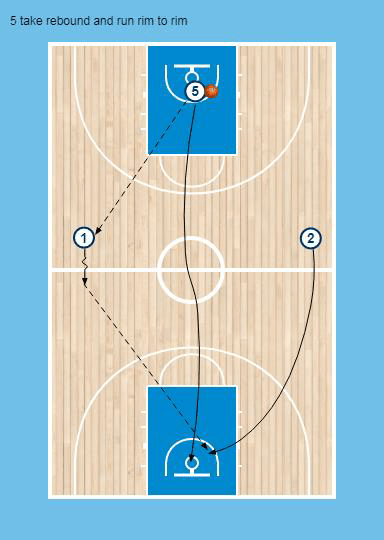
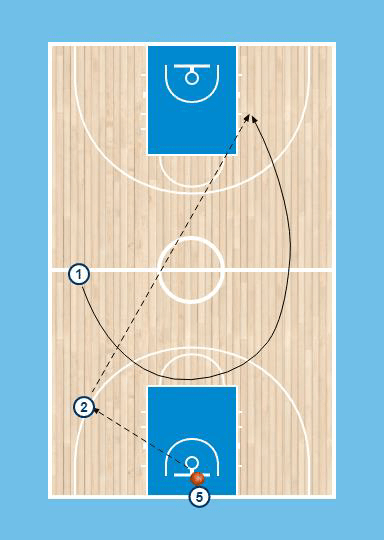
DRILL # 2

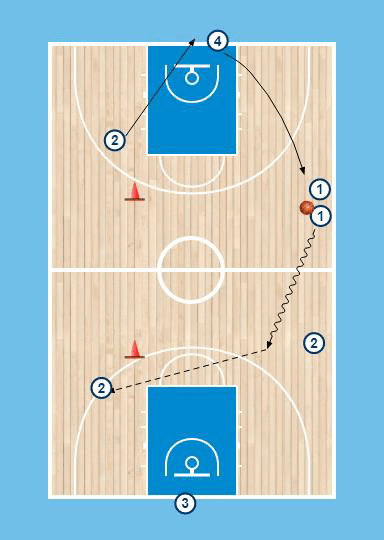
DRILL # 3
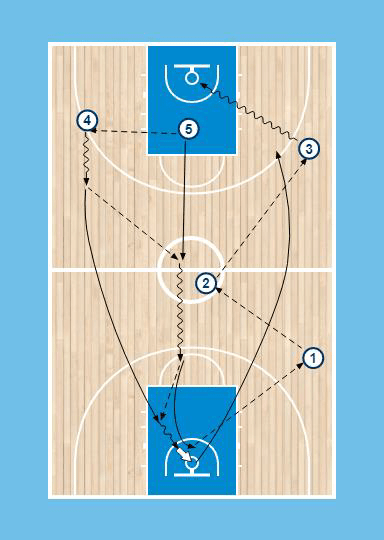
DRILL # 4 (DECISION MAKING)

DRILL # 5 (5V5 – TRY TO SCORE LESS THAN 12 SECONDS)

DRILL #6 (12/10/6 SECONDS DRILL – TRY TO SCORE LESS THAN THESE TIMES)
a-) 12 SECONDS DRILL

b-) 10 SECONDS DRILL

c-) 6 SECONDS DRILL
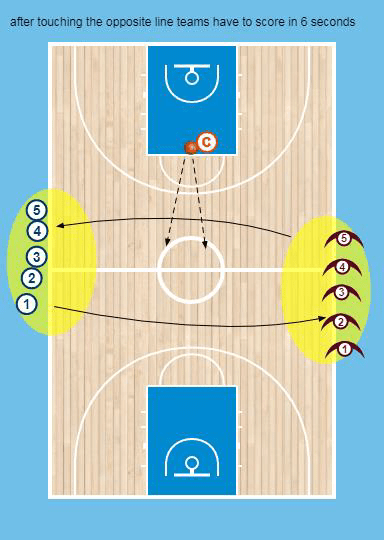
July 16, 2025
Teaching 1v1 Skill Development: A Progression-Based Approach
In the evolving landscape of player development, isolating and teaching 1v1 offensive skills remains a cornerstone of effective training. At the recent international coaching clinic, I presented a progression-driven model focused on teaching, refining, and applying 1v1 skills in real game contexts.
This approach is designed to move players through four clear developmental stages starting with pure skill acquisition and ending with live, competitive execution. It’s built to scale with player ability, give structure to your sessions, and most importantly, make the work translate to game performance.
Here’s the breakdown of my progression:
Phase A: 1v0 – Skill Acquisition
We begin in a no-pressure environment. This stage is all about introducing the skill whether it’s a footwork series, change of pace, or finishing solution and allowing players to build comfort through repetition.
Key focus:
- Mechanics and execution
- Explaining why and when to use the move
- Layering in pace and timing gradually
Phase B: 1vC – Guided Decision-Making
Once players have internalized the technique, we move to 1vC (Coach as Defender). This isn’t live defense it’s controlled resistance that encourages players to read visual cues and start making real time decisions with their new skill.
Key focus:
- Reading body positioning
- Reacting to a shifting defender
- Executing the skill under light pressure
- Reinforcing the why behind the move
Phase C: 1v1 Controlled Advantage
In this phase, players apply the skill in semi-live conditions, but with an initial offensive advantage (e.g., closeout, delayed defender, starting off a screen or a catch). The goal is to build confidence while under pressure, bridging the gap between practice and competition.
Key focus:
- Timing and spacing
- Attack decision off the catch or bounce
- Realistic defensive recovery
- Finishing or countering when the advantage closes
Phase D: 1v1 Game-Like
Now we go live. This is where the work gets tested. Players face live defenders in game-simulated 1v1 reps no predetermined outcome, no scripted reads.
Key focus:
- Compete while using the trained skill set
- Making reads at speed
- Handling physicality
- Shot selection and finishing under duress
This progression is simple, adaptable, and proven to work across different levels of play. Whether you’re coaching youth, college, or pros, it provides a framework that respects the learning process while pushing athletes toward game-readiness.
If you’re looking to implement this model or build your own progression-based training sessions, the full clinic slides and drills are available below.
July 15, 2025
AUS Women’s Basketball 2024–25: Offensive Systems of Saint Mary’s and UPEI
In the AUS Conference this season, two programs have separated themselves from the rest of the field: Saint Mary’s University and University of Prince Edward Island (UPEI). Both teams have been consistently productive on the offensive end not just in raw scoring, but in execution, control, and possession efficiency.
While their stats may appear similar at a glance, deeper analysis and video breakdowns reveal clear differences in how they approach offense. This post examines the offensive tendencies of both teams, supported by numbers and on court footage that shows how they play and how they win.
The video edits included highlight each team’s most frequent offensive structures and scoring habits. These aren’t highlight reels or full game replays they’re focused cutups of typical offensive actions that define each team’s identity.
Saint Mary’s University – Efficient, Composed, and Guard-Driven
Offensive Stats (20 games):
- Points per Game: 72.0
- Field Goal Attempts (FGA): 70.8
- Free Throw Attempts (FTA): 19.3
- Turnovers: 12.3 per game
- Offensive Rebounds: 10.4 per game
- Estimated Possessions/Game: ~72.7
- Points per Possession (PPP): ~0.99
Saint Mary’s offense is built on composure, decision-making, and pace control. They don’t overwhelm you with transition, but they run clean half-court sets and limit mistakes. Their 12.3 turnovers per game is one of the lowest rates in the country a direct result of well coached spacing and good passing discipline.
Despite a moderate rebounding rate (10.4 offensive boards), they get to the free-throw line often (19.3 FTA per game), which adds efficiency to every trip down the floor. With a PPP approaching 0.99, Saint Mary’s executes one of the most productive and disciplined offenses in U Sports.
Expect to see guard-led control of tempo, quick decision reads off ball screens, and smart rotations that pull defenders out of position.
Saint Mary’s – Offensive Video Summary
This edit focuses on Saint Mary’s calculated offense: deliberate pacing, smart shot selection, and high-IQ execution. You’ll see their lead guards managing tempo, running structured actions, and using spacing to produce efficient scoring chances.
Video Link is at the VIDEO ANALYSIS section.
University of Prince Edward Island (UPEI) – Balanced, Active, and Board-Oriented
Offensive Stats (20 games):
- Points per Game: 70.0
- Field Goal Attempts (FGA): 70.7
- Free Throw Attempts (FTA): 16.6
- Turnovers: 13.8 per game
- Offensive Rebounds: 11.8 per game
- Estimated Possessions/Game: ~73.1
- Points per Possession (PPP): ~0.957
UPEI runs a more balanced and physical offense, relying on team activity and rebounding support. They don’t differ much in pace from Saint Mary’s, but they’re slightly more aggressive on the glass (11.8 offensive rebounds) and work harder to earn second-chance looks.
With a PPP near 0.96, their offensive efficiency is solid and while turnovers (13.8 per game) are slightly higher, their physical effort helps compensate. UPEI leans on team rebounding, off-ball movement, and quick post touches to create opportunities in a flowing offense.
Expect to see possessions built on effort: boards turned into put backs, drive and kicks, and hustle created space.
UPEI – Offensive Video Summary
This video sequence shows UPEI’s gritty, team-first offensive style. You’ll see offensive rebounds turned into extra chances, mid-range decisions off movement, and inside-out play that reflects their physical approach and offensive balance.
Video Link is at the VIDEO ANALYSIS section
Final Thoughts
The AUS final this year wasn’t just about two strong teams it was about two different offensive blueprints:
- Saint Mary’s wins with control, spacing, and decision making a polished and efficient system with very few wasted trips.
- UPEI brings activity, rebounding effort, and motion a team that creates offense through grit, ball movement, and second chances.
Both systems have merit. These video edits provide a focused view into what makes each team effective not every possession, but the recurring actions and habits that consistently show up on tape.
As always, this is about understanding offensive identity, not just stats.
July 14, 2025
RSEQ Women’s Basketball 2024–25: Breaking Down Laval and Bishop’s Offensive Styles
In the competitive landscape of RSEQ women’s basketball, Université Laval and Bishop’s University have set themselves apart as the two most dominant programs this season. As conference champion and finalist, respectively, these two teams represent very different offensive identities one built on discipline and control, the other on physicality and hustle.
In this post, I analyze the offensive characteristics of Laval and Bishop’s using possession based metrics and performance indicators like scoring efficiency, rebounding, and turnover rates. Paired with video edits, this breakdown highlights what makes each team effective and where their offensive strengths truly lie.
Université Laval – Structured, Efficient, and Balanced
- Field Goal Attempts (FGA): 1,071 in 16 games
- Free Throw Attempts (FTA): 232
- Turnovers: 16.1 per game
- Offensive Rebounds: 12.5 per game
- Points per Game (PPG): 72.3
- Estimated Possessions per Game: ~75.9
- Points per Possession (PPP): ~0.952
Laval’s offensive style is grounded in structure, consistency, and shot discipline. They don’t rely on overwhelming pace instead, they focus on maximizing each possession through efficient shot selection and limiting errors. With a PPP of approximately 0.95, they boast one of the highest offensive efficiencies across any Canadian conference this season.
Their turnovers are well-controlled (16.1 per game), which supports their deliberate half-court execution. While not an elite rebounding team, they generate 12.5 offensive boards per game, providing a solid number of second-chance opportunities without sacrificing transition defense.
Laval’s scoring system is about patience, clarity, and balance allowing their talent to shine within a well-defined framework.
You can find all the video edits at Video Analysis and Articles section.
Bishop’s University – Physical, Gritty, and Rebound-Driven
- Field Goal Attempts (FGA): 1,046 in 16 games
- Free Throw Attempts (FTA): ~270 (16.9 per game)
- Turnovers: 18.4 per game
- Offensive Rebounds: 13.3 per game
- Points per Game (PPG): 63.8
- Estimated Possessions per Game: ~76.3
- Points per Possession (PPP): ~0.836
Bishop’s plays a more physical, grinding style of basketball, with a strong emphasis on rebounding and earning trips to the free-throw line. Their offensive rebounding average of 13.3 per game is slightly higher than Laval’s, and they attempt more free throws, which signals a focus on attacking the paint and drawing contact.
However, Bishop’s offensive efficiency is notably lower, a PPP of ~0.836 due to higher turnover rates (18.4 per game) and less consistent shot-making. They generate similar possessions per game as Laval but score nearly 9 points fewer per outing, showing that possession quality, not just quantity, is a difference-maker.
In the video breakdown, you’ll notice:
- Lots of post touches and drive-heavy plays
- Aggressive effort on the offensive glass
- Slower offensive initiation and fewer transition chances
- Moments of offensive stagnation when ball movement slows
Bishop’s offense is fueled by toughness and effort a team that leans into contact, thrives in physical matchups, and creates chaos on the boards. They’re most dangerous when they control the glass and get to the line consistently.
Final Thoughts
Laval and Bishop’s give us two contrasting models of successful offensive basketball within the same conference:
- Laval wins through precision, ball control, and efficiency, they don’t waste possessions and make teams pay for defensive lapses.
- Bishop’s leans into effort, physicality, and rebounding, aiming to outwork opponents in the paint and scrap for every point.
You can find all the video edits at Video Analysis and Articles section.
July 13,2025
OUA Women’s Basketball 2024–25: In-Depth Offensive Analytics of Top Contenders
The 2024–25 Ontario University Athletics (OUA) women’s basketball season has showcased some of the most tactically diverse and physically demanding basketball in the country. As the top teams jostle for dominance, understanding their offensive identities is key to predicting outcomes and appreciating the nuanced skill sets on display.
This report offers a comprehensive examination of four powerhouse programs Carleton University, University of Ottawa, Toronto Metropolitan University (TMU), and University of Windsor focusing on possession-based metrics and stylistic tendencies that define their offensive performance this season.
Why Possession-Based Metrics Matter
Traditional basketball statistics like points per game (PPG) tell only part of the story. Pace of play and possession efficiency often distinguish a good team from a great one.
- Possessions per Game reflect how many offensive opportunities a team generates, influenced by pace, turnovers, and rebounding.
- Points Per Possession (PPP) measures scoring efficiency, adjusting for pace differences and allowing fair comparisons.
- Offensive rebounds extend possessions and create additional scoring chances, making rebounding a critical factor in offensive success.
By combining these metrics, we capture a holistic view of how each team operates on offense.
Team Profiles and Tactical Insights
1. Carleton University Ravens: Pushing the Pace With Caution
- Possessions/Game: 86.4 (Fastest in this group)
- Points Per Game: 75.4
- Points Per Possession (PPP): 0.873
- Offensive Rebounds: 9.6/game (Lowest among the four)
- Turnovers: 19.0/game (Highest among the four)
Carleton leads the pack in pace, pushing a high-tempo style that seeks to create more offensive possessions. However, the trade-off is evident in their turnover rate, 19 per game which is notably high and likely limits their scoring efficiency.
Their comparatively low offensive rebound rate (9.6) means fewer second-chance opportunities. This forces the Ravens to rely heavily on their half-court execution, precision passing, and shot selection. The offensive efficiency of 0.873 points per possession signals a team still working to refine ball security and rebounding fundamentals in the fast-break context.
Expect Carleton to prioritize transition offense, but also to seek improvements in offensive rebounding and ball handling to maximize the extra possessions their pace can create.
You can find all the video edits at Video Analysis and Articles section.
2. University of Ottawa Gee-Gees: Efficiency in Control
- Possessions/Game: 77.1
- Points Per Game: 72.6
- Points Per Possession (PPP): 0.941 (Highest efficiency)
- Offensive Rebounds: 13.8/game
- Turnovers: 16.7/game
Ottawa plays at a slower pace, averaging about 9 fewer possessions per game than Carleton, but they are the most efficient offense in this group with a PPP of 0.941.
Their offensive rebounding is strong, yielding 13.8 second-chance opportunities per game, which bolsters their scoring without forcing rushed shots. Fewer turnovers (16.7) support their measured approach.
The Gee-Gees excel in half-court sets, with disciplined spacing and patient ball movement. Their offense is about creating high-quality shots, exploiting mismatches, and punishing defensive lapses.
Ottawa’s formula emphasizes quality over quantity controlling tempo to maximize every possession, making them one of the toughest offenses to defend in the OUA.
You can find all the video edits at Video Analysis and Articles section.
3. Toronto Metropolitan University Bold: Physicality and Rebounding Focus
- Possessions/Game: 75.6 (Slowest tempo)
- Points Per Game: 67.2 (Lowest scoring)
- Points Per Possession (PPP): 0.89
- Offensive Rebounds: 15.2/game (Highest offensive rebounding)
- Turnovers: 17.4/game
TMU has carved a niche with a deliberate, physical style that emphasizes offensive rebounding and controlling the paint. Their 15.2 offensive rebounds per game reflect a relentless pursuit of extra chances.
Despite running the slowest offense, their efficiency (0.89 PPP) is competitive, though below Ottawa’s peak. Turnover numbers (17.4) indicate some room for sharper ball handling and decision-making.
TMU’s offense often grinds through deep clock usage and post-up action. They rely on toughness and second-chance points to offset a lower scoring volume. For TMU, dominating the glass is not just a habit but a critical offensive weapon.
You can find all the video edits at Video Analysis and Articles section.
4. University of Windsor Lancers: Balanced and Dynamic
- Possessions/Game: 78.0
- Points Per Game: 72.0
- Points Per Possession (PPP): 0.923
- Offensive Rebounds: 14.8/game
- Turnovers: 16.6/game
Windsor strikes a balance between tempo and efficiency. With 78 possessions per game, they sit in the mid-tempo zone, blending transition chances with well-structured half-court offense.
Their strong offensive rebounding (14.8) and efficient scoring (0.923 PPP) make them a versatile and dangerous offensive squad. Turnover numbers (16.6) suggest disciplined ball control.
Expect Windsor’s offense to flow between quick hits in transition and versatile drive-and-kick sets. They excel at spacing the floor and maintaining balance between perimeter and inside scoring threats.
You can find all the video edits at Video Analysis and Articles section.
Comparative Overview
| Team | Possessions/Game | PPP | Offensive Rebounds/Game | Turnovers/Game |
|---|---|---|---|---|
| Carleton | 86.4 | 0.873 | 9.6 | 19.0 |
| Ottawa | 77.1 | 0.941 | 13.8 | 16.7 |
| TMU | 75.6 | 0.89 | 15.2 | 17.4 |
| Windsor | 78.0 | 0.923 | 14.8 | 16.6 |
Key Takeaways
- Pace vs Efficiency Trade-Off: Carleton’s fast pace creates more opportunities but struggles with turnovers and offensive rebounds, limiting overall efficiency. Ottawa’s slower, deliberate style achieves the highest PPP.
- Rebounding as a Catalyst: TMU’s offensive rebounding dominance highlights how second-chance points can elevate scoring, even at a slower pace.
- Balanced Attack: Windsor demonstrates the ideal middle ground — a balanced pace with efficient scoring and solid rebounding.
Conclusion: What This Means for the OUA Landscape
This season’s top OUA women’s basketball teams showcase diverse offensive blueprints from Carleton’s up tempo transition game to Ottawa’s precision half-court offense, TMU’s physical glass-crashing style, and Windsor’s balanced approach.
For coaches, this analysis underscores the importance of matching tempo to personnel strengths and emphasizes rebounding and turnover management as critical factors that can swing offensive efficiency.
For players and fans, it provides a window into the mechanics behind the scoreboard revealing why some teams score more with fewer possessions, and how rebounding intensity can fuel momentum.
As the season progresses, watching how these teams adapt and evolve will be key particularly whether Carleton can sharpen its efficiency at pace, or if Ottawa can maintain its methodical dominance under pressure.
July 12, 2025
Canada West Women’s Basketball 2024–25:
Deep Dive on Saskatchewan, Alberta, UBC & UFV
The 2024–25 Canada West women’s basketball season wrapped up with some intense battles and impressive team performances. I took a close look at the four top teams Saskatchewan, Alberta, UBC, and UFV through the lens of advanced stats to figure out what made them tick and what challenges lie ahead. This is a no-nonsense breakdown focused on real data: pace, efficiency, defense, rebounding, and turnovers.
Pace: Who’s Running the Floor and Who’s Controlling the Clock?
Basketball fundamentally revolves around possessions. The more possessions your team can generate, the more chances you have to score and dictate the flow of the game. Here’s what the numbers say:
- UBC leads the pack with an estimated 90.4 possessions per game. They push the tempo hard and are willing to trade some efficiency for pace.
- Saskatchewan follows close behind at 89.1 possessions per game. Their style balances speed with precision.
- Alberta takes a more measured approach at 80.2 possessions per game favoring a more deliberate half-court game.
- UFV rounds out the group with the slowest pace at 75.0 possessions per game, signaling a more conservative style.
The difference between UBC and UFV is about 15% more possessions per game, which is a significant margin. This means UBC is playing faster, testing their conditioning and decision-making under pressure, while UFV relies on grinding possessions down to maximize efficiency.
Offensive Efficiency: Scoring Points and Maximizing Possessions
Possessions alone don’t win games; scoring efficiently on those possessions does. Here’s where points per possession (PPP) provides a clear lens.
- Saskatchewan’s PPP of 0.939 stands out as the best among the group. They combine fast pace with smart shot selection and effective ball movement. This indicates a team that’s not just running, but running with purpose.
- Alberta’s 0.901 PPP shows their deliberate style pays off in solid scoring efficiency. They don’t push pace, but they capitalize well when they get the ball.
- UFV, at 0.900 PPP, is in the same range as Alberta despite playing slower. This suggests disciplined offense and effective shot creation in the half-court.
- UBC’s 0.884 PPP is slightly behind, a sign their up-tempo approach sometimes comes at the cost of shot quality or turnovers.
What’s important here is how efficiency and pace interact. Saskatchewan manages both very well a tough combination to pull off while Alberta and UFV lean on efficiency to offset slower tempo. UBC needs to tighten up shot selection and ball control to match their pace advantage with better offensive returns.
Defensive Efficiency: Stopping Opponents and Forcing Turnovers
Defense wins championships. Defensive efficiency (points allowed per possession) shows how well these teams limit opponents’ scoring opportunities.
- Saskatchewan’s 0.603 Def PPP is elite. Holding teams under 0.61 points per possession is a sign of strong rotations, smart switching, and physicality inside.
- UBC is next at 0.629, an excellent mark considering their fast pace. They are able to recover defensively despite pushing the tempo.
- UFV and Alberta’s defensive efficiencies around 0.72-0.75 are respectable but suggest room for improvement, especially for Alberta if they want to compete with the conference leaders.
This defensive profile explains much about these teams’ success or struggles. Saskatchewan’s defense is a foundation for their offense to thrive, while Alberta and UFV need to tighten things up on that end to turn close games in their favor. UBC’s defense is impressive given their up-tempo style, showing they have both athleticism and discipline.
Rebounding: Winning the Battle for Extra Chances
Rebounding controls possession and can shift momentum.
- UBC tops offensive rebounding at 17.6 per game, showing hustle and physicality even at a fast pace.
- Saskatchewan follows closely with 16.7 offensive boards, which fuels their second-chance points and offensive rhythm.
- Alberta’s 15.1 offensive rebounds per game is solid but less dominant, matching their more conservative style.
- UFV’s 13.3 offensive rebounds per game suggests they struggle somewhat to generate second chances, which could limit their scoring opportunities.
Controlling offensive rebounds is especially crucial for teams that want to push the pace and maximize possessions. Saskatchewan and UBC’s rebounding numbers support their fast, aggressive styles, while Alberta and UFV rely more on controlling possessions through other means.
Turnovers: The Hidden Killer of Possessions
Turnover rates directly impact how many quality scoring chances a team gets.
- Saskatchewan’s 19.7 turnovers per game is the best among the four. They take care of the ball better than the others, which fits their efficient, high-paced game.
- UBC (19.6) and Alberta (20.6) have slightly higher turnovers, showing some risk-taking or lapses in ball control.
- UFV at 17.3 turnovers per game has the lowest number, which might reflect a more cautious offensive style in line with their slower pace.
Reducing turnovers is an area where UBC and Alberta could improve. High turnovers diminish the benefits of a faster pace, making possession management critical.
Final Thoughts and What to Expect Next Season
- Saskatchewan is clearly the benchmark in Canada West. Their ability to marry pace, efficiency, and elite defense makes them the team to beat. Their rebounding and ball control are additional weapons that make their offense sustainable and their defense suffocating.
- UBC is exciting but needs to refine offensive efficiency and turnover management to fully leverage their high pace.
- Alberta’s slower, more traditional approach shows solid offensive efficiency but needs defensive tightening and better ball security to challenge Saskatchewan.
- UFV is competitive but will have to improve rebounding and defensive intensity if they want to move up the standings.
The 2024-25 Canada West women’s basketball season confirms the growing importance of pace and efficiency metrics. Coaches and teams that optimize possessions without sacrificing shot quality or defensive discipline will have the advantage going forward.
July 8, 2025
EuroBasket Women 2025: How the Top Three Teams Won with Structure, Not Speed
A Tactical Breakdown of Belgium, Spain, and Italy’s Performance in the Knockout Rounds
The knockout rounds of EuroBasket Women 2025 showed once again that while modern basketball rewards tempo and aggression, the teams that win at the highest level don’t just run they execute. In a FIBA setting, where games are shorter, possessions are more valuable, and margins are tighter, the ability to control the game wins out over raw pace or inflated scoring.
In this article, I take a data-driven look at how the top three teams Belgium, Spain, and Italy performed in the quarterfinals, semifinals, and medal games. We measure possessions, points per possession (PPP), turnover rates, rebounding, and offensive control to determine what separated the podium teams from the rest.
Team Overview: Possession and Efficiency Data
| Team | Games | Total Points | Est. Possessions | Possessions/Game | Points Per Possession (PPP) |
|---|---|---|---|---|---|
| Belgium | 3 | 216 | 208.1 | 69.4 | 1.038 |
| Spain | 3 | 217 | 219.9 | 73.3 | 0.987 |
| Italy | 3 | 209 | 212.9 | 71.0 | 0.982 |
Possessions are estimated using the standard FIBA formula:
FGA – ORB + TO + (0.475 × FTA)
Belgium: Precision Over Pace
Belgium won gold by playing clean, calculated, disciplined basketball. They had the lowest pace of the top three teams (69.4 possessions/game) but made up for it with elite efficiency — 1.038 points per possession — the best in the tournament.
What Drove Their Success:
- Turnover Control: Averaged just 11.7 turnovers/game, despite playing against high-pressure defenses.
- High-Value Possessions: Ran structured halfcourt sets, prioritized spacing and timing, and didn’t force early shots.
- Consistent Scoring: Scored 66, 67, and 83 in their three knockout games without needing transition bursts or hot shooting streaks.
This was not a team trying to outrun anyone. They won by forcing teams to beat their structure — and most couldn’t.
Belgium showed that you don’t need to play fast if you play smart.
Spain: Aggression Without Stability
Spain was the most aggressive team of the top three in terms of both pace and physicality but their style lacked consistency. They played at the highest tempo (73.3 possessions/game) and opened their quarterfinal with 88 points behind 33 free throw attempts. But things unraveled as pressure increased.
Game-by-Game Trends:
- Quarterfinal vs. weaker opponent: 53 FGA, 33 FTA, 88 points, explosive and physical.
- Semifinal vs. Italy: 66 FGA, 16 FTA, 64 points, pace still there, but scoring dropped.
- Final vs. Belgium: 52 FGA, 14 FTA, 18 turnovers, just 65 points and no rhythm.
Spain’s PPP dropped to 0.987, weighed down by a poor final game in which Belgium forced them into halfcourt decision-making. Their turnovers (average 15.7/game) and inconsistent shot quality cost them when games tightened.
Spain had energy and intensity, but when it came time to execute in the halfcourt, they didn’t have enough answers.
Italy: Balanced and Solid, But Lacking a Finishing Gear
Italy was right in the middle both statistically and stylistically. They played a moderately fast game (71.0 possessions/game), with decent offensive structure, and stayed close in all three knockout games. But they never dictated tempo or momentum.
Statistical Profile:
- Quarterfinal (win): 76 points on 70 FGAs clean execution.
- Semifinal (loss to Belgium): 64 points on 64 FGAs disciplined, but not disruptive.
- Bronze Medal Game: 69 points, but 17 turnovers and only 50 FGAs breakdown under pressure.
Italy’s PPP (0.982) was competitive but not high enough to threaten Spain or Belgium in key moments. When their sets were flowing, they looked like a medal team. But when the pace slowed or pressure increased, they didn’t have a go-to scorer or a transition-based release valve.
Italy was a stable team, but stability doesn’t win you the gold when shot-making and playmaking aren’t elite.
Takeaways: What Actually Wins at This Level?
1. Points Per Possession > Raw Scoring
Belgium’s 1.038 PPP beat Spain’s 0.987 and Italy’s 0.982. That margin just a few made shots per game was the difference between gold and bronze. It didn’t matter that Belgium played slower. Their execution was tighter, cleaner, and more reliable.
2. Turnovers Kill Possessions and Rhythm
- Belgium: 11.7 TO/game
- Italy: 11.3 TO/game (until the bronze medal)
- Spain: 15.7 TO/game
In knockout basketball, you don’t get enough possessions to waste 15+ of them.
3. Playing Fast Doesn’t Guarantee Efficiency
Spain ran the most, but didn’t finish well. Italy and Belgium ran less but valued each possession more. High-tempo basketball works only when it’s connected to structure and decision-making. Otherwise, it becomes empty pace.
4. Identity Wins
- Belgium: Halfcourt execution, spacing, patience
- Spain: Rim pressure, transition, physicality
- Italy: System and structure, but limited improvisation
Teams that tried to play both sides (fast and slow, system and chaos) didn’t last. The medal winners had a clear identity and they stuck to it when the games got tight.
Conclusion
EuroBasket Women 2025 wasn’t a showcase of run-and-gun basketball. It was a masterclass in why execution under pressure, turnover control, and possession value still matter more than raw pace or inflated scoring numbers.
Belgium didn’t need to run they needed to be sharp.
Spain had speed but couldn’t convert it consistently.
Italy was balanced but lacked a spark.
If you’re coaching a team at any level, this tournament confirms it:
You don’t need to be the fastest. You need to be the most prepared.
Structure still beats speed when the margins are thin and the stakes are real.
July 7, 2025
The Case for Playing Fast: A Deep Analytical Dive into the 2025 FIBA Women’s AmeriCup
Basketball is a game of possession control and efficient scoring. The 2025 FIBA Women’s AmeriCup highlights with concrete data how playing at a higher pace translates into more offensive opportunities, greater defensive pressure, and improved chances to win. This article goes beyond surface-level statistics to analyze detailed performance parameters, illuminating why speed remains one of the most effective strategic advantages in basketball.
Detailed Parameters & Analytical Breakdown
1. Possessions Per Game (Pace)
Possessions per game directly reflect the number of scoring opportunities a team has. The formula used to estimate possessions is:
Possessions=FGA−ORB+TO+0.475×FTA\text{Possessions} = \text{FGA} – \text{ORB} + \text{TO} + 0.475 \times \text{FTA}
This formula captures how field goal attempts, offensive rebounds (which extend possessions), turnovers (which end possessions), and free throw attempts influence the flow of the game.
| Team | Games Played | Total Possessions | Possessions Per Game |
|---|---|---|---|
| USA | 3 | 248.2 | 82.7 |
| Brazil | 3 | 232.9 | 77.6 |
| Canada | 3 | 247.8 | 82.6 |
| Argentina | 3 | 236.3 | 78.8 |
Interpretation: USA and Canada led the tournament in pace, averaging about 82.7 possessions per game, compared to Brazil’s more deliberate 77.6 possessions.
2. Points Per Possession (PPP) — Offensive Efficiency
PPP is a core indicator of how well a team capitalizes on its possessions:
PPP=Total PointsPossessionsPPP = \frac{\text{Total Points}}{\text{Possessions}}
| Team | Total Points | PPP |
|---|---|---|
| Brazil | 279 | 1.198 |
| USA | 267 | 1.076 |
| Argentina | 196 | 0.829 |
| Canada | 202 | 0.815 |
Interpretation: Brazil, despite playing slower, maximized every possession better than the others, posting nearly 1.2 PPP a, very high level of offensive efficiency. USA combined speed with strong efficiency, while Canada and Argentina’s offenses lagged behind.
3. Offensive Rebounding & Turnovers — Possession Extenders and Killers
Offensive rebounds (ORB) extend possessions, creating second-chance points, while turnovers (TO) prematurely end possessions.
| Team | Avg ORB per Game | Avg TO per Game |
|---|---|---|
| USA | 19.3 | 15.0 |
| Brazil | 29.7 (total 3 games) | 11.3 |
| Canada | 16.7 | 19.0 |
| Argentina | 7.3 | 10.7 |
Interpretation: USA’s aggressive offensive rebounding (19.3 per game) helped them sustain possessions and generate high-quality shot opportunities. Conversely, Canada’s higher turnover rate (19 per game) undermined their offensive efficiency, limiting scoring chances despite a high pace.
4. Shot Selection & Field Goal Attempts (FGA)
Shot volume combined with shot quality affects overall team success.
| Team | Avg FGA per Game |
|---|---|
| USA | 75.3 |
| Brazil | 77.7 |
| Canada | 69.3 |
| Argentina | 68.0 |
Brazil’s slightly lower pace is compensated by higher shot quality, indicated by their superior PPP.
5. Free Throws Attempted (FTA)
Free throws reflect aggressiveness and ability to draw fouls.
| Team | Avg FTA per Game |
|---|---|
| USA | 24.7 |
| Brazil | 28.0 |
| Canada | 23.0 |
| Argentina | 15.7 |
Brazil’s high FTA per game indicates an aggressive, physical style that forces opponents to foul, contributing to offensive efficiency.
Integrated Analysis: Pace, Efficiency, and Aggression
- USA exemplifies balanced basketball: High tempo (82.7 possessions/game), excellent offensive rebounding, moderate turnovers, and solid efficiency (1.076 PPP).
- Brazil prioritizes efficiency and physicality: Despite a slower pace, they generate more free throws and maintain the highest PPP, maximizing scoring per possession.
- Canada’s high pace is undermined by turnovers: They run quick offenses but fail to convert possessions effectively due to poor ball control and suboptimal shot selection.
- Argentina shows a moderate pace with low offensive rebounding: Their lower rebound numbers limit possession extension, impacting scoring opportunities.
Comparison to Established Basketball Research
- Dean Oliver’s “Four Factors” emphasize that winning teams limit turnovers and maximize offensive rebounding both strongly correlated with higher PPP and pace.
- Research by Kubatko et al. (2007) shows NBA teams with higher pace and moderate efficiency tend to outperform slower teams with similar or slightly better efficiency.
- Studies of WNBA and EuroLeague Women competitions consistently confirm that fast, aggressive teams controlling the glass outperform slower, less aggressive squads.
Detailed Conclusion: Why Fast, Aggressive Basketball Wins
1. More Possessions = More Opportunities
The fundamental principle reinforced by the AmeriCup data is that pace controls volume. A team like the USA or Canada creating ~83 possessions per game inherently generates more chances to score and disrupt opponents.
2. Defensive Aggression Amplifies Pace
Offensive rebounding and forcing turnovers directly impact pace. USA’s ability to secure nearly 20 offensive rebounds per game forces opponents into defensive transition, leading to more possessions and higher scoring chances.
3. Efficiency is a Force Multiplier
Brazil’s superior PPP (1.198) shows that efficiency can trump pure pace but only to a point. A slow-paced team with high efficiency will often score less total points than a fast-paced team with good (though slightly lower) efficiency, simply because the fast team has more possessions.
4. Turnovers are the Ultimate Possession Killer
Canada’s high turnover rate (19 per game) reveals how turnovers diminish the value of pace. High pace is futile without strong ball control and smart shot selection.
5. Conditioning & Execution are Essential
Sustaining a fast pace requires top conditioning, player discipline, and decision-making. Poor execution at high speeds negates pace advantages.
Actionable Takeaways for Coaches and Teams
- Emphasize conditioning and fast decision-making to maintain high tempo without sacrificing efficiency.
- Train players to attack the offensive glass relentlessly securing extra possessions and limiting opponent second chances.
- Develop defensive schemes that create turnovers and quick transitions.
- Use pace to pressure opponents and control game flow.
- Balance tempo with smart shot selection rushing shots reduces PPP and negates possession advantage.
Conclusion
The 2025 FIBA Women’s AmeriCup confirms the timeless truth of basketball: Playing fast, aggressive basketball that maximizes possessions, controls rebounds, and prioritizes efficiency is the path to victory.
Teams like the USA show us the blueprint fast tempo combined with disciplined offense and aggressive defense yields championships.
In an era of analytics and pace-centric basketball, the data is clear: Speed wins games.
July 6, 2025
Canada U17 Men’s Basketball: FIBA World Cup Campaigns & Roadmap to 2026 Gold
Canada’s U17 men’s basketball program has been a consistent presence on the global stage since the inaugural FIBA U17 World Cup in 2010. Despite moments of promise, the program has yet to capture gold, with results fluctuating and a persistent challenge breaking through the quarterfinal glass ceiling. This article provides a tournament-by-tournament review, head coach insights, detailed performance analysis, and a forward-looking strategy for Canada to contend for gold in 2026 Turkiye.
1. Tournament-by-Tournament Breakdown & Coaching Profiles
2010 – Bronze Medal | Coach: Roy Rana
- Record: 6–2
- Coach Profile: Roy Rana, a legendary figure in Canadian youth basketball, brought a unique combination of tactical discipline, player development, and calm leadership. Rana’s previous successes with Canada’s U16 and U18 teams established him as a developer of high-IQ players, capable of thriving in pressure.
- Performance Summary: Canada’s aggressive defense and balanced offense led them to bronze, marking the country’s best U17 result. The team displayed disciplined ball movement and strong rebounding.
- Strengths: Efficient inside-out scoring, low turnover rate (~12 per game), and stellar defensive rotations.
- Weaknesses: Perimeter shooting inconsistencies; reliance on balanced scoring rather than a dominant star.
- Why They Lost Gold: In the semifinal loss to USA, Canada faltered in clutch execution—shooting under 40% in the final quarter and committing costly turnovers at pivotal moments. USA’s superior athleticism and transition play overwhelmed Canada late.
2012 – 5th Place | Coach: Dan DeAveiro
- Record: 5–2
- Coach Profile: Dan DeAveiro, a respected university coach in Canada, emphasized structured offense and man-to-man defense. However, international experience was limited compared to Rana.
- Performance Summary: The team showed solid defensive tenacity but struggled to generate consistent scoring runs.
- Strengths: Defensive discipline, particularly on ball pressure and rebounding.
- Weaknesses: Lack of offensive creativity and adaptability; frequent struggles against zone defenses.
- Why They Lost Medal Chances: Failure to adjust offensive schemes in the knockout phase limited scoring options, leading to quarterfinal elimination.
2014 – 6th Place | Coach: Charles Dubé-Brais
- Record: 4–3
- Coach Profile: Dubé-Brais brought a modern approach with emphasis on pace and space, influenced by professional North American systems. His ability to develop shooters improved Canada’s floor spacing.
- Performance Summary: Canada increased three-point attempts but sacrificed defensive intensity and allowed opponents easy penetration.
- Strengths: Improved perimeter shooting (36%), faster transition offense.
- Weaknesses: Defensive lapses, particularly in help defense and pick-and-roll coverage.
- Why They Fell Short: Defensive vulnerabilities led to blowout losses against top teams, losing the ability to keep games close.
2016 – 5th Place | Coach: Paul Weir
- Record: 5–2
- Coach Profile: Paul Weir, with NCAA head coaching experience, emphasized physicality and half-court execution. Weir’s teams reflected strong post play and methodical offense.
- Performance Summary: Strong rebounding and inside scoring; however, they struggled with outside shooting efficiency (~33%).
- Strengths: Dominant paint presence, low turnovers.
- Weaknesses: Perimeter defense and lack of secondary scoring options.
- Why They Lost Gold: An inability to diversify offense against elite defensive teams in knockout rounds limited their scoring, contributing to losses in crucial moments.
2018 – 4th Place | Coach: Patrick Tatham
- Record: 6–1
- Coach Profile: Tatham, a former professional player and coach, focused on defensive intensity and physical conditioning. His system prioritized aggressive ball pressure and transition scoring.
- Performance Summary: The team showed improvements defensively and in fast-break points, but inconsistent shooting plagued close games.
- Strengths: Defensive hustle, forcing turnovers (average 18 per game).
- Weaknesses: Shooting under pressure, especially late-game free-throw percentages.
- Why They Lost Gold: Narrow semifinal loss tied to missed free throws and failure to convert transition opportunities in crunch time.
2022 – 9th Place | Coach: Chris Cheng
- Record: 3–4
- Coach Profile: Cheng, known for his player development acumen, attempted to build a balanced team with improved guard play. However, limited international coaching exposure was a challenge.
- Performance Summary: Offensive inconsistency and defensive lapses contributed to underperformance.
- Strengths: Individual talent and energy.
- Weaknesses: Poor ball security (turnovers over 20 per game), defensive breakdowns leading to opponent fast-break points.
- Why They Lost Medal Contention: Failure to close out tight games and discipline issues, especially against top-tier opponents.
2024 – 8th Place | Coach: Chris Cheng
- Record: 3–4
- Performance Summary: Marked by a strong showing against mid-level teams but overwhelmed by dominant powers like the USA (111–60 loss).
- Strengths: Dynamic guard scoring (Jordan Charles, Miles Sadler), decent rebounding.
- Weaknesses: Turnover explosion (37 in quarterfinal vs USA), poor perimeter defense, and foul trouble.
- Why They Lost Gold: Inability to handle pressure defense and control tempo; lack of a clutch performer and poor end-game execution.
2. Tactical & Statistical Analysis: Recurring Themes
Offensive Trends
- Ball Movement: Strong in early years (2010–2014) but inconsistent in later tournaments due to less experienced guards.
- Shooting: Perimeter shooting improved but never matched elite levels (best ~36% 3P). Champions consistently hit 40%+.
- Turnovers: Chronic problem post-2014; 15–20+ turnovers/game in recent tournaments versus champions’ 10–12.
- Clutch Scoring: Absence of dominant clutch scorers in recent squads; balanced scoring is insufficient under pressure.
Defensive Trends
- Pressure Defense: Effective early on; recent teams struggle to sustain defensive intensity over tournament length.
- Rebounding: Canada consistently among top rebounding teams (avg 45–50 RPG), yet opponent second-chance points often high due to poor boxing out.
- Foul Management: Elevated foul rates in critical games lead to free throw disadvantages against elite teams.
3. Comparison to Tournament Champions
| Year | Champion | Offensive PPG | Defensive PPG Allowed | 3P% | TO/Game | Coach Profile & Strategy |
|---|---|---|---|---|---|---|
| 2010 | USA | 95+ | ~65 | 41% | ~10 | Sharman White: Fast pace, full court pressure, star-driven offense. |
| 2012 | USA | 100+ | ~62 | 42% | ~11 | White & Hammon: Emphasis on transition, switching defense. |
| 2014 | USA | 105+ | ~60 | 44% | ~9 | Mike Krzyzewski influence; highly efficient offense, adaptable defense. |
| 2016 | USA | 106+ | ~58 | 45% | ~10 | Defensive intensity, NBA talent pipeline. |
| 2018 | USA | 108+ | ~55 | 47% | ~9 | Tactical versatility; elite shooting, ball control. |
| 2022 | Spain | 99.6 | 65 | 43% | 10 | Coach emphasizing ball movement, possession control, and physical defense. |
| 2024 | USA | 110+ | ~57 | 48% | 10 | Blend of youth NBA-level talent and experienced coaching (Sharman White). |
Champions showcase superior ball security, elite shooting efficiency, and tactical flexibility. Their coaches bring extensive international and professional experience, blending player development with adaptive game plans.
4. Why Canada Keeps Falling Short
- Lack of International Elite Coaching Experience: Except for Roy Rana (2010), subsequent coaches have limited exposure to high-level international tournament coaching, reducing tactical flexibility.
- Turnover Vulnerability: High turnovers (15–20+) especially against aggressive press defenses cost transition opportunities and momentum.
- Inconsistent Shooting: Canada’s 3P shooting has never reached championship levels, limiting floor spacing and offensive threats.
- Lack of a Clutch Alpha Player: Teams have lacked a go-to player who can control the ball and scoring in crunch time, leading to close losses.
- Defensive Breakdown Under Pressure: Late game fouls and breakdowns allow opponents to capitalize on free throws and fast breaks.
5. Roadmap & Strategic Recommendations for 2026 Turkiye
1. Coaching Development & Exposure
- Engage head coach and staff in international coaching exchanges and clinics to absorb best practices from USA, Spain, Serbia.
- Hire or consult with coaches with proven FIBA youth tournament success to build tactical depth.
2. Player Development Focus
- Identify and develop clutch performers early: Use psychological training, pressure simulations, and leadership mentoring.
- Prioritize ball security drills under intense defensive pressure in practice.
- Increase three-point shooting efficiency to >40% via high-volume, game-like shooting routines.
3. Tactical Adaptability
- Build versatile offensive sets, capable of adjusting mid-game based on scouting reports.
- Implement defensive schemes focused on limiting opponent transition points and controlling fouls (zone traps, selective pressing).
- Create and regularly practice “closing unit” lineups designed for high-pressure final minutes.
4. Physical & Mental Conditioning
- Prepare athletes for tournament endurance, emphasizing recovery, nutrition, and mental resilience.
- Incorporate sports psychology to build confidence and composure under pressure.
5. Analytics-Driven Game Planning
- Utilize real-time data analytics during tournaments to identify patterns, opponents’ weaknesses, and own team’s vulnerabilities.
- Adapt lineups and tactics dynamically based on performance metrics.
6. Final Thoughts: From Contender to Champion
Canada’s U17 men’s basketball program stands at a crossroads. While the talent pool is deep and promising, historic results underscore a gap in execution under pressure, coaching experience, and tactical adaptability compared to perennial champions like the USA and Spain.
The gold medal is not beyond reach. But it demands a comprehensive shift:
- From reactive to proactive coaching,
- From talent alone to mental and tactical preparedness,
- From generalist teams to those with a clear identity and leadership structure on and off the floor.
The 2026 Turkiye tournament represents more than just another world championship; it is an opportunity to forge a new culture of championship basketball at the youth level in Canada. Success will require embracing the full spectrum of player development, cutting-edge coaching, and strategic innovation.
If Canada commits to this evolution, it won’t merely participate—it will win.
Canada’s U19 Campaigns (2017–2025): A Deep Dive
2017 – Gold Medal under Roy Rana
Canada achieved a flawless 7–0 run to win the tournament. RJ Barrett led the team with 21.6 PPG and 8.3 RPG, while the squad averaged 99.4 PPG and 57.7 RPG the best in the tournament. Coach Roy Rana’s international experience (U17 bronze, Hoop Summit) was crucial in fostering both elite talent development and team cohesion.
Why they succeeded
- Star power allowed for reliable late-game execution.
- Balanced inside-out offense created matchup advantages.
- Defensive discipline minimized opponent opportunities.
2019 – 8th Place under Dan Vanhooren
After a restructuring, Canada regressed to 3–4 under Dan Vanhooren, a proven university-level coach. A lack of top-tier scoring led to stagnation when games tightened.
Why they faltered
- No player could seize control late in tight matchups.
- Offensive rhythm collapsed under pressure.
Winner: USA returned to the throne with a 7–0 record, averaging team-leading 100.9 PPG and strong playmaking (28.6 APG) . Their dominance was driven by NBA-level talent (Cade Cunningham, Reggie Perry) and veteran coaching that thrived under speed and transition.
2021 – Bronze Medal under Paul Weir
Canada rebounded to 6–1 with Paul Weir at the helm, powered by paint monster Zach Edey (15.1 PPG, 14.1 RPG) and floor general Ryan Nembhard (6.7 APG)
Why they medaled
- Interior dominance in scoring and rebounding.
- Effective offensive structure from post to guard.
Limitations
- Lack of perimeter creativity and closure.
- Dependence on Edey limited adaptability in crunch time.
Champion: USA narrowly defeated France 83–81 behind Chet Holmgren and clutch defense
2023 – 7th Place under Patrick Tatham
With Patrick Tatham, Canada finished 3–4 in Debrecen. They were physical and defensively cohesive, but offensive predictability remained an issue .
Why they fell short
- Overreliance on one guard for scoring.
- Lack of backcourt rotation and motion.
Champion: Spain, coached with precision, beat France 73–69 in OT. They forced 28 turnovers from France while committing only seven . This showcased their control and half-court execution.
2025 – 5th Place under Ramón Díaz
Canada went 4–2, losing 108–102 to USA in the quarterfinals despite outrebounding them 47–43
Key stats
- Scorers: Oliogu (14.3 PPG), Charles (13.7 PPG, 4.8 APG).
- Discipline breakdown: 17 turnovers → 25 USA fast-break points; 29 fouls vs 19, resulting in 47 USA free-throws made at 81% .
Why they lost
- Discipline cracks under pressure (turnovers/fouls).
- Balanced attack lacked a “finish” option.
USA, with NBA-level team and elite coaching, claimed the gold medal.
Why Canada Falls Short: A Multi-Year Pattern
- Lack of an Alpha Closer
Canada thrived when it possessed a late-game executor (Barrett/Edey). Without that, tight matches slip. - Discipline Under Pressure
Quarterfinals saw turnovers spike above +5 and fouls exceed 25 creating undue penalty pressure. - Perimeter Rigidity
3P% hovered around 36%, while champions hit 40%+ thanks to movement and spacing . - Rigid Game Plans
Canada struggled to adapt mid-game when primary options were neutralized.
Roadmap to Gold in 2027
- Cultivate a Closer
Identify and nurture a late-game leader. Simulate clutch scenarios with pressure and fatigue in training. - Instill Discipline Metrics
Goal: ≤12 TPG, ≤22 fouls/game. Use real-time analytics to enforce discipline in scrimmages. - Elevate Perimeter Game
Train catch-and-shoot rhythm, movement, and spacing to hit 40% from deep under duress. - Enhance Defensive Toughness
Prioritize clean rebounding and FIBA boxing-out. Minimize second-chance conversions. - Mental Resilience Training
Use under-duress scrimmages with noise, crowd, injury, and foul scenarios to build grit. - Integrated Coaching Philosophy
Blend Rana’s star development, Weir’s structured offense, and Díaz’s balance into a unified system adaptable under stress.
Final Thoughts: Why Canada Hasn’t Reclaimed Gold and What It Truly Takes
Over the past five U19 World Cup cycles (2017–2025), Canada has proven itself as one of the top-tier nations in global youth basketball. It boasts elite athleticism, a solid domestic development pipeline, strong rebounding identities, and, at times, disruptive defensive energy. The 2017 gold medal under Roy Rana wasn’t just a flash in the pan it was the result of nearly a decade of developmental groundwork, smart talent identification, and a system that empowered its best player (RJ Barrett) to lead with freedom and confidence.
But since that historic win, a recurring theme has emerged: Canada has fallen short in the moments that matter most. Whether it’s a quarterfinal exit (2019, 2023, 2025) or bronze medal consolation (2021), the story has been the same structurally sound, physically prepared, but unable to win under the intense crucible of knockout-stage pressure.
The Missing Piece: Dynamic End-of-Game Identity
Statistically, Canada performs well across most standard metrics. They typically finish in the top half of the tournament in rebounds per game, and often in the top third for points per game and field goal percentage. However, two key metrics consistently break down in losses: turnovers and fouls.
In the 2025 quarterfinal loss to the USA, for example, Canada committed 17 turnovers and 29 fouls, leading to 25 USA fast-break points and 47 free-throw attempts. That’s not just a lapse that’s a systemic failure in discipline, game management, and situational awareness. In previous years, similar issues persisted: fouling late in games, poor shot selection under pressure, and missed free throws at critical junctures.
Equally important is the absence of a true closer someone who, like Barrett in 2017 or Chet Holmgren for the USA in 2021, can be trusted to take and make the big shots, and demand the ball when momentum shifts. While recent teams have had balanced scoring (Oliogu, Edey, Charles, Nembhard), no player since Barrett has truly stepped into that role. That leadership void cannot be solved by X’s and O’s alone it requires emotional intelligence, psychological preparation, and system trust from coaches.
Comparison with Champions: What They Do Differently
When we look at what winning programs like the USA (2019, 2021, 2025) and Spain (2023) do, the differences are clear:
- They protect the ball. Their turnover-to-assist ratios are consistently better than Canada’s. In 2023, Spain forced France into 28 turnovers while committing just 7 themselves. That level of discipline matters.
- They win the foul battle. The USA in 2025 committed 10 fewer fouls than Canada and shot nearly 50 free throws at an 81% clip. Controlling contact and tempo is a hallmark of mature programs.
- They are tactically fluid. The USA adjusts defensively mid-game (zone traps, switch schemes); Spain wins through possession control and late clock execution. Canada, in contrast, has often stuck too long to rigid rotations or offensive sets that become predictable.
- Their stars elevate under pressure. Whether it’s Holmgren (2021), Aldama (Spain, 2023), or Keyonte George (USA, 2025), tournament-winning teams have players who get better as the stakes rise. Canada’s best players have often played well, but rarely played great in elimination moments.
What Must Change for 2027
- Leadership Development
Canada Basketball must deliberately invest in mental training, not just physical or tactical drills. Players need to be groomed for late-game poise using film sessions, clutch simulations, and pressure-inoculation techniques. Mental reps must match physical ones. - Tactical Versatility
Coaches must be empowered to make in-game tactical shifts. That includes late shot clock sets, two-for-one scenarios, defensive adjustment packages (e.g., zone press-breakers), and the willingness to ride the hot hand regardless of pre-game rotations. - Clear Identity
Canada has too often played reactively. The best teams force others to adapt to their strengths. For 2027, a clear identity must emerge are we a fast-paced transition team? A physical, half-court post-up squad? A five-out perimeter team? Identity breeds confidence. Confidence breeds wins. - Closing Five Philosophy
Games are won or lost in the final five minutes. Canada must establish a reliable closing unit based not on seniority or rotation, but on chemistry, decision-making, and trust. These five must train together in end-game drills regularly. - Benchmarking Against Winners
Canada Basketball must build internal benchmarks modeled after the best. What did USA’s 2025 squad do in late-game possessions? How did Spain limit turnovers? How many on-ball creators did Serbia field in 2023? These insights should inform camp design and scrimmage construction.
In Conclusion: From Strong to Special
Canada is not far from gold. In many ways, it’s already among the best in the world structurally, physically, and developmentally. But to go from strong to special, the next evolution must be psychological and strategic.
The U19 level is a crucible where stars are born and systems are tested. To win it again, Canada must not just play better basketball it must become a tougher, smarter, more adaptable basketball nation under pressure.
In 2017, Canada had a team and a leader that believed they were better than everyone and played like it. In 2025, they had the tools, but not the belief nor the execution when it mattered. In 2027, the opportunity returns.
Will Canada rise again?
That depends not just on who shows up to play but who shows up to lead.
 fatihakser.ca