
November 13, 2025
Inside the Scout Room: Matt Woodley on Preparing for Opponents
When it comes to basketball, success on the court often starts off the court. For Wake Forest Demon Deacons’ assistant coach Matt Woodley, preparing a team to defend begins long before the game tip-off. With experience spanning both college basketball and the NBA, Coach Woodley brings a unique perspective on how to scout opponents and translate that preparation into effective defensive execution.
In this video, Coach Woodley takes viewers behind the scenes of his defensive scouting process. He explains how he and his staff break down film, identify tendencies, and build a strategy tailored to the strengths and weaknesses of each opponent. From understanding how a team initiates their offense to recognizing key players’ preferred moves, every detail is analyzed to give Wake Forest a competitive edge.
What stands out is his emphasis on preparation as a mindset. Scouting isn’t just compiling data it’s about interpreting what it means for your team’s defense. Coach Woodley shares how he trains his scouts to think critically, spot patterns, and anticipate opponents’ decisions in real time. This approach allows the coaching staff to implement defensive schemes that are proactive rather than reactive.
Another key takeaway is the transfer of knowledge to players. The information gathered in scouting sessions must be communicated clearly, so athletes can understand tendencies, rotations, and adjustments during live play. Woodley highlights the importance of translating film room insights into actionable teaching points, ensuring the team is prepared to defend at the highest level.
For coaches, players, and basketball enthusiasts, this session is a rare glimpse into the meticulous work that underpins a successful defense. It demonstrates that preparation, attention to detail, and clear communication are as crucial to winning games as skill and athleticism on the court.
October 26, 2025
How to Scout Like a Pro: Breaking Down Darryn Peterson
Scouting is an essential skill for any basketball coach or recruiter. It’s not just about watching games it’s about identifying strengths, weaknesses, and projecting how a player’s skills translate to the next level.
In this preseason 2026 NBA Draft scouting video, Corey Tulaba breaks down potential #1 overall pick Darryn Peterson. The analysis covers his key strengths, areas for improvement, and how his game could translate to the NBA. While Peterson is already a highly touted prospect, the video is a perfect example for coaches who want to see what thorough scouting looks like in action.
For those looking to improve their own scouting, pay attention to how Tulaba evaluates:
- Player mechanics and skill execution
- Situational performance and decision-making
- Potential fit at higher levels of competition
This video isn’t just about Darryn Peterson it’s a teaching tool for coaches looking to refine their eyes for talent and understand what separates good players from elite prospects.
September 28, 2025
Game Scouting and Team Preparation: Turning Film into Results
Winning games doesn’t start on the court, it starts in preparation. Game scouting and structured team preparation give coaches and players a clear roadmap for success. Understanding opponents’ tendencies, strengths, and weaknesses allows your team to play smarter, faster, and more effectively.
In this video, Bogdan Karaičić, via InStat Basketball, presents a comprehensive approach to preparing team scouting in practice. He explains how to break down opponents, identify patterns, and translate scouting insights into actionable drills for your players.
Key Insights from the Webinar:
- Detailed Opponent Analysis: Learn how to study tendencies, preferred offensive sets, and defensive schemes. This is more than just film watching, it’s understanding what the team will likely do under pressure.
- Actionable Practice Plans: Scouting isn’t effective unless it informs your practice. Karaičić shows how to turn insights into drills that reinforce decision-making and execution.
- Maximizing Team Preparedness: When players know what to expect, their reactions become faster, and the team can exploit mismatches or tendencies on game day.
For coaches focused on gaining an edge, mastering scouting and preparation is essential. This video offers practical, professional guidance for turning game film into competitive advantage.
August 24, 2025
Individual and Team Preparation
In this clinic, Coach Bogdan Karaičić dives deep into the art of scouting breaking down both individual players and overall team tendencies. His approach highlights how detailed preparation can give teams a competitive edge, not just in knowing opponents’ plays, but also in understanding their habits, strengths, and weaknesses.
Coach Karaičić emphasizes that effective scouting goes beyond drawing up a game plan it’s about teaching players how to recognize patterns in real time, so they can adjust quickly during games. By focusing on both individual matchups and team wide strategies, he shows how a coach can equip their players to anticipate, react, and stay one step ahead.
For any coach or student of the game, this breakdown is a valuable reminder that the details matter. From small tendencies of individual players to broader team concepts, scouting is about putting your athletes in the best position to succeed.
Check out the full video below to learn from Coach Karaičić’s experience and insights.
August 20, 2025
Inside an NBA Scouting Report
Have you ever wondered what goes into preparing an NBA team for a big game? Scouting is one of the most critical parts of coaching, and this video gives you a rare behind the scenes look at an actual Golden State Warriors scouting report from 2016.
You’ll see exactly the kind of information that coaches and players study before tip-off offensive tendencies, defensive matchups, key plays, and adjustments for specific opponents.
For coaches at any level, this is a valuable reminder that preparation is power. Games are often won or lost long before the ball is tipped, and the details in scouting reports are what give teams the edge.
August 10, 2025
The Art of Preparation and Scouting
In this JAMODI podcast clip, Coach O’Connor dives deep into one of the most essential elements of successful basketball coaching preparation. For him, scouting isn’t just about knowing an opponent’s plays; it’s about understanding tendencies, identifying weaknesses, and anticipating adjustments before they happen.
Coach O’Connor explains how detailed scouting reports serve as the foundation for a team’s game plan, while in game adjustments allow coaches and players to adapt on the fly. He shares lessons learned from working alongside a variety of coaches, emphasizing that the best teams prepare meticulously but remain flexible when the game doesn’t go as planned.
Another highlight from his discussion is the role of small sided games in practice. These game like drills sharpen decision making, improve reaction speed, and help players develop instincts that can’t be taught through chalkboard sessions alone.
Preparation isn’t glamorous but in basketball, it’s often the difference between winning and losing. As Coach O’Connor’s experience shows, the teams that know their opponents best and adjust the fastest are the ones that thrive under pressure.
August 4, 2025
Game Preparation & Scouting: Insights from NBA Level Analysis
Understanding the game beyond the scoreboard is what separates a good coach from a great one. In these two insightful videos, Coach Bryan an experienced NBA analyst and coach breaks down the art of reading the game and the fundamentals of effective film analysis.
With years of professional level experience, Coach Bryan doesn’t just talk about plays he teaches how to see the game through a coach’s lens. His approach focuses on reading tendencies, understanding spatial advantages, and identifying patterns that most casual viewers miss. These insights are critical for any coach preparing a scouting report, building a game plan, or simply trying to help their team improve execution.
Whether you’re coaching at the high school, college, or professional level, this type of preparation sharpens your basketball mind and provides a tactical edge. Game film is not just about rewatching, it’s about interpreting. And in these videos, you’ll gain a window into how the best in the business do exactly that.
Watch both videos below to learn how elite coaches analyze the game and turn information into actionable strategy.
August 2, 2025
ADVANCED SCOUTING: A PREPARATION & GAME PLANNING TECHNIQUE
Advanced scouting is a tactic that has been practiced in the NBA for quite some time now. However, like most trends in the pros it has trickled down to the college level and even high school level. In the pros, every team have several advanced scouts that are continuously out watching upcoming opponents live. The goal is to gather as much information as possible to share with the team’s coaching staff. This information includes play calls, defenses, after timeout actions (ATO’s), and even sub rotation. The advanced scout then compiles all the information and sends it to whichever assistant has that opponent’s scout. Assistant coaches divide up the schedule so each assistant has 20-30 scouts over the course of the season. The information provided by the advanced scout provides a foundation for coaches to develop a game plan including match-ups, defensive schemes, and offensive adjustments.
All the teams that I worked for when I was preparing the advanced scout work, I divided everything into four segments: Offense, Defense, Special Teams, and Notes. Each segment consists 6-8 questions regarding the opponents techniques and tendencies within that area of the game. The questions are specific and provide answers that are specific to what our team needs to know. For example, we run a lot of actions with a perimeter on ball for our guards so the advanced scout includes our opponent’s primary and secondary POB coverages. Other questions include the opponent’s post coverage, are they packline or pressure man to man, do they deny reversals, and what are they doing for ATO’s. All the information provided by the advanced scout is tailored to our team’s philosophies.
Below is an example of my advance scout work for the teams that I worked in the past.
Advanced Scout
Opponent:
OFFENSE
1-) What are they running offensively?
2-) Are they mostly motion or sets? Verbal calls or hand signals?
3-) What is their pace? Do they want to run? Do they want to walk it up?
4-) What is their offensive identity? Who are they trying to go through? Who scores for them?
5-) Are they setting pick on balls? What kind (roll/replace, etc.)Where at on the floor? Can their bigs shoot?
6-) What do they terminate with?
7-) Do they go to the offensive boards? Who is their best rebounders?
DEFENSE
1-) What is their primary defense?
2-) Do they play any zone? If so, what zones?
3-) Packline or pressure defense? Which way do they force the dribble? Can we get the ball reversed? Do they dig hard on penetration?
4-) How do the guard pindowns, flares, cross screens, etc.?
5-) How do they guard POB’s? Will they change coverages?
6-) How are they guarding in the post? Will they double or dig?
7-) Are they a good rebounding team? Do they box out? How do they box out?
SPECIAL TEAMS
1-) Do they try to win the tip? Do they try to steal the tip? Do they run anything out of the opening tip?
2-) How are they out of ATO’s? Do they have a favorite action out of an ATO? Do they change defenses out of ATO’s?
3-) What are they doing defensively on BLOB’s? What are they taking away?
4-) What are they doing offensively on BLOB’s? Are they trying to score or get it in?
5-) What are they doing defensively on SLOB’s? What are they taking away?
6-) What are they doing offensively on SLOB’s? Are they trying to score or get it in?
NOTES
Additional information such as substitution pattern, coaches reactions and tactical decision making process, player specific information etc…
July 26, 2025
WHAT DO YOU WANT YOUR ASSISTANT COACH TO DO DURING THE GAMES?
One very important thing that I learned during my time in coaching is to ALWAYS be prepared and active during games. Too often I get frustrated while watching basketball games on television or in person and I see assistant coaches sitting court-side barking out orders, empty-handed. If you are sitting empty-handed on the bench, you are unprepared. I understand that most programs have an assistant responsible for that particular scout, so with that said it would make even more sense for the other staff members to “cheat” and have as much information on hand about their opponent as possible.
Now you may be asking, well what should I be writing down during games to be an effective assistant on the bench? There is not a perfect answer, it all depends on what your Head Coach wants and thinks will be most useful. Some coaches like to have a shooting chart on the bench to see where shots are coming from, others like to have their assistants keep stats (Rebounds, Assists, TO’s, Blocks, etc.), as well as hustle stats (1st to the floor, charges taken, not blocking out, not crashing the boards, etc.)
Below is an example game day sheet that I would suggest everyone to use.
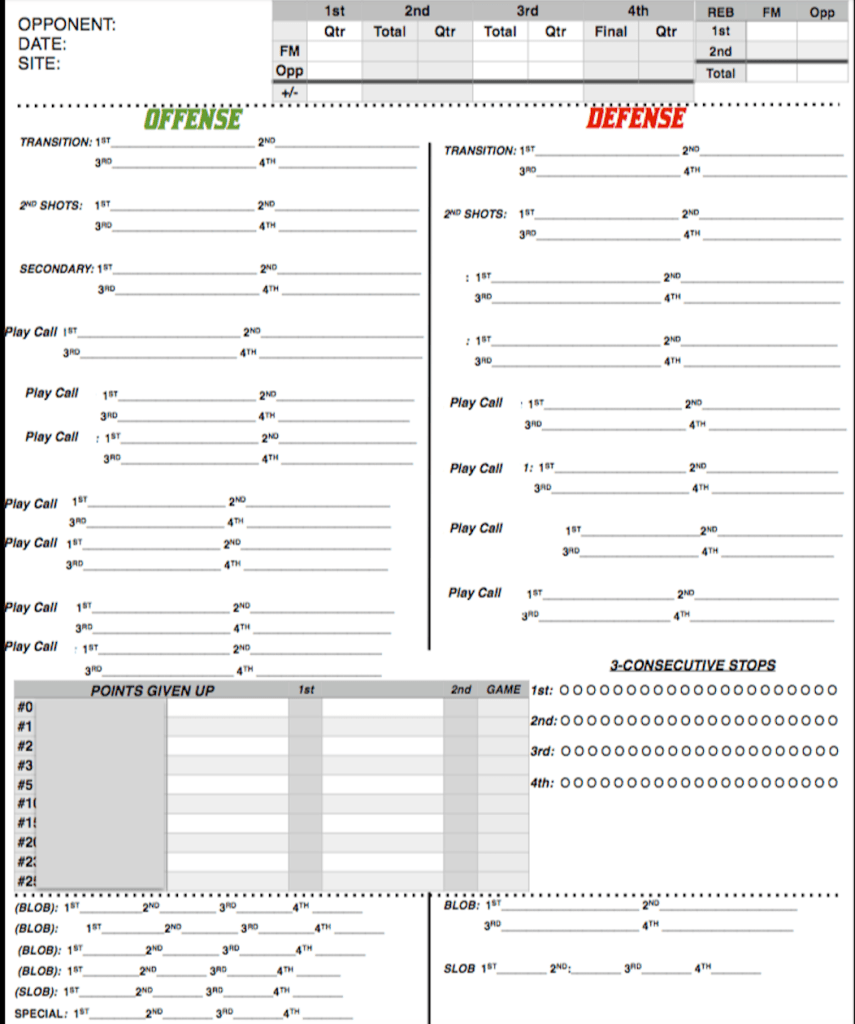
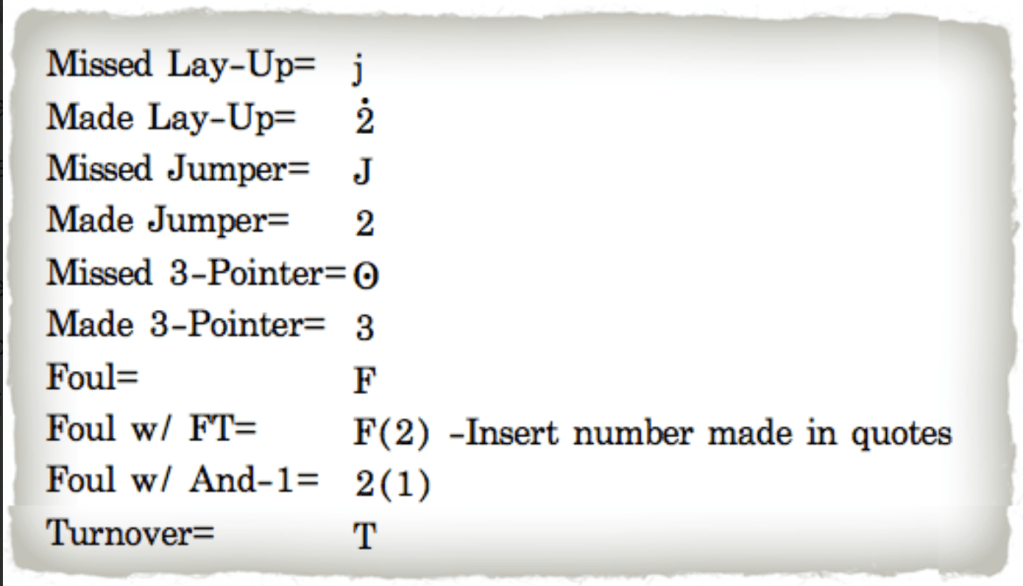
Below is what the sheet looks like after the games.

Here is the KEY of that all of the symbols mean:
Offensive/Defensive Efficiency chart is you can see in real-time what is working and was it not. The ability to know where there points are coming from throughout the game is priceless; at half-time are they hurting us in Transition, 2nd Shots, in the Paint, etc.. What adjustments should we make? As your season starts, take a step back and ask yourself this questions, “Am I doing everything in my ability to be as prepared as I possibly can be during games?”
July 19, 2025
Scouting and Game Preparation at the University Basketball Level
What Coaches Look For, How They Prepare, and What Serious Players Should Know
In university basketball, success isn’t just about skill or athleticism, it’s about being prepared. That means doing your homework long before tip-off. While all the fans in the gym see the scoreboard and the final stat lines, what they don’t see is the hours of scouting, film breakdown, and strategic practice that go into winning games at this level.
For coaches and serious players alike, scouting and game prep are non-negotiable. Here’s a deep, behind the scenes look at how this process works and what it means to be game ready in a high level university basketball program.
1. Film Study: The Foundation of Scouting
Everything begins with video analysis. Most coaching staffs will review two to four full games of their opponent to understand their strengths, weaknesses, and habits. They’re looking for:
- Offensive actions and sets (horns, stagger screens, flex, etc.)
- Defensive structure (man to man, pack line, 2-3 zone, full court press)
- Transition tendencies
- Key players’ tendencies and decision making
- How the opposing coach reacts to different game situations
Once the coaching staff has done their homework, they prepare a film package for the players usually 10 to 15 minutes of curated clips that highlight what to expect. Players are also encouraged to request individual matchup film to better prepare themselves mentally.
2. Scouting Reports: Condensed Intelligence
Each player receives a scouting report, either printed or digital, often the day before or day of the game. These reports typically include:
Team Overview:
- Primary offensive sets and actions
- Defensive schemes and weaknesses
- Tempo (fast paced, grind it out, high turnover rate)
Individual Player Notes:
- Jersey number, height, year, position
- Key tendencies (“#11 is a lefty who loves to go downhill off the ball screen”)
- Stats: FG%, 3P%, FT%, and TO ratio
- Strengths and exploitable weaknesses
Game Plan & Keys to Victory:
- “Keep #5 off the glass”
- “Force #3 to his weak hand”
- “Communicate through all switches”
- “No second-chance points allowed”
These reports are not fluff. They’re the blueprint for how to compete intelligently and avoid being out-coached.
3. Practice Adjustments: Tailoring the Week
Based on the scouting report, practices are modified. The goal is to simulate what the team will face. That includes:
- Installing or revisiting specific defensive coverages (e.g., ICE on side pick-and-rolls)
- Preparing a scout team to run opponent sets
- Emphasizing transition defense or rebounding if those are opponent strengths
- Practicing late-game situations if the opponent has specific end-of-game plays
Each practice becomes part physical and part mental—rehearsal for real-game execution. By the end of the week, players should feel like they’ve already “played” the game several times in their minds.
4. Individual Matchup Prep
Coaches often meet with players individually or in small groups to go over personal matchups. This can include:
- Film clips of the player they’ll guard
- Situational tendencies (“goes right 80% of the time when isolated”)
- Counter moves and what not to fall for
Smart players take this to heart. They look for tells, weaknesses, and patterns. It’s not enough to be ready physically you must be ready intellectually.
5. Game-Day Walkthroughs: Final Reps
On game day, most programs conduct a low-intensity walkthrough, focusing on:
- Review of opponent sets (with defenders walking through assignments)
- Communication reminders: “Talk through screens,” “Early help,” “No ball watching”
- Special situations: ATOs, BLOBs, and SLOBs
This walkthrough locks in responsibilities and reinforces mental sharpness. No new information is given here—it’s all about execution.
6. In-Game Adjustments
Great teams prepare, but they also adapt. During the game, coaches constantly watch for:
- Opponent lineup changes and how they affect matchups
- Adjusting pick-and-roll coverages if they’re being exploited
- Exploiting mismatches (e.g., posting up smaller defenders, forcing slower bigs to hedge out)
Players who recognize in-game patterns and communicate adjustments on the fly are incredibly valuable. These players often become captains or floor leaders.
7. Post-Game Review
After every game, win or lose, there is film review. This involves:
- Going over key possessions (positive and negative)
- Evaluating execution vs. the scout
- Identifying communication breakdowns or defensive lapses
- Holding players accountable to film, not feelings
It’s not about blame—it’s about clarity. How well did we execute the plan? Did we stay disciplined? What needs to improve before the next matchup?
Player Responsibilities in the Scouting Process
If you’re a player who wants to earn minutes, you have to do more than just show up. You have to prepare like a coach.
- Read the scout thoroughly and ask questions
- Watch your matchup on film and learn their game
- Take practices seriously and treat scout reps as game reps
- Understand the game plan and stick to it
- Be vocal and lead others through the plan on game day
Players who do this gain the trust of their coaches. And once a coach trusts you, your role will grow.
Final Word: Scouting is Culture
At the university level, every game is a test of preparation. Teams that are prepared steal possessions. They disrupt rhythm. They force teams out of their comfort zones. This isn’t about being the most athletic or talented it’s about being the smartest and most disciplined team on the floor.
As a coach, I believe in teaching athletes to be thinkers, not just hoopers. Scouting and preparation are what separate competitive programs from average ones. You don’t just play the game you prepare to win it before the ball even goes up.
If you want to be great, study the game. Learn to see what others don’t.
That’s where winning starts.
 fatihakser.ca
