MY FAVOURITE TRANSITION OFFENSE DRILLS (1V0 TO 4V4)


MY FAVOURITE TRANSITION DEFENCE DRILLS (1V1 AND 2V2 SITUATIONS)


MY FAVOURITE 10 DRILLS TO IMPROVE 1V0 AND 1V1 DEFENSIVE FUNDAMENTALS


2013 CANADA SUMMER GAMES U17 TEAM ONTARIO OFFENSIVE PLAYBOOK


DRILLS THAT EVERY YOUTH COACHES HAVE TO KNOW
A-) SPACING (2V0 AND 3V0)

B-) SHOOTING DRILLS

C-) TEACHING 1V1 (DEFENCE AND OFFENCE)

D-) TEACHING 2V2 PICK/ROLL SITUATIONS

E-) TEACHING 3V3 PICK/ROLL SCENARIOS

F-) TEACHING 3V3 TEAM DEFENCE

U17 TEAM ONTARIO SHOOTING CLINIC TEACHING NOTES

U17 TEAM ONTARIO PRE-SEASON PRACTICE PLAN


HOW TO TEACH TRANSITION DEFENCE (TEACHING DRILLS FROM 1V1 TO 4V4)
Transition defense is an incredibly important aspect of defense in basketball, but it is also the most overlooked. Basketball coaches almost take for granted that their players will simply get back on defence and prevent their opposition from scoring. However, this is not always the case and there is a significant amount of strategy and technique that goes into how transition defense should be played.
Transition defense, like any other aspect of basketball needs to be explained to the players and then drilled frequently in order for it to become habit. The following will provide simple keys to playing solid transition defense as well as several drills to use in practice in order to work on your team’s transition defense.
IMPORTANT KEYS
#1 It starts on offence
#2 Defend the basket, not any offensive player
#3 Communicate
DRILLS: Transition Defense
PICK AND ROLL PROGRESSION TEACHING
1 – The most employed offence.
2 – It is a team offence not only 2v2. Everybody have to be involved.
3 – To build 5v4 situation (to force defence to rotate all the time)
4 – To create long close outs
5 – 2 dribbles after the pick
6 – Aggressive attack after using the pick
7 – Screener has to quickly roll to the basket to be effective
8 – 4 man has an important role in this game
QUESTION: How much time we spend to teach and to defend it?
ANSWER: We should practice it everyday on different situations.
DRILLS: PICK AND ROLL PROGRESSION TEACHING CLINIC
DEFENSIVE TEAM CONCEPTS
TABLE OF CONTENT
1. INTRODUCTION
2. TRANSITION DEFENSE
- Release, Shadow and Quarterback and Fullback Shadow concepts
- Containing the Ball (1v1, 2v2, 3v3 and 4v4 drills)
3. FULL COURT PRESSURE DEFENSE
- Forcing the Ball
- Trappers, Interceptors and Goalie
4. HALF COURT DEFENSIVE PRINCIPLES
- On the Ball
- Off the Ball
- Against Penetration
- Post Defense
- Pick/Roll & Pop
- Off the Ball Screens (Down, Stagger, Screen the Screener)
- Defensive Drills to Improve Individual and Team Defense
5. ZONE DEFENSE
1. INTRODUCTION
In order for one team to become a very good defensive team and maintain their defensive efficiency throughout the season, that team’s player have to have a strong defensive fundamental foundation, the will, discipline and dedication.
To develop a team’s defensive attitude, coaches must teach defense from the very first practice. The more frequently the players are reminded of the importance of defense and the more they practice and work at it, the more quickly they will understand how necessary it is to the team’s overall success.
It has been my belief that coaches should build a strong foundation first and then expand and develop what they want to teach afterwards. Especially at the youth basketball level, coaches have to make sure that they teach things from basic to advance level progressively. At a young age focusing on teaching the basic defensive fundamentals such as proper defensive stance, defensive slide, backpedal, pivot and run, positioning on the court during on and off the ball defense, close – out techniques, getting into a proper rebounding position, court vision, anticipation, as well as improving athletic skills such as speed, agility, power and strength are invaluable. When a player advances his/her basic defensive fundamentals, it would be easier for next level coaches to load more complex defensive team and individual strategies.
My coaching defensive philosophy is based on to take something away from my opponents. I want my team negate our opponent’s strengths and to expose their weaknesses. I want my players to play hard, work together and demand of each other as a team all the time. My main focus is always educated and demand from my players to be aggressive and highly competitive players who act instead of reacting to their opponents. I believe that playing aggressive defense on the ball sets the tone and my team’s mind-set right away. My team’s primary goals are to always extend and pressure up the court to force the dribbler to turn and change direction.
If we would be able to disrupt our opponent’s rhythm and not let them get into an easy offensive flow, limit their penetration and forced hurried or bad shots with a hand up in a shooter’s face, I believe we have a chance to win every game.
2. TRANSITION DEFENSE
I like to teach transition defense strategy that is very common with coaches today for defensive transition. My team’s basic transition defense principles are; #1 goes to short safety at the top of the three point line; #2 goes to long safety at the centre circle. #3 / #4 and #5 form the defensive triangle.

I also teach my players to be at specific positions which are Quarterback (1/2), Halfback (3/5) and Fullback (4) in order to begin our transition defense and start playing our full court defense.
Depending on the team that we are playing, I would assign players different positions. If my team playing against a team that would not like to run and usually use a specific player to bring the ball up to the floor, I would have my players play quarterback and halfback positions.
If the opponent team likes to play up tempo transition game, then I may change my tactics and play halfback and fullback. These type of changes can be easily done during the game. Being able to switch my strategy would allow me to indicate to the players when they need to be turned and facing the ball. If I want my team to run a press, I may indicate to the front line players to pick up the ball at the quarterback zone, second line would be turned at halfback and the last line turn their body at the full back zone.

RELEASE
‘Release’ concept is an important part of our defensive strategy.
Diagram shows that our ‘#4 man’ sprinting back to protect the basket which would allow our ‘#2 man’ to move out to deny the pass up the floor. We would like to accomplish this rotation immediately because most of the early three – point shots out of transition offense comes from the release concept would not occurring properly .
It also means that a score at the rim if ‘#2 man’ moves out too soon and leaves the basket open.

SHADOW
Against teams that have one dominant player who brings the ball up the floor, I would like to use my trial defender as a shadow. Diagram is an example that, the shadow sprints to the halfback position and then looks to help on the guard bringing the ball up the floor. I find this strategy often very effective because the offensive player who is being guarded by the shadow usually is not allowed to dribble or not good at handling the ball full court.

QUARTERBACK SHADOW
Under this rule,I want my player who is assigned as a shadow role to turn and starts looking to help the ball handler’s defender by the foul line. I want shadow player to make this move when his/her player is trailing behind the ball. I believe that this is an effective strategy when a team uses a non-ball-handler as an inbounder.

FULLBACK SHADOW
Under this rule, I would like my shadow player to sprint to the fullback position to assist in stopping the ball going inside to a dominant post player or to clog the lane to prevent penetration.

BREAK –OUT DRIBBLES
One of the biggest weaknesses of this type of transition defense strategy is to use of the break out dribble by the rebounder. I started to see more and more coaches encourages their players to dribble the ball to the offensive end as the main ball handler. In order to prevent this, I would want my players to jam the dribbler with one of the closest player.

Below are the drills that I use to teach my players to play effective transition defense. I would like to use all players in all different positions to make sure everybody is on the same page.
CONTAINING THE BALL
Most important concept in my transition defense is to contain the ball. Most of the time I hear coaches shout at their players during the game as “stop the ball”. This is a very hard thing to do in the open court. I believe it is more important that our first line defender can make the ball move to a certain area of the floor, usually the sideline, and keep it there. Instant ball pressure also prevents the player from making an easy pass up the floor, especially the long cross – court pass that forces the most rotation by the defense.
Drill # 1
In this drill, players form four lines near the old hash marks. The player with the ball dribbles hard to a specific spot (the coach can decide where this can be or make it random. It is easier for the defense the closer the ball is to the sideline) and sets the ball down.
This player is now the short safety who must funnel the ball to the sideline. The player on the other side picks up the ball and now becomes the offensive player. They play 1 v 1 to the far basket. To make it more competitive I would like to give points for making the ball cross half at the sideline.

Drill # 2
In this drill, I like to start the drill in a dynamic way. The defensive team dribbles up and sets the ball down. The offensive team breaks as the ball is being dribbled. To improve the reaction and anticipation skills, I like one of my coaches to blow a whistle to indicate when the ball has to be set down.

FULL – COURT 1 V 1 TRANSITION DEFENSE
In these drills, I want my players to be able to play aggressive 1 v 1 full court defense without relying on any help and would like them to be executing our transition defense principles.
Drill # 3
In this drill, we would like to work on ‘short safety’ rule. Drill starts with defensive player handing out the ball to the offensive player and they play 1 v 1 full court. Main idea is to make sure defensive player keeps the ball – handler on the side of the court all the time during the drill.

As a continuation of previous diagram, drill continuous with ‘4/3 man’ inbounding the ball to the new offensive player at the free throw line extended. The player who just make/miss/turnover the ball turns into a defensive player.

2 v 2 CONTINUOUS TRANSITION DEFENSE
In this drill I would like to focus on 2 v 2 scenarios and would like to run the same drill that we run at drill # 3.
Drill # 4
When the defense gets the ball, it is passed to the next two offensive players. The two player who were on offense must quickly become the long and short safety. The players who were on defense fill in as the next subs.


3 V 3 CONTINOUS TRANSITION DEFENSE
Drill # 5
In this drill we would like to add the 3rd offensive and defensive player into the game. Once we start playing 3 v 3 full court game, that’s the time I would want my team to focus on executing ‘shadow’ transition defense principles.
As to keep things simple and understandable, I would like to keep building on the same drill that we have had so far. In this drill the third player is standing out of bounds ready to inbound the ball. This allows the team to practice the shadow technique. The player guarding the inbounder can stop and help since the inbounder is trailing.

RELEASE INTRODUCTION
Drill # 6
Adding the third offensive player up to the floor, it forces the defense to practice the release technique as this offensive players run to the rim. This player must run through the centre circle to simulate as a first big. The long safety cannot give up the basket until the other player comes back to release.


3. FULL COURT PRESSURE DEFENSE
I want my players and team to play aggressive full court defense all the time. In order to develop this habit, I always focus on teaching basic concepts of my full court pressure defense. I like to use baseball terms which would help my players to understand the different ways to defend the ball when it is being inbounded. It is great to use when playing
3 v 3 in the full court. By using these concepts it helps my players become better at attacking and applying pressure. They learn the strengths and weaknesses of each method. When we get into time and score situations players are able to simulate different late game situations easily. These concepts are the foundation of building all man to man and zone presses. These various presses can all start one of these concepts.
CATCHER
The defender who is guarding the inbounder is ‘the catcher’. I want my players to make sure they put pressure on the inbounder, and make sure pressure is also slightly angled to encourage the pass to the corner. The other defenders deny any cuts to the middle and do not let their check get an easy long pass. I want my players to allow the pass into the corner below the foul line extended.

If the catcher can get to the first pass in one or two slides, I want my players to look for a trap. The other defender prevents the ball handler from going up the slide line. I want us to allow the pass backwards to the inbounder. The idea of ‘Catcher’ works very well against teams that have one dominant ball handler. It is also effective when teams put a non-ball handler as the inbounder.

On the return pass we want the player guarding the ball handler to cut, prevent the quick dribble up the middle. It is important not to allow the player who was doubled to get the ball back. This is the player they want to dribble. We would like to force the inbounder to bring the ball to the offensive end and make the decision.

SHORTSTOP
In shortstop, the defender of the inbounder face guards the best ball handler of the opponent. The other defenders prevent the ball going long or to the middle.

I want my players to force someone else to have to catch the ball and bring it up to the offensive end.

RIGHT/LEFT FIELD
In the right field, the defender of the inbounder plays behind the best ball handler. The other players prevent the cut long or to the middle.

We allow this player to cut to the corner to catch the ball. If the ball handler tries to dribble quickly up to the floor, the defender is there to slow him/her down. This is a good way to slow down the opponent who wants to go quickly after inbounding. As long as the inbounder stays behind the ball the defender can shadow the ball and slow down its progress.

CENTERFIELD
In this situation the defender of the inbounder plays behind the players who are the primary receivers. The other players guard the belly button and deny the cuts to the ball.

If the inbounder tries to make a long pass, the centerfield is there to intercept. This works best when trying to get a five second count or we know that other team cannot make that long pass.

CONCEPTS OF PRESSURE DEFENSE
FORCING THE BALL
In most pressure situations, I want my players to force the ball to a specific position on the floor. Most presses want the ball handler to dribble towards the sideline. Some presses may force the player to dribble with a weak hand.

TRAPPERS, INTERCEPTORS AND GOALIE
When we decide to make trap, I want my players to have these roles;
- Trappers; they are putting pressure and trap the ball. They do not reach and foul. The turnovers usually come from the deflection of the pass. (X1 and X2)
- Interceptors; they positioned themselves in the passing lanes of the potential pass receivers. They usually are defending one and a half players. (X4 and X3)
- Goalie; this players job is to protect the basket. (X5)

STRONG SIDE TRAPS
A good time to set a strong side trap is when the dribbler is; dribbling out of control, just crosses half – court, or the trapper can get in position in two steps.

BLIND SIDE TRAPS
Against a weak ball handler, I want my team to run blind side traps. The player guarding the dribbler forces to the sideline and then tries to cut him/her off. The next closest player in the middle runs and traps. The trapper must anticipate the spin dribble or a back pivot.

SHOOT THE GAP
When a trap is called, the next player on the help side looks to rotate up and shoot the gap between the next offensive players. Read the eyes of the player in the trap. Player’s on the ball side must fake at the ball handler, trying to slow him/her down. It is rare to blind side trap in half court man defense. In some presses coaches may want to allow the pass back.
This type of press is trying to slow the offense down and waste precious time of the shot clock. It is also effective when the player trailing is not a good ball handler.

BALL IN THE MIDDLE
When the ball gets into the middle, it is important to not allow the dribbler to split two defensive players. The defensive players are allowed to jump switch to slow down the ball or fake and recover. I want my players to encourage the opponent to make a pass back out to the wing.

FAKE RECOVER
If any situation one of my player gets caught as the last defender protecting the basket, I want that player, ’the goalie’ to fake at the ball handler and then recover to the offensive player closest to the basket right away. It is hoped that this will slow down the offensive player or create a bad pass. I always encourage my players to use fake and recover or stunt move to use at the strong side defend as well to fake a strong side trap. I believe that this move puts confusion and hesitation into dribblers mind.

SPRINT OUT OF TRAPS
If the ball is passed out of a trap, I want my all players to sprint to a position where they locate themselves in front of the ball.

4. HALF – COURT DEFENSE
It is very important for every one of my players to understand our team defensive rules and concepts. Below are the defensive principles that I teach to my players from the very first day of our season.
ON THE BALL DEFENSE
When my players play on the ball defense, I want them to find their balance, feel themselves react, I want them to put one of their hand on the ball and play with the other in the possible pass location. I want them to make sure they avoid crossing over the hands or their feet. I want them to move their feet and always keep their chest in front of the ball.

BALL IS AT THE TOP
When ball is in between the two elbow line, I do not want my players to allow any kind of a middle penetration but I want them to force ball handlers to go outside of the middle court, towards both sidelines all the time.

OFF THE BALL DEFENSE
ONE PASS AWAY
When we play one pass away from the ball handler, I want my players to play up and on the passing lane. I want my player’s leading foot, hand and shoulder on the passing lane.

If there is a penetration to the hoop, I want my player put his inside foot on the driving lane and make a stunt and recover move.

BACK – DOOR CUT
On the first step to the basket by the offensive player, the defender has to slide back. On the second step, he/she has to turn his/her head and immediately see the ball. If the offensive player comes back on the three – point line, the defender has to again turn his head toward the man. I would not want my players to cross their legs during this action.

WEAK – SIDE POSITIONING
When the ball is on the other side of the court, I believe that we have to keep our aggressive defensive mentality as well.
Our rules for the weak – side positioning is; if the ball is above the free throw line extended, 1 foot inside the paint, if the ball is below the free throw line extended, 2 feet inside the paint, if the ball is below the free throw line extended, and we have the 3rd players at weak-side corner, I want that player to position himself underneath the basket.

AGAINST PENETRATION
On every penetration by the guards from the perimeter, I want my team to stunt and recover with the closest defender (extending one arm to try to touch the ball) and help with the big man from the weak-side.
My main philosophy is, not to allow a pass to the player in vision of the ball handler. The big man has to help only once the penetrator is in the paint and read if he/she wants to pass or shoot the ball. I want my big man to watch that player’s eyes so decision making would be easier.
The wing player on the side of the penetration stunts and recovers. The post does not leave the key to help. He/she protects the front of the rim – forcing the offensive player to pull up or take the charge. If the pass is made, the player can deflect the ball or still recover.

If we help off the ball side, there is no one who can help the helper. It usually leads to an easy three point shot or most likely we will be ending up chasing and scrambling off the penetration. This is what I do not want to happen. Helping up and out of the key allows ball handler to make an easy pass to his/her teammates

LOW POST DEFENSE
My main philosophy on the low post defense is not to allow the ball to get to the low post area. I want my post players to front – guard their player, if offensive player is close to the paint. I want my post players to guard ¾ defense, if offensive post player is close to the baseline.
I want my big man to stay behind if the offensive player catches the ball one step outside the paint which is what I want in order to help with the perimeter players as soon as the offensive post player starts the dribble to attack to the basket.
WHEN THE BALL IS IN THE POST AREA
If the offensive player catches the ball at the post area, I want my players to position themselves in a way that offensive post player would hesitate taking dribble and/or attacking to the hoop and kicks out the ball.
I want my players to position themselves as, X2 turns his/her back to the sideline and sees the ball and his/her check at the same time and ready to make his/her stunt and recover move when the offensive big man starts taking his/her dribble.
X4, X3 and X1 are also positions themselves at the weak – side help position (inside the key) and ready for big man to make his/her move.

WHEN THE BALL IS INSIDE THE MIDDLE – PAINT
If the ball ends up in the hand of the offensive big man right in the middle of the paint, I want my players to react this situation immediately and dig in to the ball to make sure we force the offensive post player to move the ball outside the paint.

PLAYING AWAY FROM THE BALL ON DEFENSE
Too often, the young big players do not position him/herself properly on the defensive end. They need to play with their strengths which is their size. They need to show their perimeter defenders that they can help them.
The help defender does not want to line up in the back of teammate. When this occurs, the offensive player often sees a clear path to the goal.

When the perimeter player is forcing the ball baseline, the post defender aligns in the driveline for the offensive wing player. This discourages the drive, but also means it is easier to rotate to help as the player moves up the line.

If the perimeter player is forcing middle, the post defender appears in the driveline of the offensive player.

BALL SCREEN DEFENSE (PICK AND ROLL/POP)
Pick and roll/pop game is the most overplayed game in the modern basketball. Almost every age category, coaches teach their players how to play pick and roll game. I personally do not recommend to play pick and roll game at the U16 level and lower age categories but, unfortunately, in my country most of the coaches’ play pick and roll/pop age U16 level so I have to teach very basic concept of defending these ball screen actions.
Throughout my coaching experiences, I found that at the younger ages most of the teams use switch defense against ball screens which especially at the U16 level players do not have the skills and concepts to take advantage of the mismatches.
I also like to ask several questions and find some specific answers for my questions in order to prepare myself and my team to play against a team who runs pick and roll/pop offense. Which are;
1. Where is the ball screen being set? (Side, Middle or High, Angle)
2. Who is involved? (Who is in it? Is ball handler able to shoot or a non – shooter? Is screener a popper or roller? Is screener able to shoot or a non – shooter?
3. What is the opponent alignment? (Where is opponents ‘4 – man’ located? Where are the opponents shooters located?)
When working with younger athletes especially at the U16/U18 level, I like to teach my team to play with aggressive hard hedges. I do not want to allow the screener to see the ball and basket while rolling to the paint. On the hard hedge, the big keeps one hand down on the ball to avoid a “split” and arms high while recovering. Guards always force the ball handler to use the screen and try to anticipate the pick while fighting over the top. In the meantime, I want my off the ball defenders to shrink to the key area, bump the roller to make sure ball would not go the rollers hand easily.
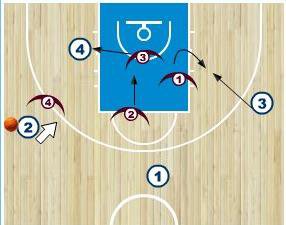
X1 makes the ball handler use the pick and X5 hedges out hard to force the ball handler back towards the sideline. He/she hedges hard with the hand low. This put pressure on the ball and makes the ball handler retreat. When recovering, the defender recovers with his/her hand high. This may cause a deflection on the pass. X2 bumps the roller and recovers back to his/her check. X3 positions him/herself underneath the basket and controls the roller with X4.

The defender of the ball handler (X1) goes over the screen but under his/her teammate. Done properly the vision of the roller is restricted. He/she cannot see the ball and the basket at the same time. This makes it easier for help defense to help if necessary.

If a team is running a pick and pop, it is often difficult to help. Teams often makes long rotations that would put defense into an emergency rotation situation. In a pick and pop scenarios like this, I would prefer not to help from inside the key to outside. I would want my player who hedged hard (X4) to recover in the passing lane, forcing the offensive player to go backdoor. In the meantime X5 is providing weak-side help in the middle of the key. This allows the help to stay in the key and not to rotate.

If the opponent team wants go to the baseline or we don’t want opponent teams ball handlers to use the screen, I want my players to trap the screen. The players who are one pass away deny. X5 is ready to control the roller, X3 goes down to control 5 and X2 goes down to control the long pass to 2 and 3. It is very important that X1 and X4 have to be active with their hands to make sure they do not allow the roller to see the ball and basket at the same time.

DOWN SCREEN
I like to teach very basic style of guarding down screen actions all the time. I want my players to understand who is setting the screen and who is using the screen first and make their decisions according to where the ball is located on the court.
IF THE CUTTER IS CUTTING TO THE BALL – SIDE
If the ball is on the cutter side, we like to chase the player who uses the screen. The defender of the screener has to stay in the passing lane to avoid any easy pass option to the offensive post player, he/she has to keep his/her feet higher than the feet of the screener in order to be ready to help in case of a curl action and also to avoid an easy basket cut.
The guard has to follow the offensive player and read the screen. On the catch, the player who guards the passer must jump to the ball. This discourages the quick middle penetration by the wing player. This defender must immediately return to passing lane defense.

IF THE CUTTER IS CUTTING TO THE WEAK – SIDE
If the ball is on the weak – side of the court, we want our X3 to cut through in between X5 and 5. Screener’s defense (X5) has to follow the same defensive principles to make sure his/her arm is on the passing lane to deny easy passing access to 5, not allowing 5 to seal him/her and also not allowing 3 to curl to the middle.
Passers defense (X1) has to jump to the ball after the pass is made to make sure there would be no easy middle penetration.

STAGGER
As on the down screen, I would like to keep the top defender of the screener (X4) on the passing lane using the same rules.
IF THE CUTTER IS CUTTING TO THE BALL – SIDE
The guard defender has to chase him/her all the way. X4 has to extend his arm and feet to deny easy pass and curl action by 3. X5 opens him/herself up to see the action and controls any slip action to the middle. The defender of the passer has to jump to the ball after the pass is made.

IF THE CUTTER IS CUTTING TO THE WEAK – SIDE
The guard defender has to chase over the first screen and cut through the last screen. X4 has to extend his arm and feet to deny an easy pass or curl action by 3. X5 opens him/herself up to see the action and controls any slip action to the middle. The defender of the passer has to jump to the ball after the pass is made.

SCREEN THE SCREENER
I want my team to force the post player to go over the top of the first screen. This would allow a shorter path for the player helping on the screen to recover.
We still would like to chase out the second screen since it is a down screen action. The player guarding the passer must jump to help on the quick attack.

DEFENSIVE DRILLS TO IMPROVE INDIVIDUAL & TEAM DEFENSE
Drill #1 One of the two coaches drops the ball to the floor (alternating). Player has to slide and pass back to the ball coach before the ball bounces twice.

Drill #2 Player passes the ball to the coach and closes out under control. Coach after a shot fake, he will fake to drive one to the right and one time to the left. The player has to retreat and recover. After that the coach will throw the ball on the glass and the player has to box – out and get the rebound.

Drill #3 The player under the basket passes the ball to the player who is at the top of the ley and closes out right away. 1 passes to 2 and X1 positions himself at the passing lane. In the meantime X2 closes out to 2.

Drill #4 Coach inbounds the ball. Offensive player makes himself open and receives the pass. Defensive players goal is to contain the ball for 5 seconds and keep the offensive player away from the mid – court.

Drill #5 The offensive player has 5 seconds to pass through the cones. The defender has to contain the ball and keep him outside the cones.

Drill #6 1 passes the ball to the coach and tries to get himself open in less than three seconds. X1 denies hard for 3 seconds, and the coach passes the ball to the other coach. In the meantime 1 and X1 makes their cut all the way to the other side of the court. If 1 gets the ball anytime during the drill it is a 1 v 1 situation.

Drill #7 “Weak-side Cut Defense”, X1 passes the ball to the coach, 2 and 3 cuts to the free throw line extended at the same time, coach passes the ball to 2 and 3 makes a weak-side cut right away. In the meantime, X2’s role is to bump the cutter, play aggressive and deny the pass all the way above to the three point line or away from the post area. After 3 catches the ball, they play 1 v 1 at the top of the key or at the post area.

Drill #8 “2 v 2 Cut Defense”, 2 passes to the coach and makes a basket cut. 3 gets himself open to receive the pass and after he catches the pass, he immediately makes a pass to the other side of the coach. Defensively, we like to work on denying hard for every passes and provide weak – side help for any penetration to the basket.

Drill #9 We play 3 v 3 and in this drill, we would want to work on defending weak-side cuts, back – door cuts and penetration help and recover situations.

Drill #10 In this 3 v 3 drill, we also like to work on defending back screen, down screen situations as well.

ZONE DEFENSE
When it comes to teaching zone defense I like to use 4 v 4 setting at the half – court. This setting allows me to go into details about what we would like to accomplish as a team when we play zone. After my team is comfortable executing our main defensive concepts we play 5 on 5 to see how we would be able to transform our knowledge into a game like situation. Overall, I want my players to understand several zone defensive movements and concepts. Below are the conceptual approach to teaching zone defense. The defense can either be in a diamond shape or a box.
CONCEPT # 1 FIND THE BALL
Someone must designate the ball. This then allows the other players to establish their rules. This doesn’t mean that the defender must run out of position to guard the ball. It just helps everyone else know what their responsibilities will be on the next pass.

CONCEPT # 2 MOVE WITH THE BALL
As a pass is made, the defense moves while the ball is in the air calling ‘ball’. The other players match accordingly. This is the same as man to man defense.

CONCEPT # 3 GUARDING THE CUTTERS
Most of the time, offenses will use cutters to disrupt our zone defense. Our defense must front the cutter to a certain point and then pass the cutter on to the next defender. X4 fronts 4 and then passes him/her on to X2. X2 must recover to prevent 2 from backing cutting into the space vacated by 4.

GUARDING DRIBBLERS
This is similar to passing on cutters. If the defender stays too long the zone is vulnerable to dribble pulls. X2 must pass onto X1 and recover back to 4 filling the vacated space.

CONCEPT # 5 BUMP OFFENSIVE PLAYERS
Against teams that employ baseline runner or overloads, we must work on the bump moves where one player shows and then is bumped back by the other defender. X4 shows to 3 and then is bumped back by X1 so that he/she can cover 4, the runner.

CONCEPT # 6 POSITIONING VS. SCREENS
I want my players to make sure that they would not get sealed or screened by the screener. I want my players to sit on top of the screen so that they can go in either direction. X3 sits on top of the screen by 4 so he/she can cover out to 2 on the pass.

CONCEPT # 7 BOX – OUT
The biggest weakness of a zone is defensive board coverage. All players must become involved, especially the guards at the top. If a team sends a player back to a safety, the guard must get involved in the rebounding.
