
December 8, 2025
Breakdown of Houston’s Elite Defense
The Houston Cougars have established themselves as the premier defensive team in college basketball, currently ranked #1 in the nation in scoring defense. Their identity is built on toughness, discipline, communication, and sustained pressure qualities that consistently frustrate opponents and fuel their Top-25 success this season.
This video breaks down why Houston is so difficult to score against and how their defensive system functions at an elite level. Using game film and clear teaching points, we examine four pillars of the Cougars’ scheme:
01:10 – On-Ball Defense
Houston refuses to allow comfortable dribbles. Their stance, hand activity, containment angles, and physicality force ball handlers into predictable lanes. We unpack the footwork, timing, and discipline that make their point-of-attack defense the foundation of their entire system.
04:07 – Ballscreen Coverage
Whether icing, hedging, switching, or flattening ball screens, the Cougars execute with precision. You’ll see how they disrupt the handler, take away the roller, and rotate behind the action turning a normally high efficiency action into a defensive advantage.
07:35 – Off-Ball Screens
Houston’s commitment off the ball is just as impressive. Their ability to fight through screens, stay connected, and deny easy catches eliminates rhythm and forces opponents deep into the shot clock. We highlight their communication patterns and how they maintain discipline in complex actions.
08:37 – How to Score Against It
Every great defense has pressure points. We finish by breaking down the strategies teams have used successfully against Houston, including pace manipulation, screening angles, spacing tweaks, and forcing matchups that disrupt their help principles.
November 13, 2025
Inside Covenant College’s 4-1 Umbrella Zone with Coach Josh Brown
If you’ve ever wanted a closer look at how a Division III team defends with purpose, this film session from Covenant College Scots head coach Josh Brown is a must-watch. Coach Brown takes us step by step through his 4-1 umbrella zone defense, breaking down how his players read the floor, rotate, and make decisions in real time.
The session starts with the team’s transition into half-court defense, showing how quickly they shift from offense to a structured zone to prevent easy drives and force opponents into less comfortable spots. From there, Coach Brown walks through defending a 1-3-1 alignment, highlighting the importance of spacing, communication, and anticipation when facing different offensive setups.
One of the highlights is how the team handles ball screens within the zone. Brown demonstrates strategies for hedging, switching, and guiding the ball-handler into help defenders without leaving shooters wide open, a skill every coach knows is critical in live games. He also dives into closeouts, showing the balance between speed and control, and how to challenge shots while maintaining proper stance and positioning.
Mid-range penetration is often the toughest part of any zone, and Brown doesn’t shy away from showing how the defense reacts when the ball goes to the middle. His players rotate, protect the paint, and contest drives while keeping the zone intact. Throughout the session, he emphasizes using analytics studying shot charts, opponent tendencies, and statistical trends to make smarter defensive decisions.
What stands out most is his philosophy that it’s okay to embrace some “messiness.” Not every possession will go perfectly, but staying disciplined in the scheme and trusting the rotations allows the team to recover and stay competitive. Finally, Brown shares the teaching cues and points he uses with players, from verbal reminders to visual triggers, helping everyone understand their role and make quick decisions on the floor.
This film session isn’t just about Xs and Os. It’s a look at the thought process behind a well-executed zone, the adjustments made in real time, and the coaching strategies that turn a scheme into something players can confidently run. Whether you’re a coach, player, or basketball fan, it’s a clear demonstration of how the 4-1 umbrella can disrupt offenses while creating high-percentage opportunities for your team.
October 26, 2025
Force Middle or Force Sideline: Which Defensive Strategy is Best?
When it comes to basketball defense, positioning can make all the difference. One common question coaches face is whether to force the ball to the middle or force it toward the sideline. The answer isn’t one size fits all it depends on your team’s size, athleticism, and strategy.
- Shorter Teams: Forcing the ball to the middle can prevent bigger opponents from using the baseline to bully their way to the rim. It allows your defenders to stay between the ball and the basket, neutralizing size mismatches.
- Taller, Athletic Teams: Forcing the ball to the sideline and baseline can turn the court boundaries into “extra defenders.” This strategy uses your team’s size and quickness to trap opponents and limit their options near the basket.
This video breaks down both approaches, giving coaches and players a clear look at when and how each strategy can be most effective. Understanding these defensive principles can help your team make smarter decisions, reduce easy baskets, and gain a competitive edge.
September 28, 2025
Packline Defense: Principles, Effectiveness, and Coaching Insights
When we talk about elite defensive systems, the Packline Defense consistently comes up. Originally popularized by Dick Bennett and later perfected by coaches like Tony Bennett at the University of Virginia, the Packline has become a staple for programs that value discipline, collective responsibility, and controlling dribble penetration.
At its core, the Packline is a man-to-man defense with a twist: instead of pressuring every pass on the perimeter, defenders are taught to sag one step inside the “pack line” (an imaginary arc about 16–17 feet from the basket). This positioning makes it extremely difficult for the offense to get into the paint off the dribble, forcing contested jumpers rather than high-percentage shots at the rim.
Why the Packline Works
- Protects the paint first: In modern basketball, rim protection is everything. Teams that hold opponents below 50% on two-pointers win over 70% of the time in FIBA and NCAA competitions. The Packline is built to achieve that.
- Forces tough shots: By clogging the middle, opponents are pushed into lower-efficiency looks — pull-up mid-range shots and contested threes late in the shot clock.
- Disciplined help principles: Every defender has one foot in the “gap,” ready to stunt, help, and recover. This minimizes breakdowns from isolation plays or drives.
- Limits fouling: Since rotations are anticipated and positioning is compact, teams using Packline often commit fewer fouls. For example, Virginia has consistently ranked in the top 10 in the NCAA in lowest opponent free throw rate.
Data Behind the System
- Virginia men’s basketball under Tony Bennett has finished top-10 in defensive efficiency 9 times in 11 seasons (per KenPom), including their 2019 NCAA championship run.
- Opponents frequently average under 0.9 points per possession against Packline teams, a mark that correlates strongly with winning at any level.
- The system excels at forcing teams into jump shots: in recent FIBA U19 and NCAA tournaments, Packline-based defenses have held opponents to under 45% shooting inside the arc, compared to tournament averages around 50–52%.
The Coaching Application
Peter Lonergan, Basketball Australia’s Head of High Performance Coach Development, has shared excellent insights into implementing Packline concepts. In his clinic, he demonstrates how to teach spacing, help-side positioning, and communication. What’s valuable is not only the tactical framework but also how to build accountability teaching athletes to value being in the right spot at the right time.
For coaches, Packline isn’t just a scheme, it’s a philosophy of team defense:
- Contain the ball.
- Shrink the floor.
- Contest every shot.
- Rebound as a unit.
The Packline is not about gambling or highlight reel steals. It’s about discipline, trust, and percentages. When executed correctly, it tilts the math of the game in your favor by reducing high-percentage shots and controlling tempo.
Below is Peter Lonergan’s clinic, an excellent resource for coaches looking to deepen their understanding and apply these principles in practice.
August 24, 2025
Team Transition Defense
Transition defense is one of the most critical aspects of the modern game. In today’s fast paced basketball, a single missed assignment or slow reaction can lead to an easy basket on the other end. That’s why coaches like Ron Adams, assistant coach of the Golden State Warriors, put such strong emphasis on the basics of transition defense.
In this video, Coach Adams breaks down the core principles of transition defense:
- Sprint back first: Beat the offense down the floor.
- Protect the paint: Stop the ball and guard the rim before worrying about the perimeter.
- Communicate early: Talk, point, and match up to prevent confusion.
- Build habits through drills: Repetition in practice creates confidence in games.
He also shares some of the cutting drills the Warriors use to sharpen defensive reactions and teach players how to recover quickly while staying connected as a unit.
What stands out is Adams’ focus on discipline and teamwork. Transition defense isn’t about one player saving the day it’s about five players buying into the system and making unselfish decisions to protect the basket.
For any coach or player, this video is a reminder that great defense starts before the offense sets up. If you can master transition defense, you can take away easy points, frustrate opponents, and give your team the edge in crucial moments.
Watch below to learn from one of the NBA’s most respected defensive minds.
August 20, 2025
Understanding Modern NBA Team Defense
In today’s NBA, offenses are faster, smarter, and more skilled than ever before. To keep up, teams have had to adapt with modern defensive concepts designed to slow down high-powered scoring attacks.
This video breaks down how NBA defenses rotate, communicate, and adjust to counter the pace and creativity of today’s game. From switching ball screens to help-and-recover rotations, you’ll see how the best defenses work together as one unit, not just as individual defenders.
For coaches and players, it’s a great reminder that defense is more than effort—it’s about trust, communication, and discipline.
August 10, 2025
Breaking Down Panathinaikos’ Elite Defense Under Ergin Ataman
Defense wins championships, it’s a phrase often repeated, but in the case of Ergin Ataman’s Panathinaikos squad, it’s a philosophy brought to life on the court. Last season, the Greek powerhouse stood among the EuroLeague’s top defensive teams, thanks to a combination of well-drilled strategies, disciplined effort, and the relentless commitment of their roster.
One of the hallmarks of their system was hedge out coverage a pressure heavy tactic that forces ball handlers to retreat, disrupts offensive flow, and invites turnovers. What made this work wasn’t just the scheme, but the execution. Players like Jerian Grant, Mathias Lessort, and Juancho Hernangomez turned defensive principles into an art form, combining active hands, sharp anticipation, and relentless hustle.
The details mattered tagger positioning, high hands to contest passing lanes, and constant communication were the foundation. Role players like Marius Grigonis brought an underappreciated presence, while high energy contributors such as Kostas Antetokounmpo and Giorgos Kalaitzakis provided bursts of defensive intensity when it mattered most.
Panathinaikos’ defense was more than a tactic it was a mindset. Every possession was an opportunity to impose their will, disrupt rhythm, and make opponents uncomfortable. Watching them work together was a masterclass in how individual effort merges into a collective wall of resistance.
If you’re a coach, player, or student of the game, this breakdown is a valuable look into how elite defense is built not just with talent, but with buy in, discipline, and trust in the system.
August 6, 2025
Building a Solid Weakside Defense – Step by Step Breakdown
One of the most underrated aspects of great team defense is weakside help and rotation. In this video, Coach Massimo Riga provides a masterclass in defensive collaboration, breaking down how to build effective man to man defense from the ground up starting from 1v1 principles and advancing all the way to 4v4 rotations.
Originally shared by Basket Coach Net, this training segment captures the essence of European defensive discipline: staying connected, trusting your teammates, and reacting in sync when defending dribble penetration and kick-out scenarios.
What You’ll Learn:
- How to progressively build help side awareness
- The importance of early communication and body positioning
- When and how to rotate after a drive and kick
- Why timing and spacing matter even on defense
This is a perfect video for coaches looking to drill defensive habits into their teams habits that win games, especially in high pressure moments when a single breakdown can decide everything.
Watch how this simple drill evolves from 1v1 to 4v4, and consider implementing it into your next practice session.
August 4, 2025
Understanding the Language of Defense: A Visual Guide to Defensive Terminology
One of the most underrated aspects of coaching and playing great defense is shared language. Without a common understanding of terms, even the most well designed schemes can break down due to simple miscommunication.
In this excellent video from The Film Room YouTube channel, you’re invited into a comprehensive breakdown of defensive terminology a kind of basketball dictionary for the modern game. From fundamental concepts like “being in the gap” to more advanced strategies like “X-ing out off ball screens” and naming ball screen coverages, this video walks through it all with clarity and game film.
What makes this video especially valuable is the humility and openness of the creator. He shares the terms he’s learned through his own coaching and playing journey, while also acknowledging that terminology can vary from coach to coach, region to region. That honesty reinforces the idea that learning is a continual, communal process.
Whether you’re a high level coach refining your system or a young athlete trying to grasp the building blocks of team defense, this video is a must watch. Clear language leads to clear execution and this kind of shared understanding is what turns effort into real defensive success.
Watch the full video breakdown below.
JULY 25, 2025
Transition Defense Build – Up
In this section, I’m sharing the full library of transition defense drills and progressions I use with my teams. My approach combines full court and half court concepts, emphasizing not only defensive principles but also conditioning, communication, and mental toughness.
Each drill is designed to simulate real game speed and decision making, helping players build habits that carry over into 5v5 situations. Whether it’s sprint recovery, load the ball, or match up accountability, these drills demand urgency, clarity, and consistent effort.
JULY 16, 2025
Defensive Identity: 3v3 Closeouts, Scramble Reads & Help-Side Rotations
Defense isn’t just about effort it’s about discipline, timing, and accountability. In this video, I break down how to build your team’s defensive identity through 3v3 closeout based drills that demand communication, anticipation, and rotational precision.
We start with straight closeouts (long and short) to lock in footwork, shot containment, and urgency. From there, we elevate the challenge with 3v3 scramble closeouts, forcing players to rotate out of disadvantage and protect each other. These live reps simulate the chaos of real defensive possessions.
What This Defensive Package Covers:
- 3v3 Straight Closeouts
- Long & short recovery reads
- Teach pace, control, and early contest positioning
- 3v3 Scramble Closeouts
- Full-speed breakdowns into help and rotate situations
- Build trust and reaction habits under pressure
- Help-Side Awareness & X-Rotations
- Interior coverage when help is drawn
- Backside protection and baseline accountability
These drills combine structure and scramble, helping your players learn how to defend individually and as a unit whether they’re first to the ball or rotating from the backside.
JULY 15, 2025
DEFENSIVE DRILLS – HOW TO BUILD TEAM DEFENSE
JULY 14, 2025
PACKLINE DEFENSE & DRILLS TO BUILD STRONG TEAM DEFENSE
JULY 13, 2025
WHICH DEFENSIVE CONCEPTS COULD BE POTENTIALLY ENHANCED WITH THE SHELL DRILL
The shell drill could potentially enhance basketball defensive concepts such as the defensive stance, defensive sliding, on-ball pressure defense, jumping to the ball, and defensive closeouts.
Defensive stance
Before beginning the shell drill, it is necessary to understand the very basics of the defensive stance in the game of basketball. To execute the proper defensive stance, each defender that is practicing the shell drill should have their feet slightly wider than shoulder width apart, their knees bent, and their back straight while maintaining balance. Also, defenders should try to remain on the balls of the feet and not stand flat-footed. Moreover, defenders should have their hands up with their arms extended away from their sides.
On-ball pressure defense
Additionally, when executing the shell drill, on-ball defenders should generally be within three feet of the offensive player with the ball to apply an adequate amount of defensive pressure while still maintaining the proper defensive stance. Moreover, on-ball defenders should have their hands mirror the ball. That is to say, if the ball is high near the offensive player’s chest or above the shoulders, then the hands of the defender should be high as well. By doing this, the on-ball defender may be able to deflect the ball if the offensive player attempts to pass it to another teammate.
Conversely, if the ball is low near the offensive player’s waist or below the waist (i.e. the offensive player is basically in a triple threat position), then the hands of the defender should be low as well. Also, in that particular instance, if the offensive player is a good perimeter shooter, then the on-ball defender could have one hand near the face of the potential shooter while the other hand is near the ball. This allows the on-ball defender the opportunity to take away a probable jump shot and at the same time, the defender is in a position to completely stop or at least, slow down any feasible dribble penetration by the offensive player.
In addition to that, it is important to note that an on-ball defender should not reach in aggressively in an attempt to steal the basketball from the offensive player. If that occurs, the defender could possibly get called for an unnecessary foul by the referee.
Defensive sliding
After executing the proper stance, shell drill defenders should be prepared to execute the defensive slide in which those same defenders would move their feet laterally from side to side with one foot leading the other.
For example, if a defender wants to move to their right (which would be the left side of the court from the offensive team’s point of view), then the defender should move laterally (from side to side) with the right foot leading first followed by the left foot thereafter.
Conversely, if a defender would like to move to their left (which would be the right side of the court from the offensive team’s point of view), then the defender should move laterally (from side to side) with the left foot leading first followed by the right foot afterwards.
Also, it is important to note that a defender should try to keep their feet as close to shoulder width apart as possible while executing the lateral slide. In other words, the defender’s feet should never be too close together as that would take away the defender’s lateral quickness.
Furthermore, it should be mentioned as well that a defender should not cross their feet when executing the lateral slide. If that were to occur, not only does this eliminate the defender’s ability to effectively slide laterally, but it also could cause the defender to lose balance.
Jump to the ball
Within the execution of the shell drill, if an offensive player with the ball passes it to an adjacent teammate, the shell defender that is currently guarding the offensive player that passed the ball should jump to the ball on the air time off that pass. By practicing the concept of jumping to the ball within the shell drill, it will emphasize to that same player the importance of preventing any potential face cuts by the player that executed the pass.
In addition to that, the defender will also understand how the concept of jumping to the ball helps to limit any immediate offensive dribble penetration by the player that receives the ball from the initial pass.
Closeout to the ball
During execution of the shell drill, if the ball gets passed to a defender’s assignment, that same defender should closeout the open space between themselves and their assignment that is now in possession of the basketball. Generally speaking, to execute the defensive closeout, defenders should have a good defensive stance and sprint towards their assignment, particularly with long steps.
Afterwards, defenders should use short choppy steps upon fully closing the space and defenders should also get at least one hand up, typically slightly above the shoulders of their assignment with the ball.
Limit dribble penetration
In certain instances of the shell drill, the offensive players, particularly near the perimeter areas, could try to get dribble penetration towards the basket. Therefore, in general, the shell defenders, particularly the on-ball defenders as well as the adjacent off-ball defenders to a small degree could attempt to limit that dribble penetration, especially away from the middle of the lane, also referred to as the key. This is feasible by executing the aforementioned proper defensive stance as well as the movement of the on-ball defender’s feet via the defensive slide technique.
Stunt at the ball
In certain situations within the shell drill, if an offensive player attempts to get dribble penetration against an on-ball defender, then an adjacent off-ball defender could stunt at the ball to limit that dribble penetration. To stunt at the ball, the adjacent off-ball defender would temporarily step towards the offensive player with the ball, particularly at the moment of the initial dribble penetration, before recovering to the original assignment.
The primary objective of the stunt action in this case is to slow down the dribble penetration of the offensive player with the ball which should give the on-ball defender enough time to recover back in front of that same player with the ball.
Deny the ball
When implementing the shell drill, it is also possible for an off-ball adjacent defender to deny the ball and hinder the offensive player that they are currently guarding one pass away from receiving the ball altogether. To deny the ball, the adjacent off-ball defender should place the foot that is opposite the ball in the middle of the denied offensive player’s body, usually between the feet of that same offensive player.
Furthermore, the off-ball defender should place the other foot that is closest to the player with the ball slightly above the offensive player that is being denied. Next, the off-ball defender should place the forearm that is opposite of the player with the ball on the chest of the offensive player that is being denied. After that, the off-ball defender should have their arm and hand that is closest to the ball fully extended in the passing lane between the offensive player being denied and the player with the ball.
Moreover, the off-ball defender should have the palm of their hand towards the ball. In other words, the defender should be able to see the back of their hand and not their palm. This basically helps the defender deflect the ball if the offensive player with the ball attempts to pass it to the offensive player being denied.
JULY 12, 2025
WHAT ARE SIMPLE EXAMPLES OF A 3 ON 3 DEFENSIVE SHELL DRILL
Example 1 – Part 1
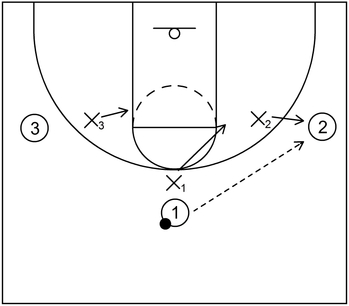
This is an example of a 3 on 3 defensive shell drill that seeks to practice jumping to the ball, defensive sliding, and closeouts. Offensively, 1 begins with the ball at the top and receives on-ball defensive pressure from X1 while X2 and X3 are about a step away from their respective assignments inside of the three-point line. Afterwards, 2 receives the ball from 1 and when that occurs, X1 jumps to the ball and X2 performs a closeout to implement on-ball defensive pressure near the right side wing. Additionally, X3 executes a defensive slide towards the left side of the lane as a weak side help defender that is more than one pass away.
Example 1 – Part 2
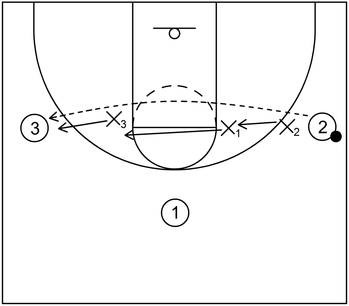
Next, 3 receives the ball via a skip pass from 2. When that happens, X3 executes a defensive closeout on the ball and X1 covers the gap near the left side high post elbow to limit dribble penetration. Additionally, X2 slides towards the right side of the lane as a weak side help defender.
Example 2
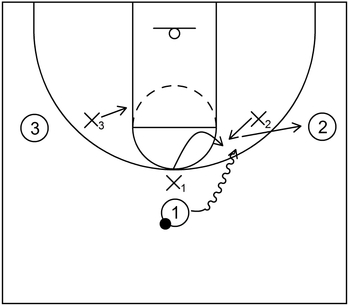
This is an example of the 3 on 3 shell drill in which dribble penetration occurs from the top. To start, 1 attempts to dribble towards the basket. However, X2 is able to hinder the dribble penetration by executing the stunt and recover tactic. Furthermore, as that happens, X1 sprints to get back in front of the ball while X3 slides towards the left side of the lane as a weak side help defender.
JULY 11, 2025
WHAT IS A SIMPLE EXAMPLE OF A 4 ON 4 DEFENSIVE SHELL DRILL
Part 1
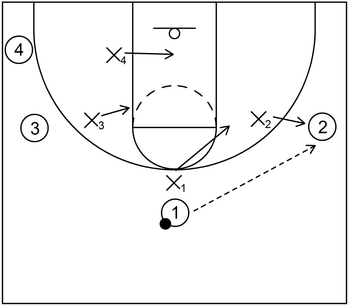
This is a simple example of a 4 on 4 defensive shell drill that implements various on-ball and off-ball defense concepts. To start, X1 applies on-ball defensive pressure at the top against 1.
Following that, 2 receives the ball from 1 and when that happens, X2 performs a defensive closeout to apply on-ball pressure while X1 jumps to the ball near the right side elbow.
Additionally, X3 slides towards the left side of the lane while X4 can slide into the lane for extra basket protection.
Part 2
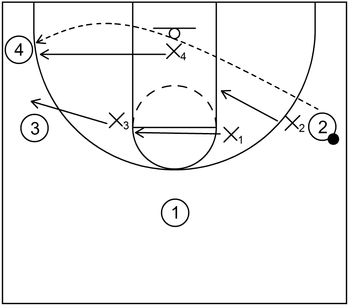
Next, 4 could receive the ball via a skip pass from 2 and when that occurs, X4 follows the pass to closeout near the left side corner. Moreover, X3 could deny the ball towards the left side wing area while X1 stands in the gap between the left side wing area and the left side high post elbow. Also, X2 could drop back towards the mid-post near the right side of the lane area as a weak side help defender. This gives X2 the opportunity to mitigate any potential basket cuts by 1 or 2.
JULY 10, 2025
WHAT IS A SIMPLE EXAMPLE OF A 5 ON 5 DEFENSIVE SHELL DRILL
Part 1
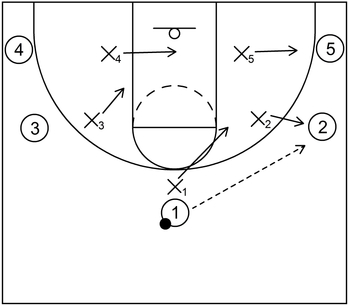
This is a simple example of a 5 on 5 defensive shell drill that seeks to develop a variety of defense concepts on the ball and off the ball. To begin, X1 applies pressure at the top against 1. After that, 2 receives the ball from 1 and when that happens, X2 performs a defensive closeout while X1 jumps to the ball. Furthermore, X5 moves a step closer towards the right side corner in anticipation for a possible closeout if 5 were to receive the ball. On the weak side, X4 could slide into the lane to protect the basket while X3 could drop back towards the mid-post area near the left side of the lane.
Part 2
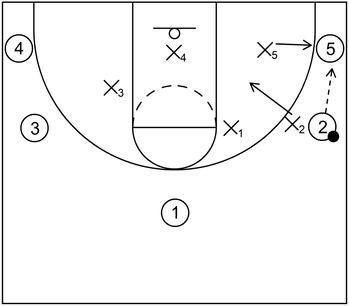
Next, 5 could receive the ball from 2 which triggers a closeout by X5. Additionally, X2 could drop back towards the gap between the right side wing and right side corner to take away middle dribble penetration if necessary. X1 stays near the right side high post elbow, X3 continues to stand near the mid-post, and X4 continues to protect the basket.
Part 3
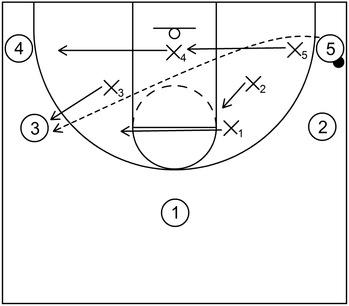
Next, 3 could receive the ball by way of a skip pass from 5. When that occurs, X3 performs a closeout on the ball while X4 sprints from the paint towards the left side corner. Additionally, X1 covers the left side elbow to take away dribble penetration while X2 slides toward the right side mid-post and X5 sprints into the lane to protect the basket.
 fatihakser.ca