
December 8, 2025
BEST Plays From the 2025 NBA Summer League Season
This breakdown looks at 15 of the most effective plays drawn up during NBA Summer League, focusing on actions that consistently create clean scoring opportunities. Each play is designed with a different purpose some free shooters for open threes, others generate backdoor cuts, slips, or easy finishes at the rim.
The video walks through every action step-by-step, explaining the timing, spacing, and decision making behind each play before showing it again at full speed. It’s a practical toolbox for coaches and players who want simple, modern sets that translate directly into open shots and high quality scoring chances.
Below is the full breakdown so you can study the plays, steal ideas, and apply them to your own team.
November 13, 2025
Breaking Down the Zoom Action in Basketball
Basketball is a game of space, timing, and misdirection. One play concept that captures all three is the Zoom Action. It’s a versatile offensive tool designed to create spacing, driving lanes, and high-percentage scoring opportunities, especially against man-to-man defense.
1. What is the Zoom Action?
The Zoom Action is a pick-and-roll or staggered off-ball screening concept where the ball-handler’s teammate(s) “zoom” or slip through the defense in motion, creating confusion and multiple scoring options.
Key characteristics:
- Off-ball movement: Players without the ball cut sharply through the lane or around screens.
- Decoy screens: Players set screens that may or may not be used, forcing defenders to make decisions.
- Spacing emphasis: It opens driving lanes and creates mismatches for shooters, cutters, and roll men.
Essentially, the Zoom Action is about accelerating player motion to exploit defensive gaps while keeping the defense guessing.
2. How the Zoom Action Works
Let’s break it down into typical components:
Step 1: The Setup
- Usually starts in a spread formation or side pick setup.
- The ball-handler positions near the top or wing, while off-ball players align near the opposite corner or baseline.
- The “zooming” player prepares to cut or roll through the paint.
Step 2: The “Zoom”
- The off-ball player executes a sharp cut through the lane, often behind a staggered screen.
- The defense is forced to make a quick decision:
- Switch, fight through the screen, or fight over/under.
- The ball-handler can either attack the rim, kick out to the cutter, or pass to the rolling screener.
Step 3: Options & Reads
- Primary option: The ball-handler attacks the basket or pulls up if the lane opens.
- Secondary option: The zooming player receives a pass for a layup, float, or pull-up jump shot.
- Spacing option: Shooters on the weak side are ready to catch-and-shoot if the defense collapses.
Step 4: Spacing Recovery
- After the play develops, players must reset spacing to avoid defensive overloading.
- Proper spacing ensures the next action whether pick and roll, off ball cut, or drive and kick remains effective.
3. Why Zoom Action is Effective
- Misdirection and Confusion:
Multiple screens and rapid cuts force defenders to communicate quickly. A single hesitation can open a lane for a high-percentage shot. - Creates Mismatches:
When defenders switch or misread the action, a smaller guard may end up on a big, or a slower defender may be trailing the cutter, a prime scoring opportunity. - Flexibility:
The action can start anywhere on the court, wing, top, baseline and can involve one or multiple “zooming” players. - Supports Modern Spacing:
In today’s game, teams prioritize spacing for three-point opportunities. The Zoom Action helps pull defenders out of the paint while keeping lanes open.
4. Common Variations of Zoom Action
- Standard Pick and Roll Zoom: One off-ball player screens for the ball-handler while another cuts through.
- Double Screen Zoom: Two staggered screens set near the lane for a cutter. This is effective against aggressive switch-heavy defenses.
- Baseline Zoom: Initiated from baseline or corner, the cutter moves along baseline toward the hoop, opening up perimeter shots.
- Slip Zoom: The screener fakes the screen and immediately cuts toward the basket if the defender overcommits.
5. Reading the Defense During Zoom Action
Successful execution depends on reading defenders in real-time:
- Hesitation by defender → cutter attacks rim.
- Over-commitment by help defender → kick out to shooter.
- Switch confusion → exploit mismatch (size or speed advantage).
By training players to recognize these cues, Zoom Action turns from a scripted play into a dynamic, read-and-react system.
6. Teaching Zoom Action in Practice
- Start without defense: Focus on timing, angles, and spacing.
- Add passive defenders: Allow players to experience mild resistance and practice reads.
- Full defensive simulation: Execute against aggressive man to man to train cutters and ball-handlers under pressure.
- Emphasize recovery: After each play, players must reset spacing to maintain offensive flow.
7. Key Takeaways
The Zoom Action blends cutting, screening, and reading defense into one high-level motion. It’s effective because it creates confusion, mismatches, and spacing advantages. Execution requires timing, vision, and communication, not just athleticism.
October 26, 2025
Mastering the Spurs’ Motion Offense
Few NBA systems have been as influential or successful as the San Antonio Spurs’ Motion Offense. Since Gregg Popovich took over as head coach in 1997, the Spurs have captured five NBA championships, earned over 1,200 wins, and made 22 consecutive playoff appearances. While elite players like Tim Duncan, Manu Ginobili, Tony Parker, and Kawhi Leonard contributed to this success, the backbone has always been the Spurs’ system: the Motion Offense.
The Roots of the Spurs’ Motion Offense
The offense was born from Tex Winter’s principles and the Triple Post Offense, blending ball circulation, player movement, and constant reads. Its core philosophy emphasizes:
- Altruism and the extra pass
- Creating open driving lanes and spacing
- Adapting to the defense in real time
Designed to engage defenses continuously, the system allows players to read, react, and make decisions within a structured yet flexible framework.
The Lineup and Player Versatility
- Four perimeter players and one inside player (positions are interchangeable in transition)
- Tall players (4 & 5) occupy central lanes, with one trailing and the other outside the three-point line
- Versatility is key: the more positions a player can cover, the more the offense can stretch defenses
Three Main Variations
- Motion Strong: After passing, the ball-handler remains on the strong side.
- Two primary entries: pass to the wing and cut to the corner, or dribble to the wing while the wing player drops to the corner
- Form two strong-side triangles to engage the defense, create stagger screens, and open scoring options at the post, wing, or perimeter
- Motion Weak: After passing, the ball-handler cuts to the weak side.
- Can start with a pass to the post or wing, followed by an Iverson cut or under-the-basket cut
- Utilizes staggered and horizontal screens to free shooters or create pick-and-roll opportunities
- Motion Loop: Starts with the ball-handler dribbling under the free-throw line, triggering a loop of player rotations and screens
- Includes zipper cuts, backdoor options, triple screens, and flexible handoffs
- Designed to constantly manipulate defensive positioning and create open opportunities
Why the Motion Offense Works
- Encourages player creativity while respecting spacing and timing
- Offers dozens of variations against defensive pressure
- Teaches players to read the game, collaborate, and exploit matchups
- Its principles have influenced coaches across the NBA, from Budenholzer and Kerr to Brett Brown and Doc Rivers
The Spurs’ Motion Offense is essentially “open-source” basketball: a controlled, adaptable system that allows players and coaches to generate infinite plays without sacrificing structure. For any coach looking to teach teamwork, versatility, and intelligent offense, studying this system is a masterclass in modern basketball strategy.
October 12, 2025
Mastering the 5-Out Motion Offense
The 5-out motion offense is all about spacing, constant movement, and reading the defense to create open shots or driving lanes. Every player stays on the perimeter, which spreads the floor and allows for backdoor cuts, pick and rolls, and quick ball reversals. Success in this offense depends on teamwork, communication, and timing every cut and screen is intentional.
In this video, Coach Russ breaks down the fundamentals of the 5 out motion, including player positioning, movement patterns, and options when defenses switch or trap. It’s a great visual resource to complement the concepts discussed here.
September 28, 2025
Traditional NBA Offensive Systems: From Structure to Innovation
Basketball has always been a game of balance between structure and creativity. Over the years, different offensive systems have shaped how teams play each reflecting the philosophy of its coaches and the talents of its players. While today’s game leans heavily toward pace, space, and shooting, some of the most influential systems in NBA history laid the foundation for what we see now.
The Triangle Offense
Phil Jackson’s Triangle Offense remains one of the most famous systems in basketball. Rather than a rigid play, it’s a framework: three players forming a triangle on one side of the floor, with constant movement, passing, and spacing. This system thrived because it required every player from Michael Jordan and Scottie Pippen in Chicago to Kobe Bryant and Shaquille O’Neal in Los Angeles — to read the defense, stay unselfish, and act decisively. The triangle emphasized versatility and teamwork, rather than relying on just one player to dominate.
Seven Seconds or Less
Mike D’Antoni’s Phoenix Suns revolutionized modern basketball with the “Seven Seconds or Less” offense. With Steve Nash orchestrating, the Suns aimed to get a quality shot within seconds of gaining possession. Quick ball movement, early offense, and relentless pace forced defenses into constant scramble mode. While critics said it was too risky, this system anticipated the NBA’s current obsession with pace and space and three point shooting.
Small Ball Revolution
The Golden State Warriors took offense to another level with their “small ball” approach, especially during their championship runs between 2015–2018. By playing without a traditional second big man, they maximized spacing, shooting, and defensive versatility. The famous “Lineup of Death” (Curry, Thompson, Green, Iguodala, and Barnes or Durant) overwhelmed opponents with speed and floor spacing. This strategy redefined what positions meant, proving that skill and spacing could outweigh size.
Horns Set
The Horns offense became a favorite for its adaptability. Starting with two bigs at the elbows and guards spread, it allowed multiple actions from double pick and rolls to high low entries. Its flexibility let coaches tailor attacks to their personnel and exploit mismatches. Horns remains a staple because it provides structure without sacrificing creativity.
Isolation Basketball
Finally, isolation offense “iso” play has always been a powerful tool. By clearing space for a star player, teams let scorers like Kobe Bryant, Carmelo Anthony, or James Harden go one on one. Iso plays highlight individual brilliance and can be crucial in crunch time moments. But while iso basketball delivers excitement and reliability in key possessions, overreliance can stall ball movement and reduce efficiency.
Each of these offensive systems tells part of basketball’s evolution from Phil Jackson’s disciplined triangle, to D’Antoni’s free flowing tempo, to Golden State’s spacing revolution. Together, they show how basketball constantly adapts, blending tradition with innovation.
Below is a video breakdown that dives into these traditional NBA offensive systems in more detail.
September 1, 2025
Why Pick & Roll Matters
The Turkish Men’s National Team is looking sharp in its offensive execution especially in pick & roll sets. Based on video analysis from their latest exhibition games as well as their first 3 games at the EuroBasket 2025, this post breaks down how they’re constructing their offense, who’s leading leadership duties, and how their system works at its core.
Why Pick & Roll Matters for Turkey
Turkey’s current offensive foundation heavily leverages NBA level talent mixed with European experience. Alperen Şengün, coming off a recent All Star appearance, anchors the inside, while guards like Shane Larkin, Cedi Osman, and Furkan Korkmaz provide craft and spacing.
Supporting them is a deep roster:
- Adem Bona (Sixers rookie) brings energy and defensive toughness.
- Omer Yurtseven, Onuralp Bitim, Sehmus Hazer, and others offer flexibility and depth.
In qualifiers, players like Cedi Osman (23.3 PPG), Omer Yurtseven (22.0 PPG, 9.0 RPG), and Kenan Sipahi (8.2 APG) led Turkey in efficiency and production. These stats reflect both individual quality and how well the offense runs through their pick & roll dynamics.
August 19, 2025
Breaking Down the Modern 5-Out Motion Offense
One of the most effective and widely used offensive systems in today’s game is the 5-Out Motion Offense. Built on spacing, movement, and decision making, this system gives players freedom while still maintaining clear principles that lead to efficient scoring opportunities.
This film study dives into how Yeshiva University, one of the top programs in NCAA basketball, has refined the 5-Out offense to perfection. The breakdown covers both the history of motion offense and the modern adaptations that make it so effective against today’s defensive schemes.
Core Principles of 5-Out Motion
- Spacing: All five players start outside the three point line, maximizing driving lanes and passing angles.
- Player Movement: Continuous cutting, screening, and replacing ensure the defense is always shifting.
- Decision Making: Players learn to read the defense and react in real time, developing IQ as much as skill.
- Versatility: Guards, wings, and bigs all become interchangeable parts, making the offense unpredictable.
Why It Works
- Encourages Team Play: Every player is involved, creating a true “positionless” environment.
- Develops Individual Skills: Players learn how to attack off the dribble, pass under pressure, and cut with purpose.
- Tough to Scout: Because the reads are based on defense, not fixed plays, it’s harder for opponents to predict actions.
This video breakdown explains the rules, actions, and reads within Yeshiva’s system showing exactly why their version of the 5-Out has been so successful. For coaches, it’s a great resource on teaching spacing and decision making; for players, it’s a masterclass in learning how to play the game the right way.
August 10, 2025
Mastering Horns Actions: The NBA’s Ultimate Offensive Weapon
In today’s NBA, offensive creativity and precision are more critical than ever. One of the most versatile and effective offensive sets you’ll see across the league is the Horns action. This setup has become a staple for teams looking to maximize spacing, create mismatches, and generate high-quality scoring opportunities.
What is the Horns Set?
The Horns formation typically places two big men at the high posts usually around the elbows of the free throw line while the guards and wings spread out on the perimeter. This alignment creates multiple passing lanes, screen options, and opportunities for both ball handlers and roll men to attack the defense.
Why Do NBA Teams Love Horns Actions?
- Versatility: The Horns set can be adapted to fit any team’s personnel and style. Whether your big men are excellent passers, screeners, or shooters, Horns actions can highlight their strengths.
- Multiple Options: From pick and rolls, pick and pops, slip screens, to quick handoffs, the Horns set provides a plethora of reads for the ball-handler. This makes it difficult for defenses to predict and react.
- Spacing & Mismatches: With two bigs positioned high, defenders are forced to communicate and switch screens often, increasing the chance of defensive breakdowns and mismatches.
- Creates Elite Passing Angles: The elbow positioning allows for crisp, effective passing lanes that can lead to open shots, cuts, or easy rolls to the basket.
Key Horns Actions You’ll See in the NBA
- Horns Pick and Roll: The classic one big sets a screen for the ball-handler while the other either pops for a shot or rolls to the rim.
- Double Screen Actions: Both bigs set staggered or simultaneous screens to free up the guard for drives or shots.
- Slip Screens: When the defense anticipates the screen, the screener quickly slips to the basket for an easy finish.
- Hand-offs and Dribble Handoffs: These keep the defense on their toes and allow the offense to flow smoothly.
The Impact on Modern Offense
Many NBA stars thrive in Horns sets because it allows them to showcase their decision-making, athleticism, and shooting ability. From LeBron James to Luka Doncic, these actions create the kind of dynamic, unpredictable offenses that keep defenses guessing.
August 6, 2025
50 Best Offensive Sets from European Basketball
In the world of basketball, European clubs have long been admired for their precision, creativity, and execution in half court offense. This video brings together a collection of 50 elite level offensive sets run by some of the best teams across Europe.
Whether you coach at the youth level, university, or pro, there’s something in here for every system and style.
From horns actions to staggered screens, Spain pick & rolls, flex variations, and misdirection plays, this video is packed with ideas that emphasize timing, spacing, and off ball movement hallmarks of intelligent team basketball.
Why You Should Watch:
- Improve your playbook with adaptable, efficient sets used by professional teams.
- Learn how to create advantages through off ball movement, deception, and screen angles.
- Steal, adapt, and implement many of these plays can be used across different age groups and skill levels with just a few tweaks.
European basketball has always placed a premium on ball movement, player IQ, and reading the defense. This video is a powerful resource for any coach looking to evolve and expand their offensive toolbox.
August 4, 2025
A Simple Yet Elite Offensive Tool
In today’s blog, I’m highlighting a powerful and increasingly popular offensive concept: Zoom Action.
This action, which has become a staple at the NBA and NCAA levels, is also highly teachable for high school and even youth teams. What makes Zoom so effective is its ability to create space for dribble drives and force defensive indecision two pillars of modern offensive basketball.
Programs like Northern Iowa and Loyola Chicago have used Zoom Action as a core part of their motion offenses, building entire possessions around its flow and spacing benefits.
The breakdown video I’m sharing today comes from the team at Breakthrough Basketball credit to them for consistently putting out quality teaching material. This is a great resource to help coaches understand not just how to run the Zoom Action, but why it works.
Watch the video below and think about how you might adapt this into your own team’s structure. Whether you’re running a read-and-react offense or structured sets, Zoom can be a versatile weapon.
August 3, 2025
Flex Offense Breakdown – Teaching Timing, Spacing & Reads
In this breakdown, I dive into the core principles of the Flex Offense one of the most timeless and teachable offensive systems in basketball. From screening angles to timing, spacing, and second-side action, this system offers structure for young teams and adaptability for experienced ones.
This video highlights:
- The fundamental cut , screen and replace pattern
- How to teach reading the defense off the initial flex cut
- Adjustments for different skill levels and team identities
- How to build continuity without sacrificing creativity
Whether you’re a new coach or refining your system, this breakdown will help you see Flex as more than a pattern, it’s a framework for decision-making and discipline.
👇 Watch the video below and let me know how you teach Flex in your program.
August 2, 2025
Teaching Motion Offense at U14 & U16: Building Skill Through Structure
One of the most powerful tools for youth basketball development isn’t just a good drill it’s a well designed offensive system that teaches decision making, spacing, and skill development within the game itself. That’s where motion offense becomes a transformational approach for coaches working with U14 and U16 age groups.
Why Motion Offense for Youth Teams?
At the U14 and U16 levels, players are just starting to understand the game beyond individual skills. Motion offense gives them:
- A structure that demands constant movement
- Spacing principles that force reading and reacting
- Touches for every player no ball dominant stars
- Repetitions of game like actions: cutting, screening, passing, relocating
- An environment where decisions drive development
It’s not just about “running plays” it’s about training instincts and basketball IQ through repetition and freedom.
Drill Breakdown: How We Teach It
In this blog, you’ll find breakdown videos that introduce and refine motion offense concepts using small sided games, live action drills, and controlled scenarios. Here’s how we break it down:
2v0 and 3v0 Concepts
- Basic pass and cut, screen away, and fill the spot actions
- Teaching players to time cuts, use fakes, and finish efficiently
- Reps to build muscle memory and decision confidence
3v3 and 4v4 Live Reads
- Small-sided games that emphasize spacing and movement
- Drills that teach how to recognize backdoor opportunities, curl cuts, slips, and flares
- Guided reads where coaches insert constraints to teach specific actions (e.g., no dribble, score off two passes max)
5v5 Shell into Live Play
- Build from controlled “freeze and explain” moments into free flowing live offense
- Emphasize ball reversals, patience, and purposeful movement
- Teach players when to attack, when to pass, when to respace
Motion Offense = Individual Development in a Team Setting
One of the most overlooked benefits of motion offense is how it accelerates individual player growth:
- Guards improve their passing, decision making, and cutting timing
- Forwards learn how to screen, slip, and pop with purpose
- Every player gains reps as a handler, cutter, and finisher
- Conditioning improves due to constant movement
- Players become better without the ball a rare skill in today’s game
Rather than isolating skills in drill lines, motion offense builds them organically in real time situations.
Repetition. Realism. Responsibility.
Motion offense teaches accountability if a player doesn’t cut, screen, or space properly, the offense stalls. That natural feedback loop forces learning in a way that sticks.
Combine this with age appropriate teaching, clear rules, and lots of game speed reps, and you’ll create:
- Smarter players
- Better teammates
- More confident decision-makers
U14/U16 Motion Drill Videos
Below, you’ll find:
- Small sided drills
- Shell build ups
- Set examples of simple continuity
- On court breakdowns of effective spacing and flow
- Games that reinforce the offense through fast-paced reps
These are real drills used with youth teams focused on learning through play, not memorization. The goal is to teach the game, not just plays.
July 28, 2025
Dave Severns “Hurry-Up Offense”
Maximizing Pace, Precision, and Possession Value
In today’s game, speed alone doesn’t win purposeful speed does. That’s exactly what veteran coach and NBA player development specialist Dave Severns dives into with his teaching on the Hurry-Up Offense. What makes this clinic especially valuable is how clearly and efficiently it breaks down transition and early offense actions not just for show, but with executable detail that applies from the NBA to the EuroLeague, and even at the youth and college levels.
As someone who builds their entire coaching identity around tempo, spacing, and full roster engagement, I found this one of the most applicable breakdowns for designing offensive systems that:
- Put immediate pressure on defenses after both makes and misses
- Create advantages before the defense is fully set
- Give players freedom within structured spacing concepts
- Seamlessly flow from transition into half court without resetting
What You’ll See in the Video Clips
The videos below are edited versions of the full clinic, focusing on the actual drills, alignments, and reads used in hurry up and early offense systems. You’ll see:
- Wing entries and middle penetration in flow
- Drag screens and delayed ball screens off the secondary break
- Early slips, wide pins, and quick hitter options
- Spacing responsibilities and rim run principles
- The logic behind each action not just the “what” but the “why”
These clips are especially valuable for coaches who want their teams to play fast without being careless, and who believe offense starts with the way you teach transition principles from day one of training camp.
July 25, 2025
Warm-Up Drills: 2v0 & 3v0 Progressions
These 2v0 and 3v0 warm up drills aren’t just for getting loose, they’re built to reinforce game like spacing, court awareness, and finishing variety. Each drill introduces specific movements, timing, and concepts that translate directly into live play.
Whether it’s off-ball cutting, filling lanes in transition, or finishing at different angles, these drills provide structure without defenders, allowing athletes to build habits, footwork, and timing essential for execution in 5v5 settings.
Perfect for the first 10–15 minutes of practice to build rhythm, communication, and flow before adding live pressure.
July 16, 2025
Building Transition Offense: A Frame-by-Frame Breakdown
Transition offense isn’t just about running fast it’s about spacing, purpose, and execution. In this video breakdown, I walk through how to build your transition offense from scratch, using real game clips and step-by-step progressions that you can apply directly in your own practices.
This is not a surface level overview. The goal is to show coaches how to teach transition offense with clarity, using actual in game footage to emphasize timing, player roles, and decision making not just drills, but the why behind them.
What This Breakdown Covers:
- How to teach lane discipline and spacing from Day 1
- The role of the rebounder, outlet, and first 3 seconds
- Teaching the rim runner vs. wing runners
- Early advantage reads: hit ahead vs. push
- How to drill these progressions in a way that translates to live play
- Frame-by-frame clips showing spacing breakdowns, timing issues, and solutions.
July 15, 2025
Close – Out Attack Teaching Progression
In this presentation, I explained how I teach closeout attack offense with various drills. I shared my breakdown drills and provided some game situational drills to advance your players skill set.
July 14, 2025
7 SECONDS AND LESS OFFENCE
JULY 13, 2025
4 OUT HALF COURT SETS
JULY 12, 2025
AFTER TIME OUT SPECIALS
JULY 11, 2025
MY FAVOURITE FAST BREAK DRILL
If you are a coach that loves to attack on turnovers, rebounds and made baskets. Here is a drill that would help your players to run faster and smarter.
Running the drill
In order to run, your players must first establish the defensive rebound and make a proper pivot on the outside foot. Outlet players are expected to come back to the ball by taking at least two steps and yelling “outlet, outlet!” to the rebounder. Upon receiving the pass, the outlet player must square up in triple-threat position and make the sideline pass up the court to the next outlet player.
The next player must turn and put the ball in the outside hand, with the off arm up and attack the corner or middle of the court for an entry bounce pass to a low-post player who has established good post-up position.
Continuing the drill
As the low-post player is making the low-post shot, the next rebounder is tossing another ball off the backboard and starting the drill all over again. Each person moves to the next open position by rotating clockwise. Repetition of this drill will prepare your players to instinctively run an aggressive fast break. They will automatically know where to go on the floor and what kind of passes they will need to make.
Make sure that the rebounder is practicing proper rebounding technique (boxing out, securing the ball with two hands, elbows high, and proper pivot on the outlet pass) at all times.
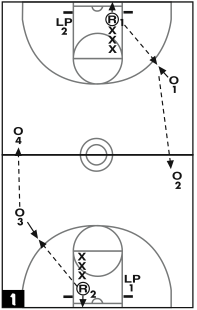
DIAGRAM 1: R1 and R2 each have a ball. At the whistle, each player begins the drill by throwing the ball off the backboard, secures the rebound and pivots to throw the outlet pass to O1 and O3.
O1 and O3 must come back to the ball and yell “outlet, outlet!” O1 and O3 pass to O2 and O4.
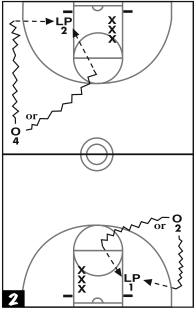
DIAGRAM 2: O2 and O4 attack the corner or make a change of direction dribble to the middle of the court for an entry pass to LP1 and LP2.
LP1 and LP2 must use any one of a variety of post moves (front turn, drop step, hook shot or counter move) and finish by making the basket.
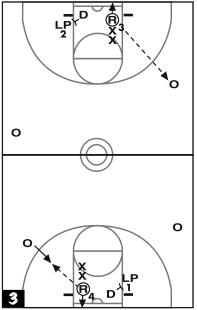
DIAGRAM 3: As an option, you may use a defender to guard your low-post players. Players rotate clockwise. Once they become good at this, add a third and fourth basketball to the drill. This will ensure that the action is fast and that a lot of players get involved.
JULY 11, 2025
UCLA OFFENSIVE CONCEPT
JULY 10, 2025
PRINCETON OFFENSIVE SYSTEM
 fatihakser.ca